


Episode Summary
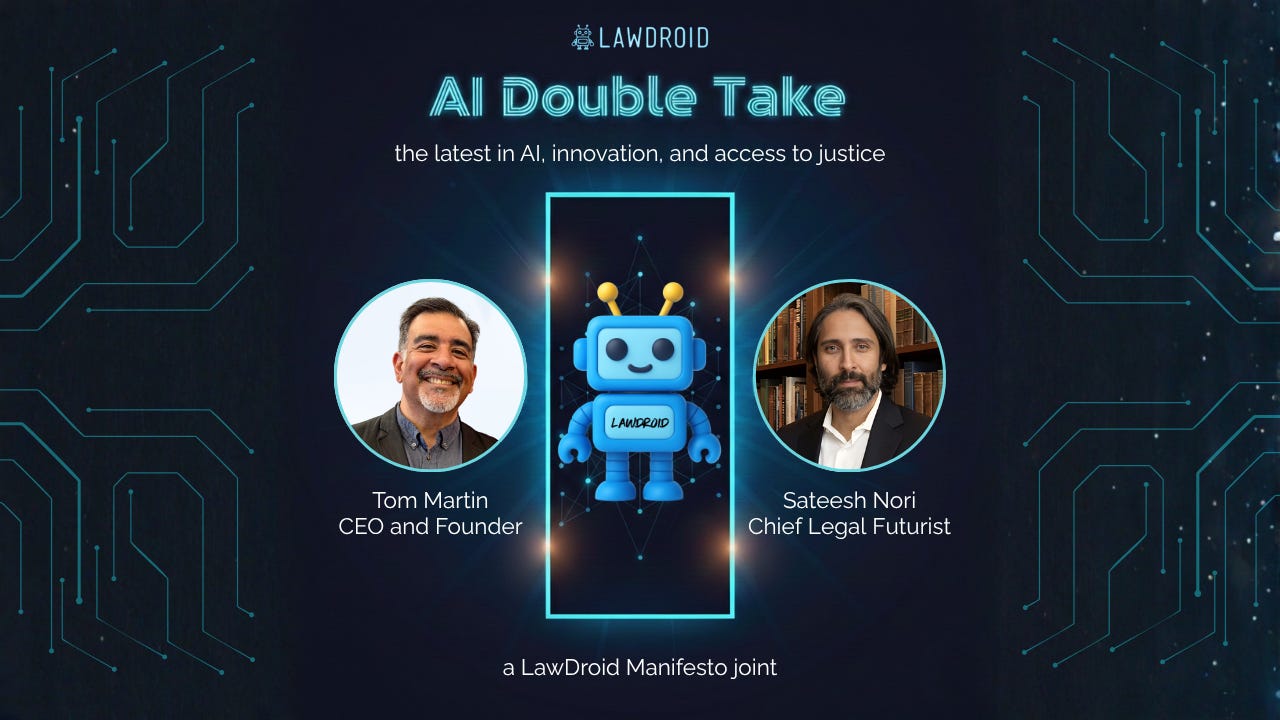
In this month’s AI Double Take, LawDroid CEO Tom Martin and Chief Legal Futurist Sateesh Nori open with a milestone: the launch of LawDroid’s Legal Aid Plugin, an open-source tool built on Anthropic’s Claude platform that fills the legal aid gap Anthropic’s own legal plugins left entirely unaddressed. From there, the hosts unpack a genuinely startling study in which AI responses were preferred over human professors’ answers by law professors themselves (76% of the time, blind test) and discuss a companion research paper showing AI actually helps law students learn the law better. They close with big-picture market moves: OpenAI stepping firmly into legal AI, Anthropic filing for its IPO, and Kirkland & Ellis committing $500 million to AI investment. The thread running through it all: the pieces are finally coming together, and the summer of legal tech is here.
Key Takeaways
1. LawDroid’s Legal Aid Plugin — Filling the Gap Anthropic Left
Just three weeks after Anthropic released its Claude legal plugins, LawDroid launched the Legal Aid Plugin: open-source, built on Claude, and targeted specifically at legal aid organisations and civil legal access. Anthropic’s plugins addressed the commercial legal market; the legal aid segment was entirely absent. Tom credited Anthropic’s architecture, skills, plugins, and the Claude platform, while noting that LawDroid’s decade of access to justice focus made it the natural team to build in that corner of the sandbox. Early feedback highlighted strong interest alongside privacy and security concerns, which the team is actively addressing.
2. From Reductive to Expansive — AI as a Productivity Shift
Sateesh drew a sharp distinction between two modes of AI use. Reductive use: summarising, translating, comparing, going faster through existing work. Expansive use: generating something new that takes you two or three steps ahead, a document, a workflow output, a legal instrument. The Legal Aid Plugin marks a move from the first mode to the second. The shift matters because it changes what is actually possible, not just how quickly existing things get done. Tom added: it’s about better, not just more.
3. The Institutional Knowledge Problem — And AI’s Answer
Tom identified one of the most underappreciated problems in legal aid: institutional knowledge that lives in practitioners’ heads walking out the door when they leave. The Legal Aid Plugin and its underlying skills architecture is a mechanism for capturing that knowledge, codifying it, and making it available to everyone who comes after: customisable, shareable, and open-source. The old paradigm made organisations dependent on vendors. The new one makes practitioners co-authors of the tools themselves.
4. AI Preferred Over Law Professors — By Law Professors
A study using Gemini 2.5 presented law professors with a blind comparison: student questions answered either by a human professor or by AI. The result: law professors preferred the AI-generated responses 76% of the time, without knowing which was which. More striking still: human professors gave answers the study classified as “harmful,” responses that actively hindered student learning, more frequently than the AI did. Sateesh’s takeaway: if AI can fool legal educators who do this for a living, arguments that AI cannot be good enough for everyday people no longer hold.
5. AI Helps Law Students Learn Law Better
A companion study by Professor Daniel Schwartz at the University of Minnesota Law School set out to test the common-sense hypothesis that AI use would hurt law students’ understanding. The result was the opposite: students who used AI learned the law better. The reason: AI provided the scaffolding to understand what the rule actually was something law school casebooks deliberately obscure through Socratic hazing. Tom described it as the ultimate study guide. Sateesh’s implication: AI courses should be introduced on day one of law school, not in the second or third year, and UC Berkeley Law’s current restrictive policy likely runs counter to both studies’ findings.
6. Richard Susskind’s Outcome Thinking Applied
Tom invoked Richard Susskind’s concept of “outcome thinking” to reframe the AI-in-education debate. If the outcome law school exists to produce is students who understand the law and succeed in legal careers, then the question is not who or what delivers the instruction; it is whether the outcome is achieved. Both studies say AI improves the outcome. Process-centered arguments against AI adoption, whether in legal education or legal services, do not survive contact with outcome-focused analysis.
7. The UPL Parallel — Scarcity as System Design
Sateesh connected the law school access debate to the broader unauthorized practice of law problem: both are systems designed around scarcity, limiting who can deliver legal knowledge regardless of quality. The cost of maintaining law schools as gatekeepers (in tuition, time, and the legal labour market they create) is borne disproportionately by people who cannot access legal help at all. AI breaks the scarcity assumption. The model is broken, and the studies provide evidence for why it needs to change.
8. OpenAI Enters Legal AI — Both Giants Now in the Market
OpenAI has followed Anthropic in making a clear, committed move into legal AI. With both leading foundation model companies now focused on the legal market, Tom sees the concentration of capital, talent, and technology as ultimately beneficial for clients, even if the immediate motivation, as Sateesh quipped, may partly be to reduce their own legal fees before their IPOs.
9. Anthropic Files for IPO — and Kirkland Commits $500M
Anthropic has filed for its IPO. Separately, Kirkland & Ellis, the highest-grossing law firm in the world at approximately $10 billion in annual revenue, has committed $500 million to AI investment. Tom’s read: as a fraction of revenue it is not betting the farm, but it is a meaningful signal. The lesson for smaller firms is not to match the dollar amount but to adopt the underlying habit: consistent commitment to innovation, collaboration, and communication.
Show Notes
Topics Covered
LawDroid Legal Aid Plugin launch — open-source, built on Claude, targeting legal aid market
Anthropic’s Claude legal plugins and the legal aid gap they left unaddressed
Privacy and security concerns raised during the plugin launch webinar
Institutional knowledge capture: skills as a mechanism for preserving practitioner expertise
The shift from reductive AI use (efficiency) to expansive AI use (productivity)
AI co-authorship of tools vs. vendor dependency in the old software paradigm
Blind study: law professors preferred AI responses (Gemini 2.5) 76% of the time
Human professors gave “harmful” answers more often than AI in the same study
Professor Daniel Schwartz (University of Minnesota Law School): AI helps law students learn law better
Law school AI courses currently offered in year 2–3; argument for day-one integration
UC Berkeley Law’s restrictive AI policy critiqued in light of both studies
Richard Susskind’s “outcome thinking” as a framework for evaluating AI in legal education
UPL parallel: scarcity-by-design in law schools mirrors scarcity-by-design in legal services
OpenAI entering legal AI — both major foundation model companies now in the market
Sateesh’s theory: AI legal tools partly motivated by reducing IPO legal costs
Anthropic IPO filing
Kirkland & Ellis $500M AI investment commitment
The habit of innovation as the takeaway for small and mid-size firms
People & Organizations Mentioned
Tom Martin — CEO & Founder, LawDroid
Sateesh Nori — Chief Legal Futurist, LawDroid
Professor Daniel Schwartz — University of Minnesota Law School; co-author of AI/law student learning study
Richard Susskind — Legal futurist; “outcome thinking” concept cited
Anthropic — Claude platform; released Claude legal plugins; filed for IPO
OpenAI — Entered legal AI market
Kirkland & Ellis — Committed $500M to AI investment; ~$10B annual revenue
Gemini 2.5 (Google) — AI model used in the blind law professor preference study
UC Berkeley Law — New AI policy noted as running counter to the research findings
LawDroid — Released Legal Aid Plugin (open-source, Apache 2.0) on Claude platform
Final Takes
Sateesh Nori:
“The next two or three months are going to be huge. I can’t even imagine what’s to come — the OpenAI legal rollout, what Anthropic does next, the impact of the IPO on big legal tech companies. The summer is going to be the summer of legal tech.”
Tom Martin:
“Things are finally coming together. Kirkland’s $500 million is a big headline, but they make $10 billion a year — it’s a good start, not betting the farm. And you don’t need $500 million to do this. You just need the habit of innovation, collaboration, and communication. If you build that habit, you’ll do well.”
AI Double Take is produced by LawDroid | lawdroid.com


