


Episode Summary
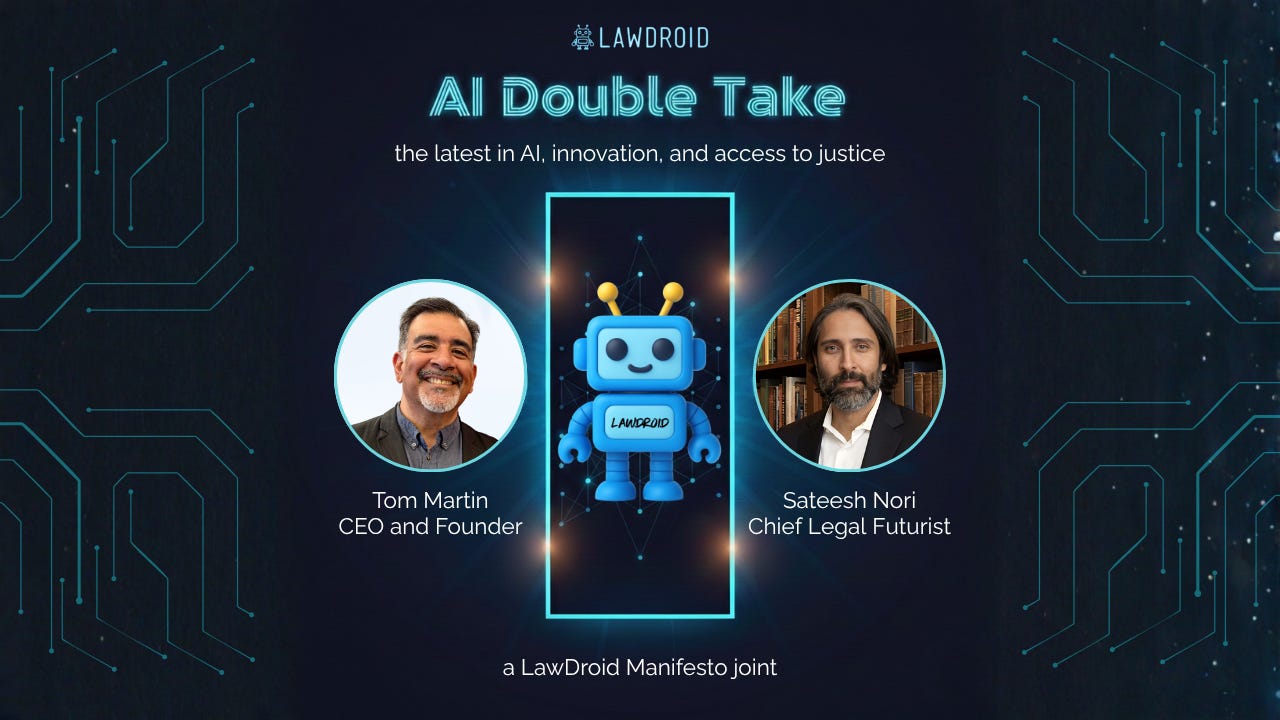
In this month’s AI Double Take, LawDroid CEO Tom Martin and Chief Legal Futurist Sateesh Nori reconnect after a month of globe-trotting — Sateesh in India, Tom in Argentina — and compare notes on how legal AI looks radically different depending on where you stand. From India’s booming, hustle-driven legal tech scene of over a thousand companies to Argentina’s civil-law skepticism about hallucinations, the hosts unpack why “cheaper” isn’t a universal pitch for AI, why UPL enforcement varies wildly by country, and why big law firms’ new “AI leadership” hires might be window dressing. They close on the deeper question both keep circling back to: what are lawyers actually for, and how do we retain our judgment as AI comes for reasoning itself.
Key Takeaways
1. India’s Legal Tech Boom — Scale, Hustle, and a Different Value Proposition
Sateesh reported that India’s legal tech market may be as large as America’s, with more than a thousand companies building legal AI. The country’s hustle culture, reflected in bestselling business and self-help books, fuels relentless competition. Crucially, the value proposition differs from the US: with cheap human labor already abundant (including lawyers offering free services on folding tables outside courthouses), AI’s pitch in India cannot simply be “cheaper.” It has to be genuinely better: offering things like real-time translation across 200+ languages that no human workforce, however large, could scale.
2. The Wi-Fi Story — Crowdsourcing vs. AI-Native Solutions
Sateesh’s hotel Wi-Fi outage, which drew five or six staff into his room before it was resolved, became a metaphor for India’s default problem-solving approach: throw more people at it. He connected this to law firm structure, where “hire more people” is the traditional scaling model. The insight: sometimes the answer isn’t more people, or even AI, it’s the right person or right tool, and figuring out where each fits is the real challenge.
3. UPL Enforcement Cuts the Opposite Way in India
Counter to Tom’s expectation that a market with abundant cheap lawyers would have looser UPL enforcement, Sateesh found the opposite: India’s bar council enforcement is stricter than the US, with harsher penalties. Despite this, Indian legal tech companies are pushing forward boldly with translation tools, explainers, and court-form assistance, arguing these fall outside UPL: a genuinely bold regulatory bet given the stakes.
4. Argentina’s Civil Law System Reframes the Hallucination Debate
At Subtech in Buenos Aires, Tom found that US-style fears about AI hallucinations and fabricated case citations don’t map cleanly onto Argentina’s civil law tradition, which relies less heavily on case citation than common law systems. One associate at the conference described her own firm’s “use AI for everything” culture, and was herself pushing back, citing concern about over-reliance dulling her own independent judgment.
5. Chief AI Officer Hires — Window Dressing or Real Change?
Tom noted a wave of AI leadership hires at major firms (e.g., Pillsbury, Harvey’s expanding innovation-liaison roles). Sateesh’s take, borrowed from a LinkedIn commentator: much of this is window dressing. A Chief AI Officer earning a fraction of what rainmaking partners earn has little actual power to change how a $10M-a-year partner works. Real change requires altering the billable hour, hiring practices, and training, not just adding a title. The synchronized timing of these hires across firms struck Sateesh as more marketing-driven than substantive.
6. Why Legal Is the Beachhead for Big AI Labs
Tom, drawing on a recent call with Bloomberg Law, laid out why Anthropic and OpenAI are converging on legal AI: both are pursuing IPOs at trillion-dollar valuations and need to prove their technology generalizes beyond their software-engineering home base. Having already proven AI-assisted coding at reliable, corporate-grade levels, legal is the strongest available beachhead to demonstrate cross-vertical value to investors, with more verticals expected to follow.
7. Skeptics in the Room — Palantir’s Counter-Narrative
Tom raised the counterpoint offered by Palantir’s CEO, who has publicly dismissed much of the AI legal narrative as “smoke and mirrors.” Sateesh’s response leaned on a recent op-ed from the head of Goldman Sachs on AI’s labor market impact: whatever the skepticism, the nature of work is clearly changing, and the billable-hour, time-based legal model cannot survive the shift unchanged.
8. The Core Question — What Are Lawyers For?
Sateesh framed the central, recurring question of the episode: what have lawyers done for centuries that made the profession essential, and is that still true? He argued the answer is changing, and that the profession needs to actively redefine its purpose rather than wait for the market to define it. Tom connected this to Professor Cat Moon’s conference talk, “Do We Even Like Technology?” — a challenge to the assumption that AI adoption is simply inevitable, and a reminder that the profession retains real agency in how and whether to adopt these tools.
9. Choosing Where to Exercise Judgment
Both hosts converged on a theme that carried into their final takes: as AI becomes capable of reasoning, learning, and experiencing the world on our behalf, the essential human choice is not whether AI can do a task, but whether we should let it. Retaining judgment, deciding deliberately where human agency belongs, is itself the discipline the profession now needs to practice.
Show Notes
Topics Covered
• Sateesh’s trip to India: legal tech market scale (1,000+ companies)
• India’s hustle/self-improvement culture and its effect on tech entrepreneurship
• Why “cheaper” doesn’t work as an AI pitch in a low-labor-cost market
• Translation across 200+ Indian languages as a genuine AI differentiator
• The hotel Wi-Fi story: crowdsourcing vs. targeted problem-solving
• UPL enforcement in India: stricter than the US, yet legal tech pushes forward boldly
• Tom’s trip to Buenos Aires and Subtech conference at Universidad de San Andrés
• Argentina’s civil law system and its different relationship to hallucination risk
• An Argentine associate pushing back on her firm’s “use AI for everything” policy
• Chief AI Officer and AI leadership hires: Pillsbury, Harvey, and others
• The “window dressing” critique of AI leadership titles at major firms
• Why legal is the beachhead vertical for Anthropic and OpenAI’s IPO ambitions
• Palantir CEO’s skeptical “smoke and mirrors” take on AI’s legal impact
• Goldman Sachs leadership op-ed on AI and the labor market
• The core question: what are lawyers for, and how is that changing?
• Professor Cat Moon’s conference talk: “Do We Even Like Technology?”
• Personal travel notes: Taj Mahal visit, father’s honor from the Indian government, Buenos Aires culture and the Museum of Fine Arts
• Sateesh’s upcoming book: The Analog Lawyer
• Tom’s own forthcoming book: AI with Purpose: A Strategic Blueprint for Legal Innovation
People & Organizations Mentioned
• Tom Martin — CEO & Founder, LawDroid
• Sateesh Nori — Chief Legal Futurist, LawDroid
• Professor Cat Moon — Presented “Do We Even Like Technology?” at Subtech, Buenos Aires
• Mark Lauritsen — Long-time organizer of the Subtech conference (30+ years)
• Harvey — Legal AI company; actively hiring innovation-liaison roles
• Legora — Referenced as a comparable product in the Indian legal tech market
• Pillsbury — Law firm; recently hired an AI leadership figure (“Oz”)
• Anthropic — Pursuing IPO; entering legal AI as a proof-of-concept vertical
• OpenAI — Pursuing IPO; entering legal AI alongside Anthropic
• Palantir — CEO publicly skeptical of AI’s legal market narrative
• Goldman Sachs — Leadership op-ed on AI’s labor market impact, referenced by Sateesh
• Bloomberg Law — Interviewed Tom on the state of the AI-in-legal market
Final Takes
Sateesh Nori:
“We as lawyers need to come up with a new way to think about being lawyers — the human skills of lawyering. That’s what I’m exploring in a new book I’m working on, called The Analog Lawyer. Let’s assume tech takes away 90% of what we do. That’s a gift. We can double down on being human beings, leaders, counselors — actually guiding people in real life with their legal problems in a way technology won’t be able to do. That’s where we’re headed, and it’s not a bad thing.”
Tom Martin:
“Every single day, every single hour, with all the choices we make, we’re deciding where we retain our agency and our judgment. AI is coming for reasoning — for how we learn, how we experience the world. We could let it do all of that for us, because it’d be more than eager to. Or we could exercise our judgment to decide when not to. That choice is entirely within our power, and we should exercise it.”
AI Double Take is produced by LawDroid | lawdroid.com
 | A guest post by
|