

Precedent vs. Probability: Why Lawyers Need to Think Like Bayesians to Succeed in the Age of AI
Where I explore why looking backward for answers might be holding your strategic thinking hostage and limiting what you believe is possible


There’s a peculiar irony in how lawyers are trained to think.
We spend three years in law school learning to reason from precedent, to find the case that came before and extract its wisdom for the case at hand. It’s a beautiful system, really. Centuries of judicial reasoning, catalogued and cross-referenced, forming an intricate web of decisions that guide future outcomes. For legal analysis, this method is not just useful but essential. The problem arises when we carry this backward-looking habit into domains where it doesn’t belong.
Increasingly, the decisions that will determine our professional futures are not legal questions at all. They are business and strategic questions. Should your firm invest heavily in AI tools? Should you restructure your practice model? How should you position yourself as the profession transforms around you?
For these challenges, our beloved precedent offers little guidance. The past, as it turns out, is not always prologue.
If this sounds interesting to you, read on…
This substack, LawDroid Manifesto, is here to keep you in the loop about the intersection of AI and the law. Please share this article with your friends and colleagues and remember to tell me what you think in the comments below.
The Elegant Logic of Stare Decisis

Legal reasoning by precedent operates on an elegant assumption: similar cases should be decided similarly. When a court faces a novel dispute, lawyers present prior decisions as evidence of how the matter should resolve. The doctrine of stare decisis gives this process its legitimacy, creating predictability and stability in the law. Clients can plan their affairs knowing that courts will treat them as they’ve treated others before.
This approach works remarkably well for its intended purpose. If you want to predict how Judge Smith will rule on a motion to dismiss in a breach of contract case, studying her prior rulings on similar motions is genuinely useful. Judges themselves rely on precedent. They’re trained in the same tradition, and professional norms encourage consistency. When everyone in the system is playing by the same rules, backward-looking reasoning becomes self-fulfilling prophecy.
This is exactly why precedent-based reasoning remains the right tool for legal analysis. When advising a client on contract enforceability, litigation risk, or regulatory compliance, we should absolutely study how courts and agencies have handled similar matters. The institutional commitment to consistency makes the past a reliable predictor of the future.
The Map No Longer Matches the Territory
Consider the lawyer deciding whether their firm should invest heavily in AI-powered research tools. Will these tools deliver enough efficiency gains to justify the cost? How quickly will competitors adopt similar technology? Will clients soon expect, or even demand, that their counsel use these capabilities?
These are not legal questions. They are business and strategic questions. And yet lawyers must answer them constantly, both for their own practices and in guiding their firms’ futures. Try answering them using precedent. You might examine how firms responded to previous technology waves: Westlaw in the 1980s, email in the 1990s, cloud computing in the 2000s.
But this analysis immediately runs into problems. Each of those transitions occurred at a different pace, with different competitive dynamics, and with tools of fundamentally different capability. The “precedent” of prior technology adoption may be not just unhelpful but actively misleading, anchoring your strategic thinking to conditions that no longer exist. The firm that waited five years to adopt email suffered few consequences; the firm that waits five years to integrate AI may find itself unable to compete on cost or speed.
Daniel Kahneman, in his research on judgment and decision-making, identified what he called the “planning fallacy,” our systematic tendency to underweight new information while overweighting our existing mental models. Lawyers may be particularly susceptible to this bias. Our entire training reinforces the authority of the past. When faced with novel strategic questions about our own practices and careers, we instinctively reach for analogies and historical patterns, even when those patterns have limited predictive value.
We think: “Lawyers survived the introduction of the Cloud, so we’ll survive AI.” But this reasoning by analogy obscures more than it illuminates.
The Bayesian Alternative
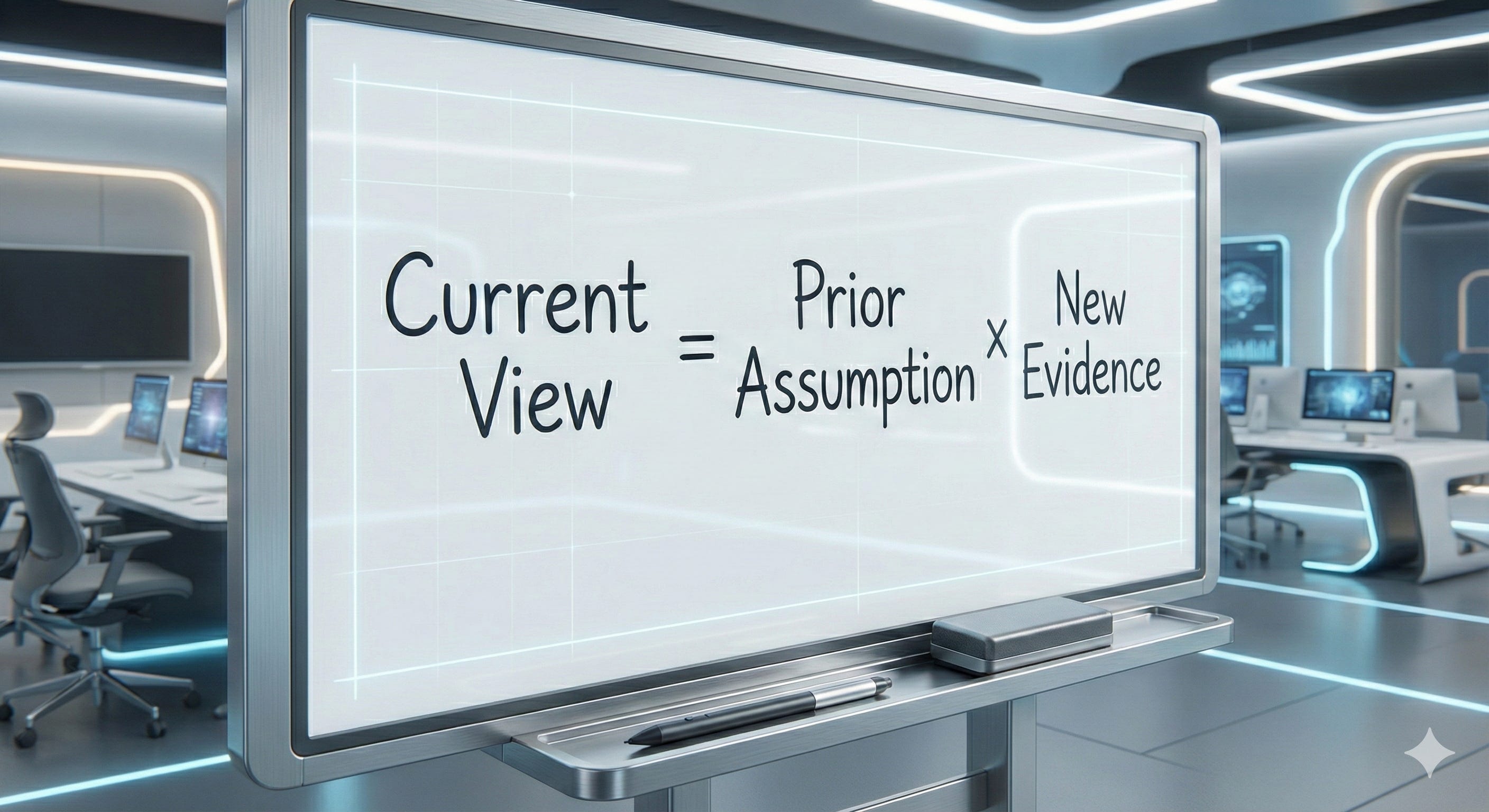
Bayesian reasoning offers a fundamentally different approach to prediction. Named for the 18th-century mathematician Thomas Bayes, this framework treats beliefs as probability distributions that should be updated as new evidence arrives. Rather than asking “what happened before?” a Bayesian asks “what is my current best estimate, and how should new information change it?”
The mechanics are straightforward. You start with a prior belief, a probability estimate based on whatever information you had before encountering new evidence. When new evidence arrives, you update that prior belief. The result is a new belief that incorporates both your prior knowledge and the new information.
What makes this powerful for strategic thinking is its explicit treatment of uncertainty and its built-in mechanism for adaptation. A Bayesian reasoner doesn’t pretend to know the future. Instead, they think of the probability of possible outcomes and continuously refine their beliefs as reality unfolds.
Imagine a solo practitioner deciding whether to invest $3,000 in AI document automation tools. A precedent-focused approach might ask: “What did lawyers who invested in previous technology cycles experience?” A Bayesian approach would ask different questions: “What is the current probability that this investment will pay for itself within two years? What evidence would make me revise that estimate upward or downward?” Each data point, a competitor’s adoption, a client’s feedback, a new product release, a bar association ethics opinion, becomes an opportunity to refine the model and adjust the decision.
The Practical Difference in Action
Let me make this concrete with an example closer to home for many lawyers thinking about their own futures.
In 2020, a precedent-focused lawyer considering whether to leave BigLaw and start a virtual practice might have looked at historical data on law firm departures. They would find that most lawyers who left large firms for solo practice experienced significant income drops in the first few years. Based on this precedent, they might have concluded the risk was too high and stayed put.
A Bayesian lawyer would have approached the question differently.
They might have started with a similar belief, perhaps a 30% probability of matching their BigLaw income within three years. But they would have explicitly identified the assumptions underlying that estimate and monitored for new evidence to update those assumptions. The rapid normalization of remote work during the pandemic, the growing client acceptance of virtual law firms, the emergence of AI tools that could multiply a solo practitioner’s productivity: each of these developments would have prompted a formal update to their probability estimates. By late 2021, that 30% prior might have become 65% or higher.
The precedent-focused lawyer risks becoming anchored to historical patterns that formed under different conditions. The Bayesian lawyer, by contrast, has a systematic method for letting current reality reshape their beliefs. This difference may seem subtle in the abstract, but in practice it can mean the difference between seizing an opportunity and watching it pass by.
Nate Silver, who built his reputation on probabilistic prediction in baseball and politics, argues in his work that the key advantage of Bayesian thinking is not that it produces better initial estimates but that it forces explicit acknowledgment of uncertainty and provides a principled method for updating your beliefs with new information.
Most experts, he notes, are reluctant to change their minds even when evidence clearly warrants it. The Bayesian framework creates cognitive discipline, a structured process that fights our natural tendency toward confirmation bias.
Two Ways of Thinking for Two Types of Questions
The key idea here is not that Bayesian reasoning should replace precedent-based reasoning. It’s that each mode of thinking is suited to different types of questions.
When you’re doing legal work, precedent remains king. Analyzing whether a contract clause will be enforceable, assessing litigation risk, advising on regulatory compliance, predicting judicial outcomes: for all of these, studying how courts and agencies have handled similar matters is exactly the right approach. The legal system’s institutional commitment to consistency makes backward-looking reasoning genuinely predictive.
But when you’re making business and strategic decisions, whether for yourself, your firm, or in advising clients on non-legal matters, you’ve left the realm where precedent reliably predicts outcomes. Markets don’t follow precedent. Technology doesn’t follow precedent. Competitive dynamics don’t follow precedent. In these domains, the Bayesian approach of maintaining explicit probability estimates and updating them with new evidence offers a more accurate map of the territory.
The challenge for lawyers is recognizing which type of question we’re facing. “It depends,” right?
Our training makes everything look like a precedent problem. When a partner asks “Should we open an office in Austin?” we instinctively want to research what happened when other firms expanded to secondary markets. But this is a business question operating in a fast-moving environment. The better approach is to form explicit probability estimates about Austin’s legal market growth, update those estimates as new evidence arrives, and make the decision based on current conditions rather than historical analogies.
Closing Thoughts
The legal profession stands at an inflection point. The skills that made lawyers valuable for centuries, our mastery of precedent, our ability to find the case on point, our talent for analogical reasoning, remain essential for legal work. Nothing I’ve said here suggests otherwise. When you’re in the courtroom or drafting a contract or assessing regulatory risk, reason from precedent. It’s what the system is designed for.
But the scope of decisions lawyers must make has expanded dramatically. We’re facing questions about technology investment, practice model transformation, career positioning, and organizational change that have no legal answer. These are business and strategic questions, and they demand different cognitive tools. The past behavior of law firms tells us little about how to respond to AI transformation, because no prior transformation has looked like this one.
Adopting Bayesian reasoning for strategic decisions isn’t about becoming statisticians. It’s about developing the intellectual humility to acknowledge what we don’t know and the cognitive discipline to update our beliefs when evidence warrants it. It’s about recognizing that the question “how have lawyers handled this before?” is sometimes the wrong question entirely.
The rear-view mirror remains essential for legal work. But for the strategic decisions that will shape your practice and career in the age of AI, it’s time to look through the windshield, and to the future.
Because where we’re headed, we won’t need roads.
The 2020 virtual practice example really highlights how dangerous anchoring can be. I'd add that the problem isn't just about recognizing when conditions have shifted, but also knowing which aspects of the "precedent" actually matter. Like, maybe the income drop pattern from past solo departures wasn't about going solo at all, but about geographic constraints and overhead costs that remote work fundamentally changed.
Hi Tom! I really loved reading the post. I think this is one of the reasons as well as to why there's a perception that lawyers hate technology. They don't hate technology. Lawyers think like this because of their way of thinking (Precedential reasoning). The practitioners that reshape their current beliefs based on new information and take a forward-looking approach will be the ones that enjoy the productivity gains from AI.
I write on LegalTech, Law and Innovation as well. My latest post analyzes AI-driven due diligence tools and how these tools are reshaping M&A workflows. Would love to chat with you on this!
https://harshithviswanath.substack.com/p/ai-driven-legal-due-diligence-the