

The First Draft Trap: How AI Blinds Us to the World of Possibilities
Where I Explore How AI Solved the Blank Page Problem, But for Lawyers, the Blank Page Was the Point

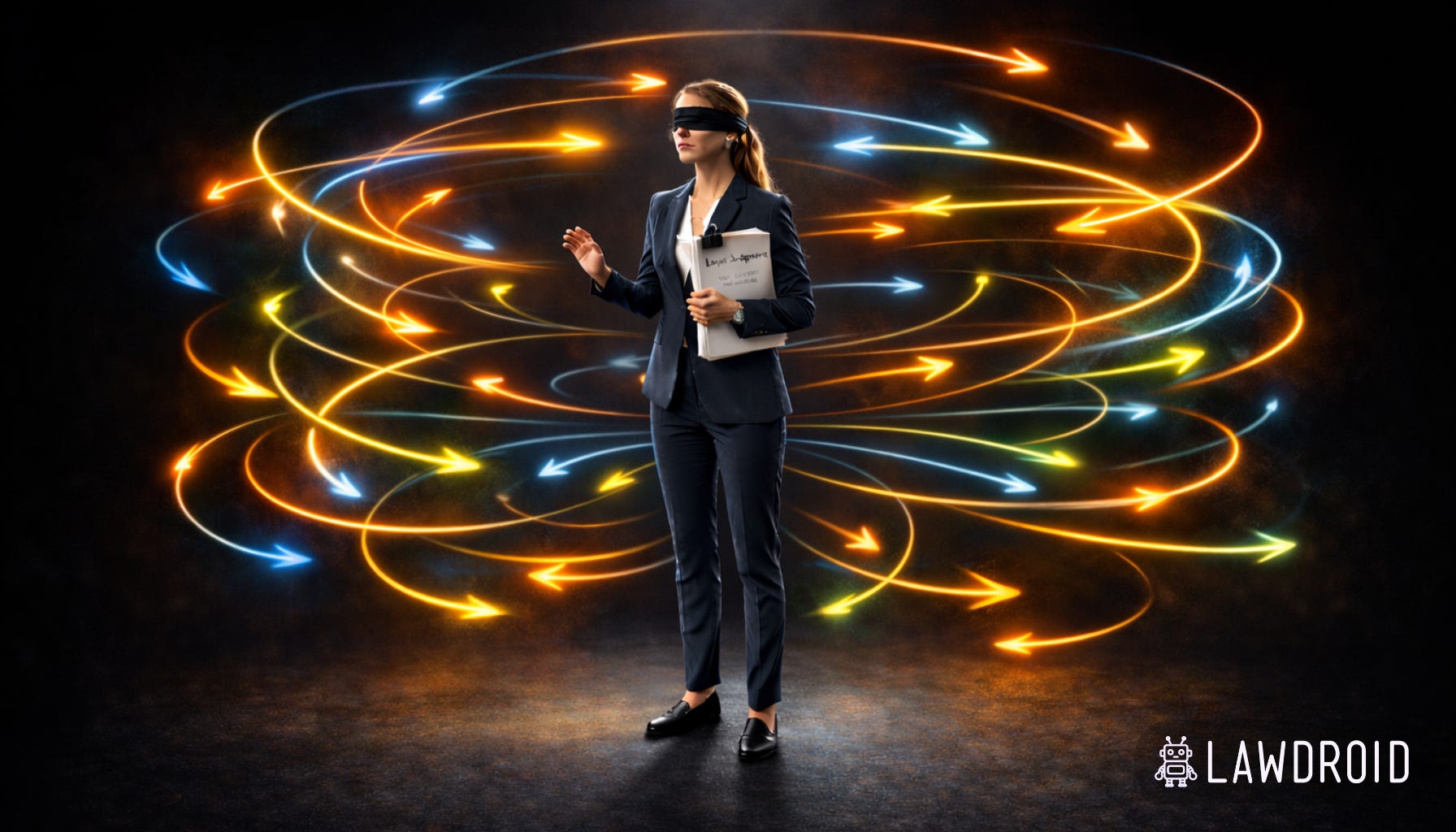
We’ve all heard the pitch. Staring at a blank page? Just prompt AI!
In seconds you’ve got a working draft: structured, coherent, surprisingly competent. The blank page problem, that ancient enemy of productivity, has been vanquished.
Except the blank page was never just an obstacle. It was a space of possibility, of roads untraveled. And for lawyers, it was the space where the most important part of our work actually happens.
I call it the First Draft Trap!
The moment you accept an AI-generated draft as your starting point, you’ve already made the most consequential decision of the entire project; and you made it by not making it. You let the machine choose your direction, your framing, your theory. Everything that follows is editing. And editing, no matter how rigorous, is not the same as thinking.
If this sounds interesting to you, read on…
This substack, LawDroid Manifesto, is here to keep you in the loop about the intersection of AI and the law. Please share this article with your friends and colleagues and remember to tell me what you think in the comments below.
The Cognitive Hijack
There’s solid psychology behind why this happens. Daniel Kahneman and Amos Tversky demonstrated in their landmark 1974 paper, “Judgment under Uncertainty: Heuristics and Biases,” that once people are exposed to an anchor, even a transparently arbitrary one, it distorts their subsequent judgments. In their experiments, subjects who watched a roulette wheel spin to a random number still let that number influence their estimates of completely unrelated quantities. The anchor held even when people knew it was meaningless.
An AI first draft is the most seductive anchor imaginable. It’s not random; it’s plausible. It’s well-organized. It sounds like something a lawyer would write. And that’s precisely what makes it dangerous. You know intellectually that it’s just one of many possible approaches. But the anchor holds anyway. Kahneman would tell you that knowing about the bias doesn’t protect you from it.
There’s an even more precise concept here. In 1942, the psychologist Abraham Luchins identified what he called the Einstellung effect: once a person finds a solution that works, they become functionally blind to better solutions, even when those alternatives are obvious to someone encountering the problem fresh. The first working solution doesn’t merely compete with alternatives. It blocks perception of them entirely.
That’s the First Draft Trap at the pyschological level. The AI draft isn’t just one option you happen to prefer. It’s a cognitive filter that prevents you from seeing the other options that were available to you: the roads you never even noticed you didn’t take.
The Anti-Socratic Method
Now consider what this means for a profession built on the opposite instinct.
From the first day of law school, we’re trained to resist the obvious answer. The Socratic method exists for exactly this reason. A good professor hears your confident response and asks: What else? What if the facts were different? What’s the argument on the other side? The goal isn’t to arrive at an answer. It’s to build the mental habit of holding multiple possibilities in tension before committing to any of them.
The First Draft Trap is the anti-Socratic method. It delivers a confident answer before you’ve even formulated the question properly. And instead of interrogating it, you polish it.
Think about what a senior partner actually does when a junior associate brings a memo. The partner’s value isn’t better writing. It’s peripheral vision: the ability to see what the memo doesn’t address. The argument it didn’t consider. The framing that would land differently with this particular judge or this particular jury. That capacity to see beyond the document in front of you is what clients pay premium rates for. And it’s exactly the muscle that atrophies when your default workflow begins with “generate a draft.”
There’s a direct parallel to case strategy. A litigator who latches onto the first viable theory of the case is a dangerous litigator; dangerous to the client. The great ones hold three or four theories in suspension, stress-test each against the facts, and only then commit. That uncomfortable period of ambiguity, of genuinely not knowing which path is best, is where the real lawyering lives. The AI first draft is the equivalent of committing to a theory of the case before you’ve finished reviewing discovery.
System 1 Hijacks a System 2 Profession
Kahneman’s two-system framework gives us a clean way to describe what’s going wrong. System 1 is fast, intuitive, pattern-matching. System 2 is slow, deliberate, analytical. The practice of law, at its best, is a System 2 discipline. We’re trained to override our gut reactions, challenge assumptions, and think through consequences before acting.
The AI first draft feels like a System 2 output. It’s structured, footnoted, methodical. But your decision to accept it as a starting point is pure System 1: a fast, intuitive grab at the nearest plausible answer. You’ve used a sophisticated tool to bypass the sophisticated thinking the tool was supposed to support.
What to Do Instead
None of this means stop using AI. It means stop using it to skip the part that matters.
Before you ever ask for a draft, ask for the map. Try a prompt like this:
I’m working on [describe the matter, motion, or document]. Before drafting anything, give me:
1. Three fundamentally different strategic framings for this problem.
2. For each framing, the strongest argument in its favor and its most serious vulnerability.
3. Which framing best fits [the client’s goals / the audience / the procedural posture].
Do not write a draft. I want to choose the direction before we start building.
That last line is the key. It keeps you in the driver’s seat during the phase that matters most. You’re using AI to expand the possibility space before you collapse it, not after.
In Kahneman’s terms, use AI to fuel System 2, not to hand the controls to System 1. Let the machine generate options. You exercise judgment. And, also don’t forget to add your own ideas and explore them too!
The blank page was never your enemy.
It was the last place where all possibilities were still alive; where your judgment, your experience, and your capacity to see what others miss had room to operate. The First Draft Trap paves over that space with something that looks like progress but might be the most expensive shortcut you’ve ever taken.
For lawyers, the ability to see what isn’t there is the whole game.
Don’t let the first draft trap blind you to it!
If you found this article useful, you’ll love the LawDroid AI Conference 2026. April 28–29, virtual, and completely free — two days of keynotes, panels, and workshops on AI and the legal profession. I’d love to see you there.
What if the trap works in both directions? The lawyer who opens with a specific framing anchors the AI on that frame. The AI optimizes within it. The lawyer reads the output as validation. Neither side surfaces what was outside the frame to begin with.
The recommended prompt is a great practical take on the first draft trap. But I keep thinking about the upstream anchor: the lawyer's own description of the matter is itself a frame, and the three strategic alternatives the AI generates will be shaped by how the question was framed.
I like your prompt. Another idea is to use old fashioned free writing to help get out your thoughts and then let AI synthesize them for you. I'll pop in a half-baked idea and then converse with the AI to flesh it out.