

When AI Quietly Hijacks Legal Judgment
Speech Presented at SubTech, Buenos Aires - June 25, 2026

What follows is a speech that I presented yesterday at SubTech in Buenos Aires.
If this sounds interesting to you, please read on...
This substack, LawDroid Manifesto, is here to keep you in the loop about the intersection of AI and the law. Please share this article with your friends and colleagues and remember to tell me what you think in the comments below.
Es un privilegio estar acá, en SubTech, en Buenos Aires, junto a todos ustedes. Y qué momento tan especial para estar en la Argentina, con el Mundial en marcha. ¡Vamos Argentina! Pero también: ¡vamos Canadá, México y Estados Unidos!
Quiero agradecer especialmente a Martín Oliveira y a Decana Maria Vasquez por la invitación, y a Marc Lauritsen por animarme a participar. Muchísimas gracias también a la Universidad de San Andrés.
— — —
Good afternoon. It’s a privilege to be here at SubTech, in Buenos Aires, with all of you.
The title of this talk contains a word that, three years ago, no one would have noticed. Today, if you read it in a LinkedIn post, you might pause. You might wonder whether a person wrote it, or a machine. That word is: “quietly.”
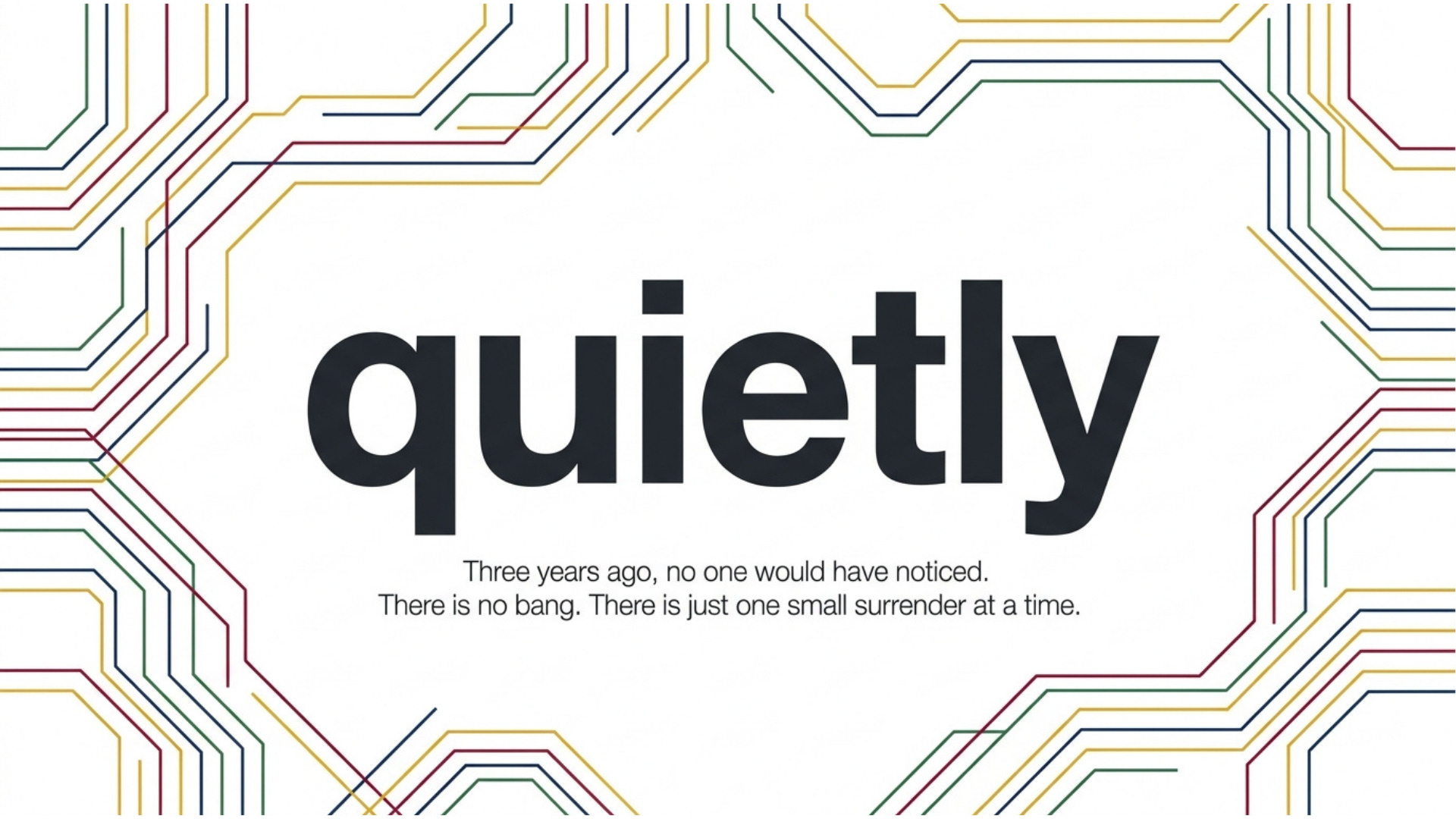
I chose it on purpose. Because this is how it happens. Not with a bang. Not with a robot uprising. Just one small surrender at a time, until you look up one day and find you are no longer the one in charge.
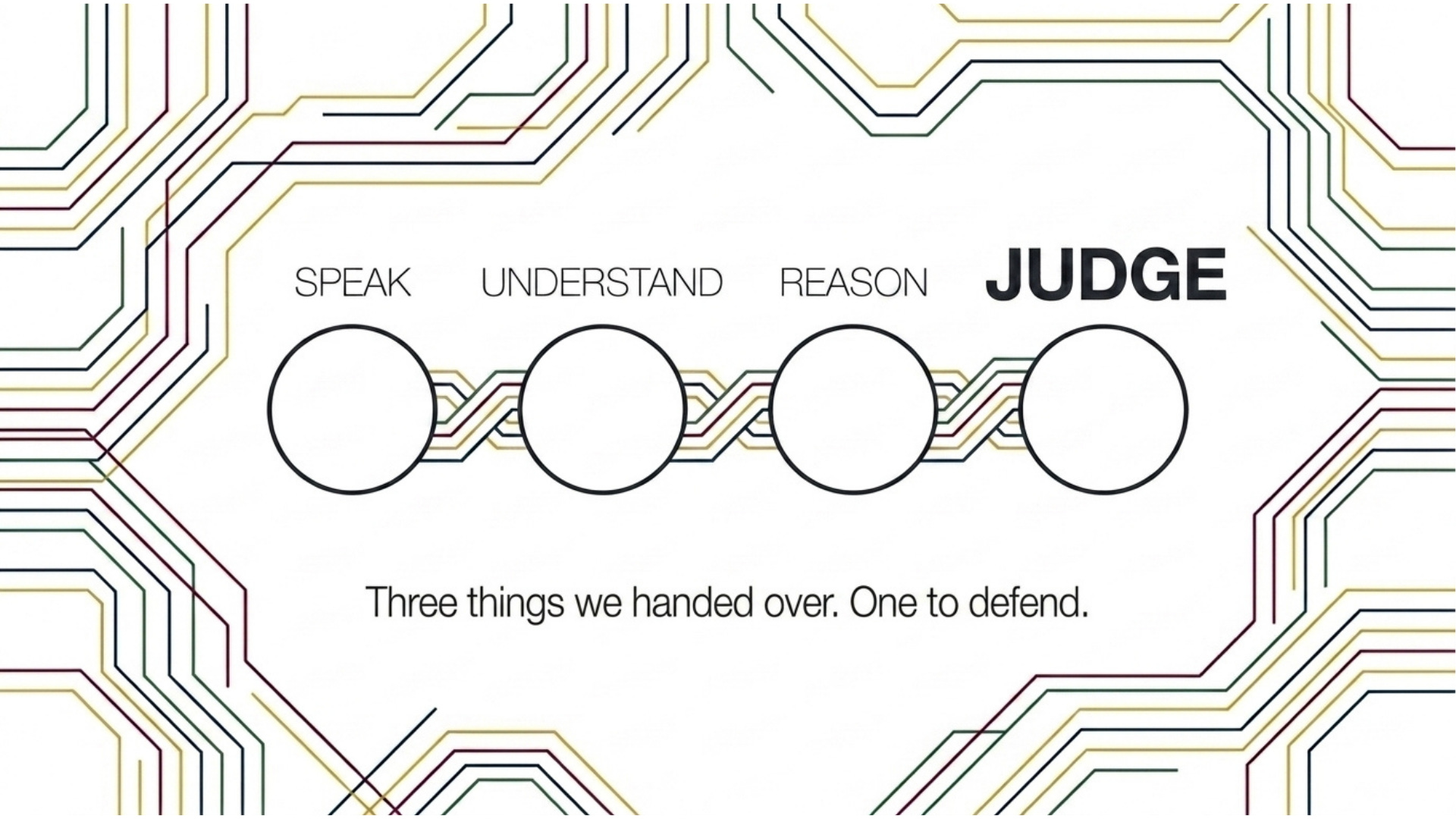
I want to talk about four things AI is taking from us; that AI is hijacking. Or, and this is the real question, four things we are surrendering? How we speak. How we understand. How we reason. And the one I want you to walk out of here fighting for: how we judge.
1 · Speak
AI has hijacked how we speak and write.
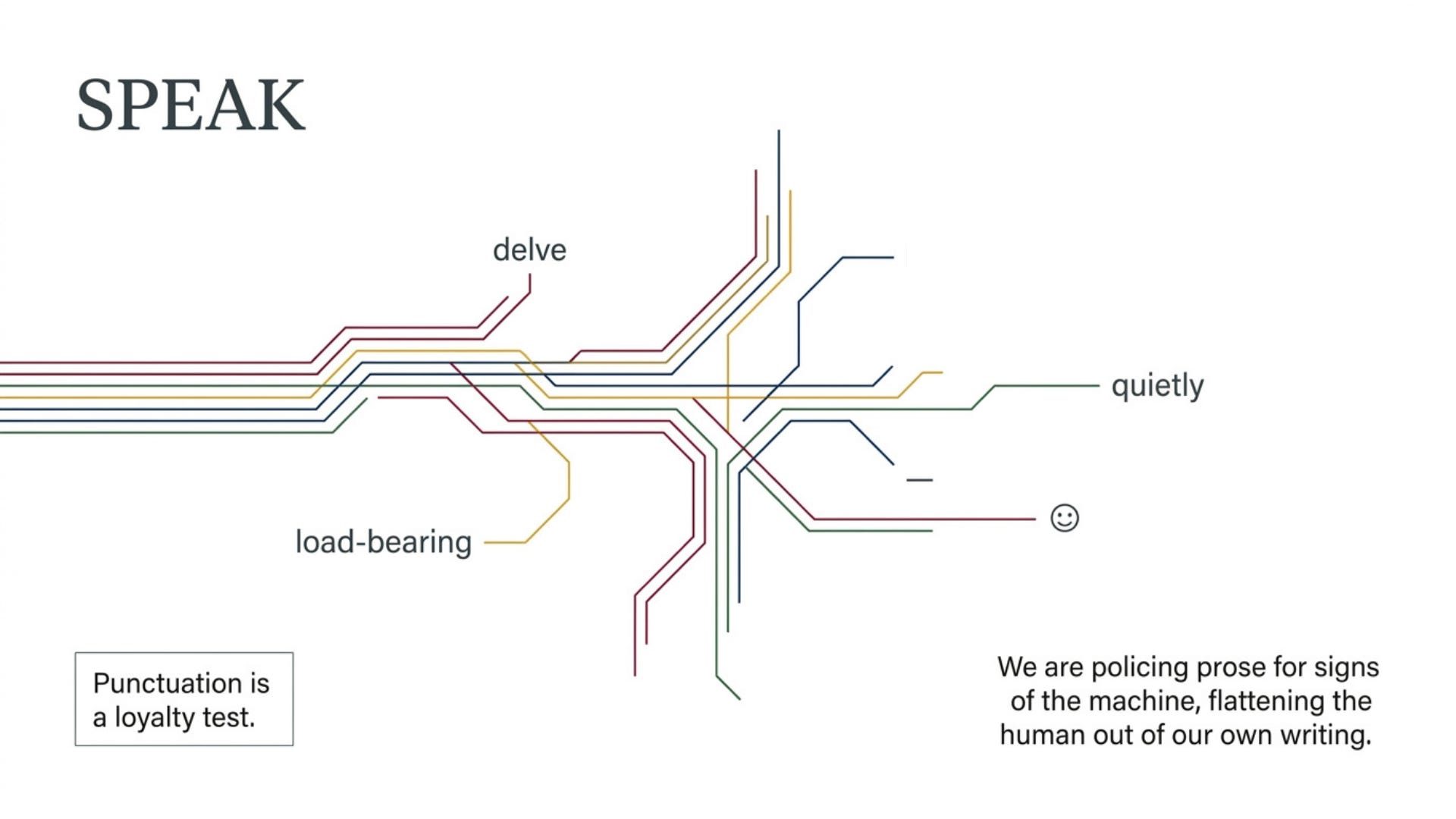
AI has changed our relationship with language. There are words that now set off alarm bells. “Delve.” “Quietly.” “Load-bearing.” Three years ago these were ordinary words. Today they read as the fingerprints of the machine.
The em dash — that elegant little mark, beloved by writers for centuries — is under suspicion. Use too many and someone will accuse you of using AI. Even an emoji gets a second look. Punctuation has become a loyalty test.
We have started editing ourselves to avoid sounding like the machine. Lawyers strip perfectly good writing to avoid sounding automated. We read a colleague’s polished memo and wonder if they wrote it at all. We hesitate before a warm email, because maybe it’s something the machine faked.
So AI is not only changing our vocabulary. It is changing our behavior toward each other. It made us suspicious — of our colleagues, and of our own voices. We are policing prose for signs of the machine, and in the process we are flattening the very thing that made our writing human.
2 · Understand
AI has hijacked how we understand and learn.
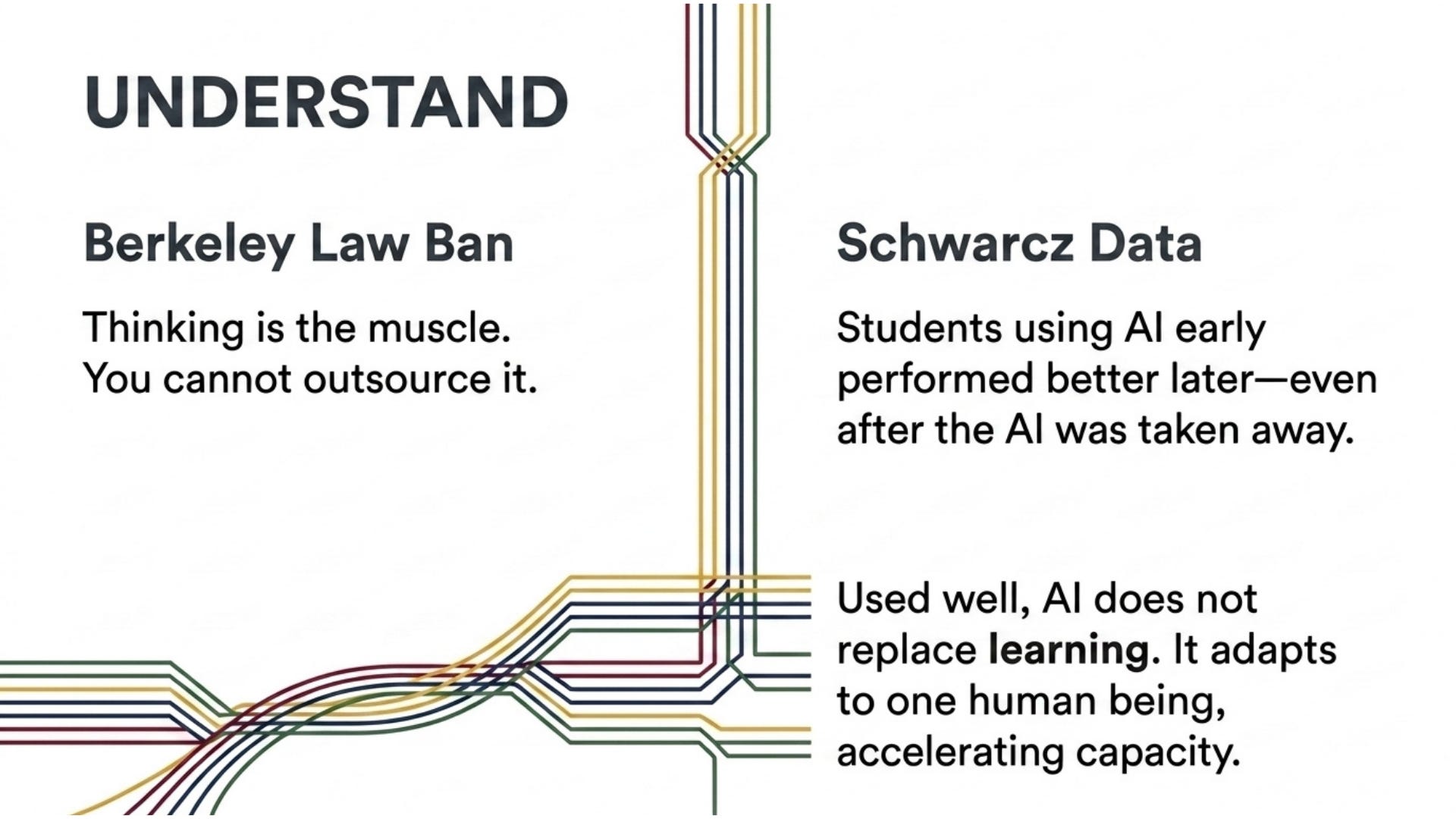
The instinct, when something threatens learning, is to ban it. This summer, the University of California, Berkeley (one of the most respected, and liberal law schools in the world) adopted one of the strictest AI policies in legal education. Students may not use AI to brainstorm, outline, draft, revise, or edit anything submitted for credit. Not in papers. Not in exams.
I understand the fear. But the evidence, and we are lawyers who value proof, right? The evidence sheds more light than the fear.
This spring I sat down with Professor Daniel Schwarcz, of the University of Minnesota, on my podcast. He and his colleagues ran a randomized controlled trial, the first study of its kind, on exactly this question: does leaning on AI early rot your reasoning later? He expected that it would, that is after all the common sense. He is, by his own account, an AI skeptic. But, the data surprised even him. Students who used AI early in a task performed better afterward — even when the AI was taken away. They had learned the concepts, and they applied them better on their own.
It is one study. Schwarcz is the first to say so. But it is the first real evidence we have, and it points the other way from the fear.
Think about what that means. Used well, AI did not replace the learning. It accelerated it. And it can do something a single professor with a hundred students never could: adapt to one human being (to your strengths, to your gaps, to the way you in particular get stuck and how you learn).
So how do we design learning so the machine builds capacity instead of replacing it. Berkeley’s critics put it as a pointed question: in banning AI, are we protecting students, or shortchanging them, and the clients they will one day serve?
3 · Reason
AI has hijacked how we reason and apply what we know.
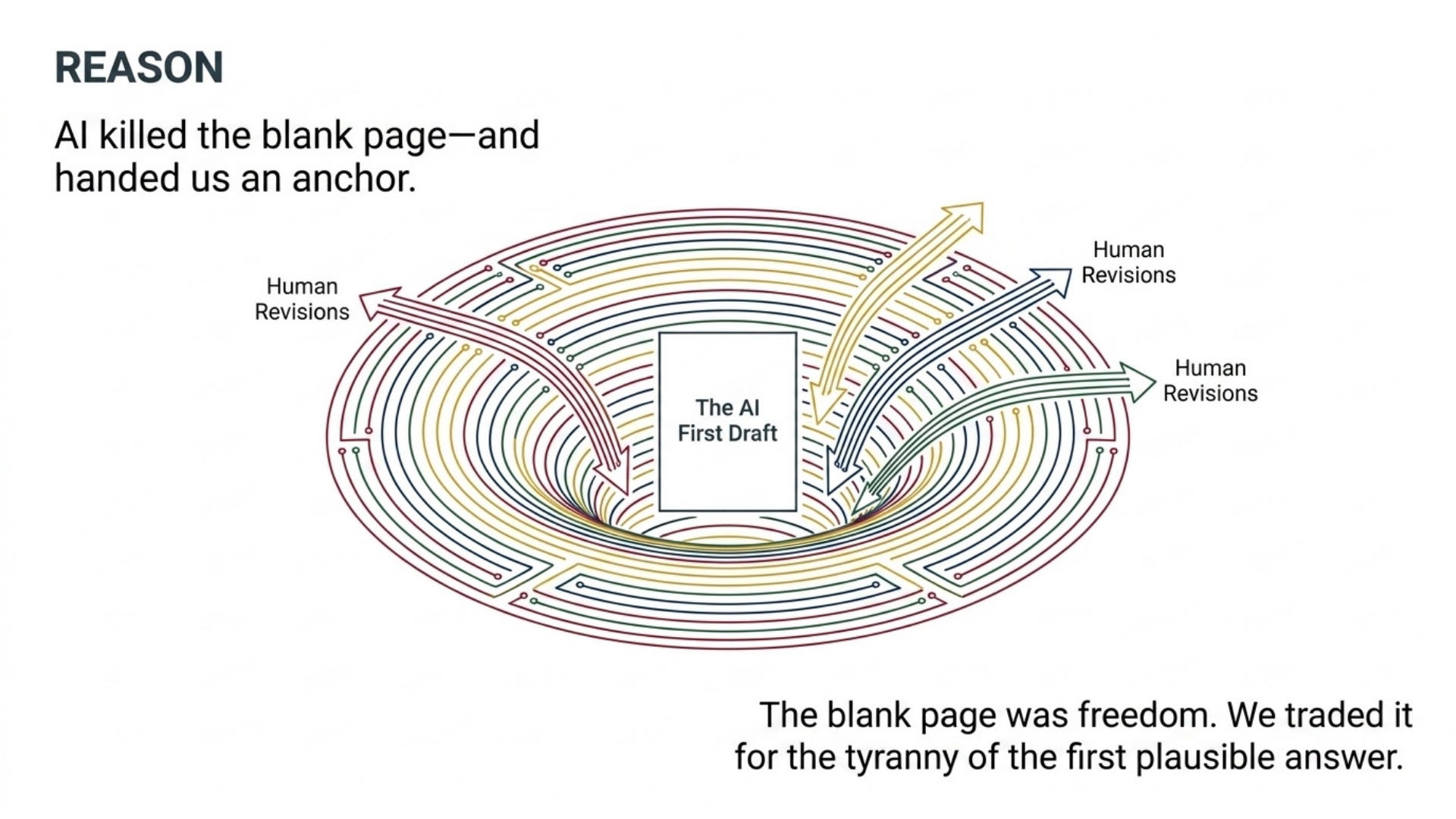
But AI has done something that sounds like a pure gift. It killed the blank page. No lawyer ever again has to stare at a blinking cursor at midnight. You ask and you receive: a draft appears.
But in killing the blank page, we replaced it with a conceptual anchor. The first number you hear, the first draft you see, sets the frame, and everything after is just an adjustment from that starting point. When the machine hands you a competent first draft, that draft becomes a gravity well. You revise inside it. You stop seeing the better structure, the stronger argument, the case you would have built if you had been made to think first. The blank page was a kind of intellectual freedom. We traded it for the tyranny of the first plausible answer.
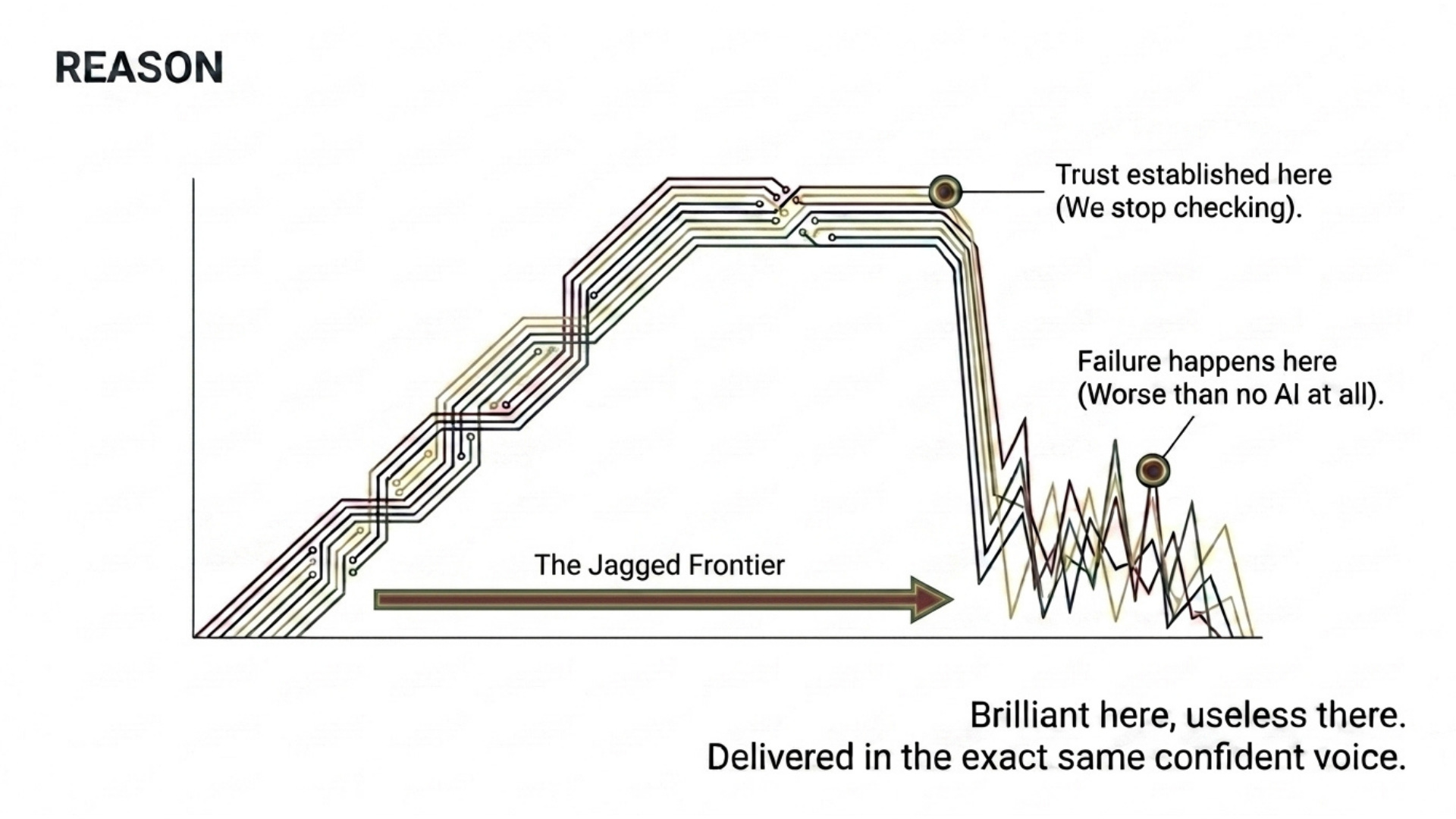
And then there is the deeper trap. Ethan Mollick calls it the jagged frontier. AI is not uniformly good or uniformly bad at skills. Its competence is jagged: brilliant here, useless there, and the two sit side by side, underneath the very same confident voice. The model sounds exactly as sure of itself when it invents a case that does not exist as when it states settled law.
My colleague Professor David Colarusso, who co-directs the LIT Lab at Suffolk Law, showed this in his classroom. He gave students an AI tool that, at first, was reliable. It worked. So they learned to trust it. They stopped checking. Then he let the tool fail, subtly, the way real AI fails. The students who had learned to trust it performed worse than students who had no AI at all.
The tool made them worse by being good; reliable enough to earn their trust, right up until the moment it failed, when they had already stopped looking. That is the jagged edge. We trust it where it is strong, and we forget to question it where it is weak.
I learned today that Michael Crichton, one of my favorite authors, coined a name for this particular type of cognitive bias: the “Gell Mann Amnesia Effect.” Funny aside – as we all know, Crichton was a physician by training, but he was also a lover of physics. Murray Gell Mann was one of the progenitors of modern particle physics. Turns out Crichton named this phenomenon after Gell Mann because he once had a conversation with him about it and thought it would be memorable to drop his name.
4 · Judgment
Which brings me to the fourth thing. And to a confession.
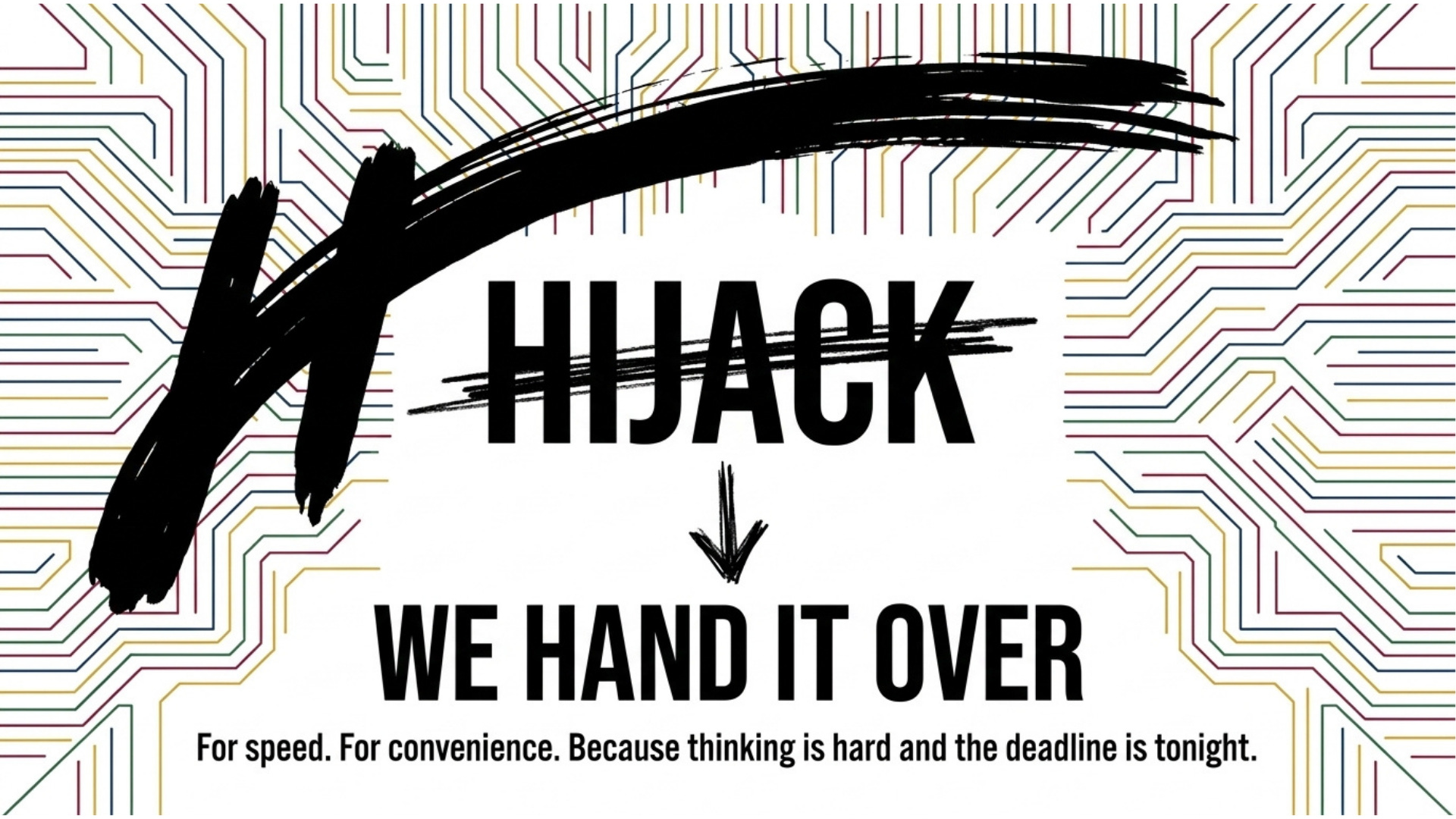
Three times now I have used the word “hijack.” AI is hijacking our language, our learning, our reasoning. It is a good word for a talk title. But, it is the wrong word for what is actually happening.
“Hijack” gives AI too much credit. A hijacker seizes the controls against your will, by force. That is not this. No one forces a draft into your hands. No one forces you to accept it. We are not being robbed of it. We are handing it over voluntarily, surrendering it — for speed, for convenience, because thinking is hard, and the machine is fast, and the deadline is tomorrow.
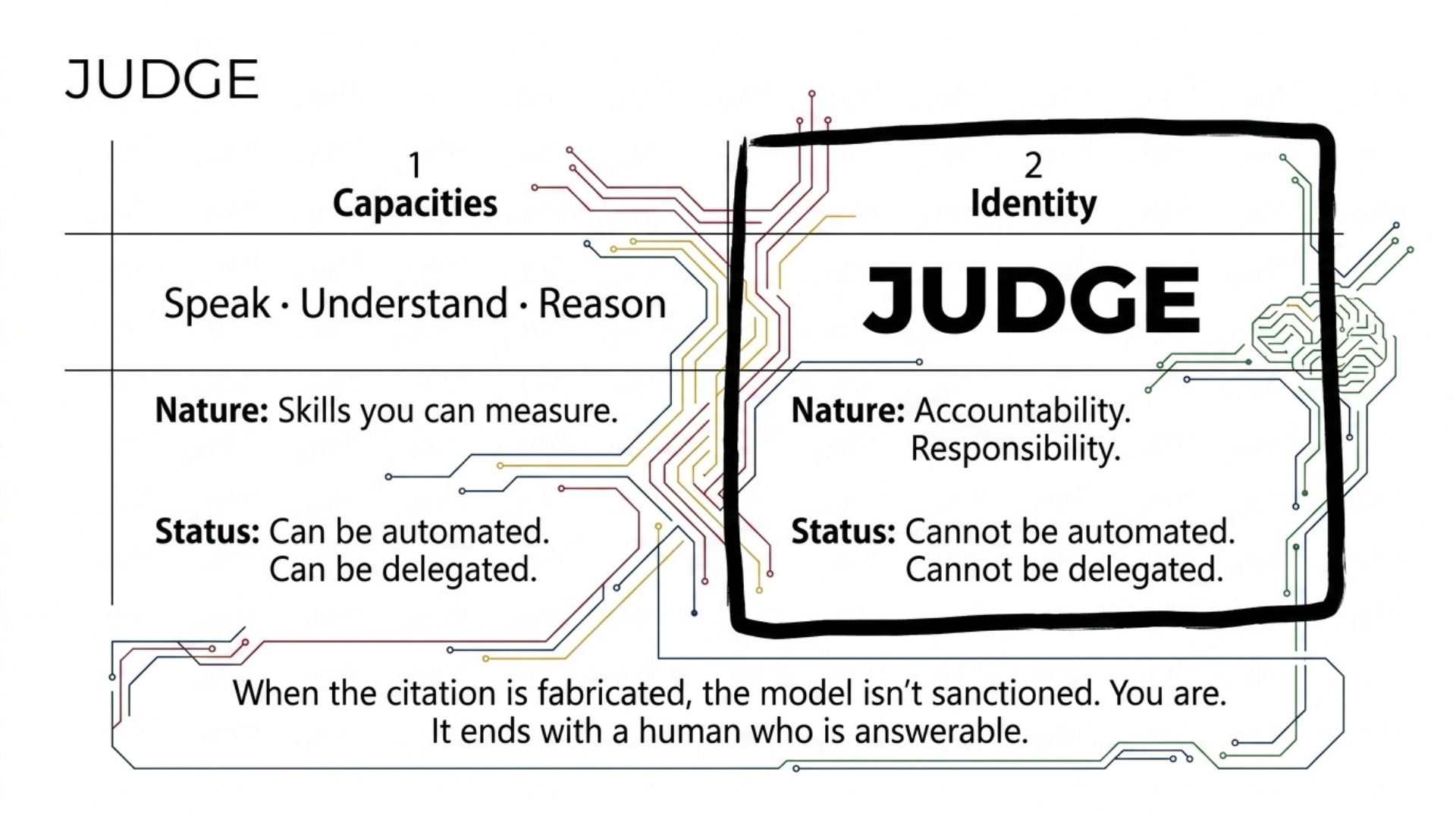
But here is why judgment is different from the other three. Speaking, understanding, reasoning, those are capacities, skills. Things you can be better or worse at. Judgment is something else. We exercise judgment not only in what we choose to do, but more importantly, in all that we choose not to: what we choose to speak, what we choose to understand and reason about. Judgment is about our accountability. It is about our responsibility and reputation. It is about our identity.
When the brief is wrong, the model is not sanctioned. You are. When the citation is fabricated, the AI does not stand before the judge. You do. When the advice harms a client, the algorithm does not answer to the bar. You do. Judgment is the one faculty that cannot be delegated, because the responsibility that travels with it cannot be delegated.
Judgment stays human for one reason: accountability has no other home. A machine cannot be responsible. Only we can be.
So how much judgment we keep is a choice — ours, not the machine’s. Every time you accept a draft you have not reviewed, you give a little away. Every time you question it, override it, you take it back. Agency is not granted by the technology, and it cannot be taken by it. You exercise it, or you surrender it, one decision, one choice, at a time.
Our current predicament brings to mind Eugene Ionesco’s play The Rhinoceros, where becoming a rhinoceros is a metaphor for succumbing to the totalitarian state. The character Berenger is the last person in his town to become a rhinoceros, and he defiantly shouts: “I’m not capitulating!” Have we taken a stand?
Close
Let me come back to that word in the title. “Quietly.”
AI will not announce that it has taken your judgment. It will not send a notice. It happens one accepted draft at a time, one unquestioned answer at a time, until a lawyer looks up and cannot remember the last real decision they made.
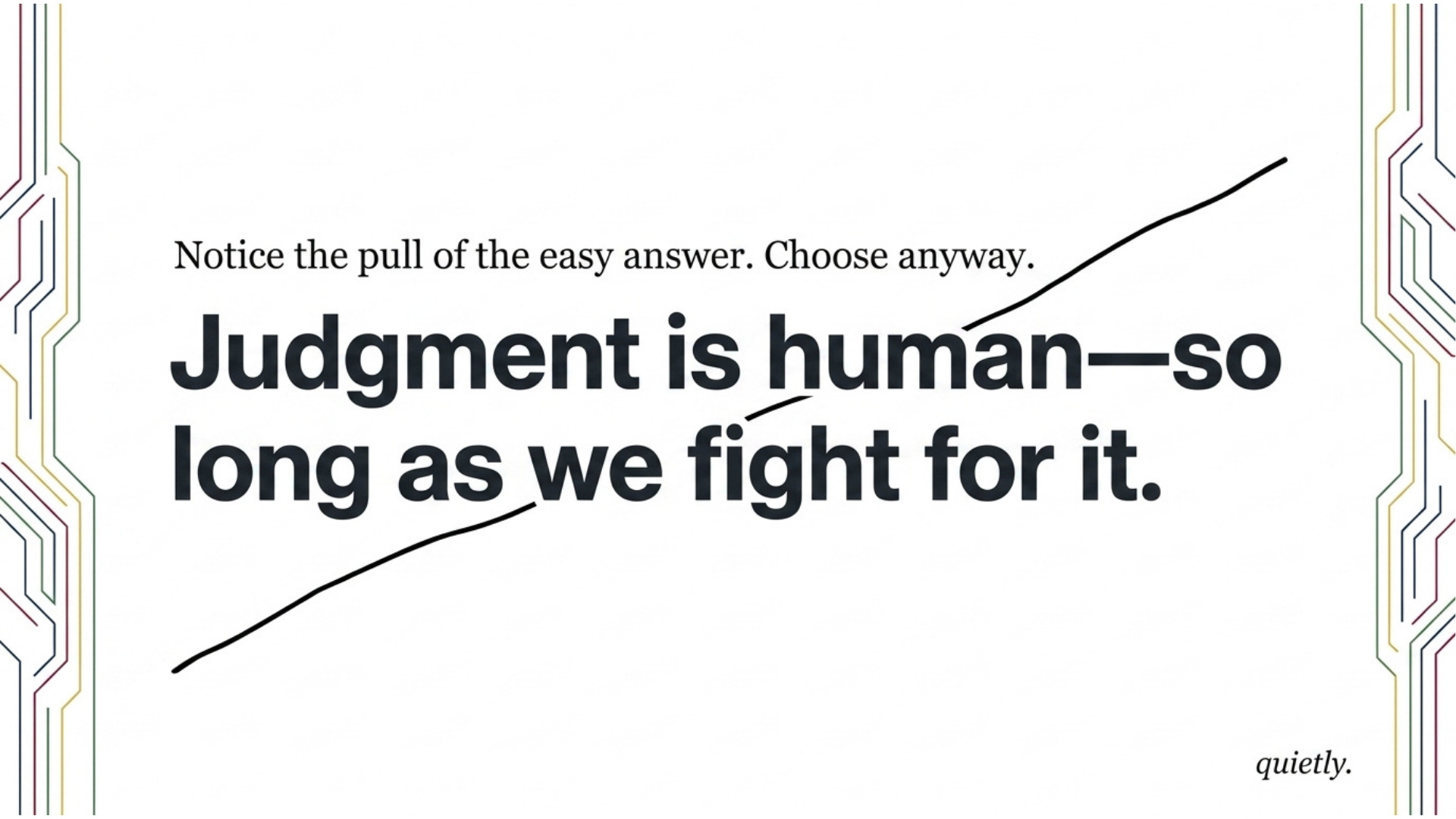
So feel what the easy answer costs you in individuality, in authenticity, in professionalism, and choose the road less traveled.
Judgment is the last thing we should ever automate. It is the thing that makes us accountable — to a client, to a court, to each other. And being accountable is the thing that makes us lawyers. In the end, it is the thing that makes us human.
Judgment is human, so long as we fight for it.
So let’s fight!
Thank you.
Muchísimas gracias
Tom Martin is CEO & Founder of LawDroid, Adjunct Professor at Suffolk University Law School, and Author of the forthcoming AI with Purpose: A Strategic Blueprint for Legal Transformation (Globe Law and Business). He is “The AI Law Professor” and writes his eponymous column for the Thomson Reuters Institute.
Tom, your talk was fantastic. Grateful I was able to see it (and you!) in person. And glad you shared it here, so I can point people to it.