


Hey there Legal Rebels! 👋 I’m excited to share with you the 55th episode of the 2026 season of the LawDroid Manifesto podcast, where I will be continuing to interview key legal innovators to learn how they do what they do. I think you’re going to enjoy this one!
If you want to understand how the legal profession is navigating the AI transformation through education, practical resources, and thoughtful policy development, you need to listen to this episode. Joey is at the forefront of helping lawyers understand and adopt AI while maintaining the profession’s commitment to access to justice and ethical practice.
Building Bridges Between Innovation and the Legal Profession
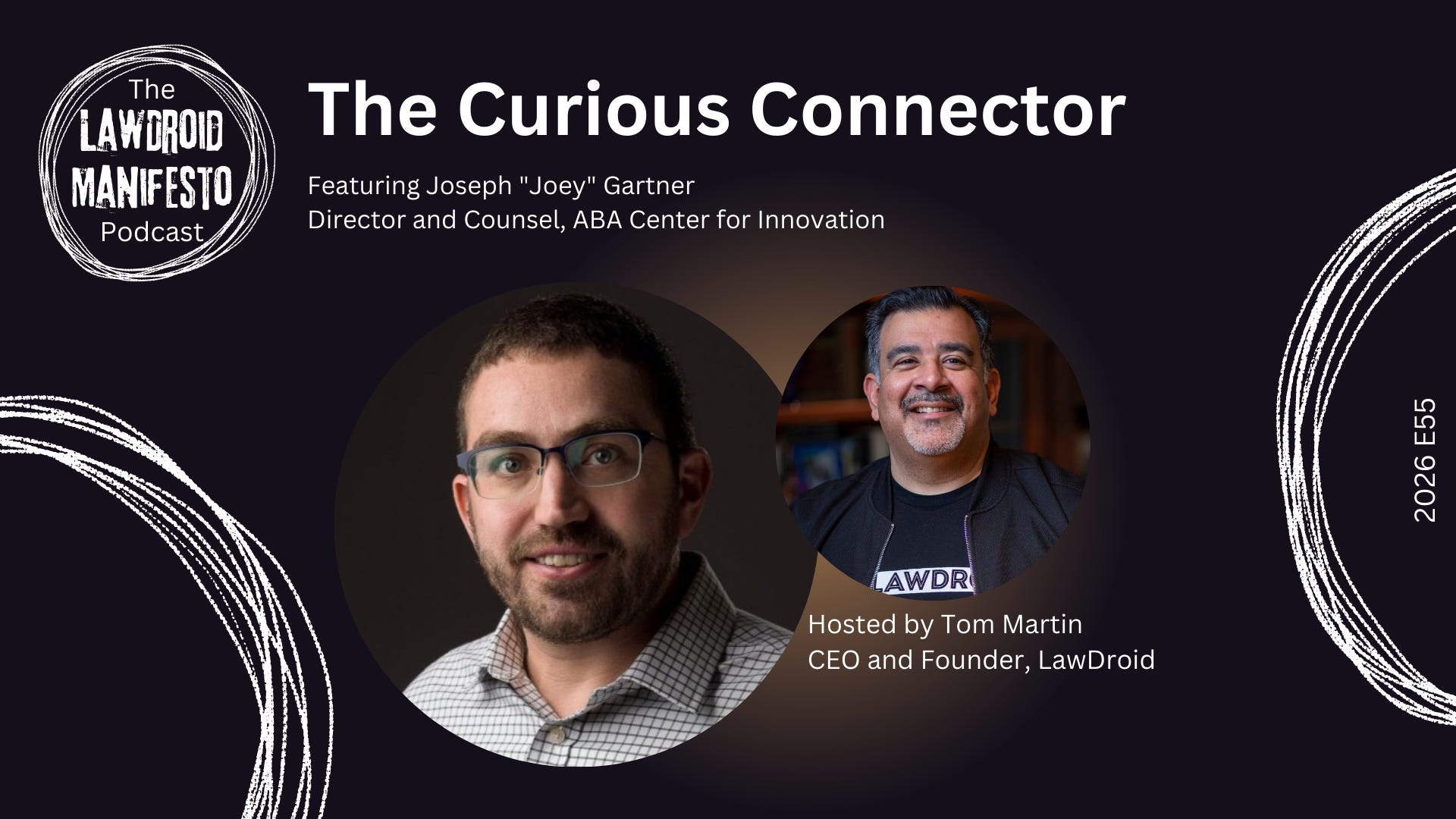
Join me as I interview Joey Gartner, Director and Counsel at the ABA Center for Innovation.
In this insightful podcast episode, Joey shares his journey from legal aid attorney to becoming a key figure in guiding the legal profession through technological transformation. He dives deep into the work of the ABA’s AI Task Force, which recently completed a comprehensive two-year study examining AI’s impact across courts, law practice, legal education, and access to justice. Joey also discusses the practical resources the Center for Innovation has developed, including AI glossaries, innovation mapping tools, and trend reports designed to help legal professionals understand and implement new technologies.
His stories and insights underscore his belief in curiosity-driven learning and the importance of meeting legal professionals where they are in their understanding of technology. This episode is a must-watch for anyone interested in how large professional organizations can effectively support innovation while maintaining ethical standards and expanding access to justice.
The Skinny
Joey Gartner, Director and Counsel at the ABA Center for Innovation, shares his path from Midwest roots through legal aid work to becoming a central figure in helping the legal profession navigate technological change. With a naturally curious and inclusive approach, Joey demonstrates how asking “why” and “how” questions—rather than making assumptions—creates space for broader participation in innovation conversations. Throughout the conversation, Joey emphasizes the importance of building boundaries to maintain work-life balance while pursuing multiple professional interests, noting that his wife and family help him maintain perspective when he loses sight of priorities. Joey’s philosophy centers on his response to new challenges: “I’m not sure how to do that, but I’ll figure it out”—an attitude that has served him well in developing resources and programs that make innovation accessible to the broader legal community.
Key Takeaways:
The ABA AI Task Force completed a comprehensive two-year study examining AI’s impact on courts, law practice, legal education, access to justice, and policy development
The task force produced 24 webinars, three reports, and multiple surveys to help legal professionals understand AI’s implications for the profession
A key outcome was creating centralized access to AI resources across the ABA’s numerous sections and committees, making information easier to find
The legal profession isn’t speaking the same language when it comes to AI—some conversations focus on doom and gloom while others emphasize practical use cases
The Center for Innovation developed an AI glossary specifically for legal professionals to help standardize terminology and understanding
Joey’s background in legal aid taught him to be skeptical and ask fundamental questions like “why does this exist” and “how does this help people”
He emphasizes building firm boundaries and routines (like morning workouts and journaling) to maintain work-life balance amid multiple professional commitments
The Center’s innovation mapping tool tracks rural practice initiatives, AI guidance from state and local bars, and community justice workers across the country
The “I’ll figure it out” attitude—being willing to tackle unfamiliar challenges through curiosity—is essential for innovation work
Change within large organizations like the ABA can be slow, but presidential initiatives and external forces like ChatGPT can rapidly shift priorities
Notable Quotes:
“The AI Task Force was a two-year presidential initiative launched under then-President Mary Smith of the Association which really aimed at looking at issues of artificial intelligence that were affecting the profession and doing kind of a large-scale undertaking and understanding of those issues.” - Joey Gartner (02:43-02:58)
“The legal industry has definitely in some ways embraced and in some days retreated from this conversation. But I think what it’s done very effectively also is it’s kind of recognized that from a starting point, we’re not all speaking the same language.” - Joey Gartner (05:45-05:59)
“I’ve learned to kind of be like, I want to understand the why and the how before I decide I want to actually work on the what. And I think that question is something that legal aid work teaches you to have.” - Joey Gartner (15:27-15:38)
“My job is not to come in to be an expert or to be the most knowledgeable. My job is to create space for people who maybe think they’re not the most knowledgeable to feel like they can contribute.” - Joey Gartner (18:10-18:19)
“I think what keeps me going through all of it is building, like laying down my boundaries and being very explicit about it. And for me, that’s like waking up really early, working out in the morning.” - Joey Gartner (45:38-45:47)
“It’s very easy to kind of fall out of repetitive habits when you’re feeling stressed and anxious. But if you build those boundaries, it’s a little easier to rebound to.” - Joey Gartner (46:13-46:22)
“When asked to build a project or figure out how to do something, my answer has never been like, no, I can’t do that. My answer is, I’m not sure how to do that, but I’ll figure it out.” - Joey Gartner (49:38-49:48)
“Part of also what keeps me going is just that skepticism, right? That what we talked about before, that kind of asking like the why and how questions, you know, I still get to do that now.” - Joey Gartner (49:16-49:23)
Clips
Start One Small Change
AI Won't Replace Lawyers—It Replaces Tasks
Law Firms Are Customer Service Businesses
Innovation Isn't Just Technology
Joey’s approach to innovation leadership offers a valuable model for the legal profession. Rather than positioning himself as the ultimate expert, he creates space for others to contribute and learn together. His background in legal aid instilled a healthy skepticism that serves him well—constantly asking why systems exist and how they serve people, rather than accepting them at face value.
What makes Joey’s work particularly valuable is his ability to navigate the tension between the legal profession’s natural caution and the rapid pace of technological change. By developing practical resources like AI glossaries, innovation mapping tools, and accessible trend reports, he’s helping bridge the gap between those who are deeply immersed in AI and those just beginning to explore it.
Closing Thoughts
As someone who’s worked closely with Joey through the Center for Innovation, I can attest to the authenticity of his curiosity-driven approach. What strikes me most about Joey is his genuine commitment to making innovation accessible to everyone in the legal profession, not just the early adopters or technology enthusiasts.
The work of the AI Task Force represents exactly the kind of thoughtful, comprehensive approach our profession needs. Rather than rushing to judgment or making sweeping pronouncements, the task force took two years to examine AI’s implications across multiple dimensions of legal practice. This kind of careful study, combined with practical resource development, gives lawyers the foundation they need to make informed decisions about technology adoption.
For our Legal Rebels community, Joey’s story demonstrates that effective innovation leadership isn’t about having all the answers, it’s about asking the right questions and creating space for collective learning. His “I’ll figure it out” attitude, combined with healthy boundaries and genuine curiosity, offers a sustainable model for anyone working at the intersection of law and technology.
As AI continues to transform our profession, we need more people like Joey who can bridge the gap between technical possibility and practical implementation, all while keeping access to justice and ethical practice at the center of the conversation. The future of legal innovation depends on curious connectors who can bring people together, translate complex concepts, and create resources that make technology accessible to everyone.


