


Hey there Legal Rebels! 👋 I’m excited to share with you the 59th episode of the LawDroid Manifesto podcast, where I will be continuing to interview key legal innovators to learn how they do what they do. I think you’re going to enjoy this one!
If you want to understand how to reinvent your legal career with purpose and intentionality, and why it’s never too late to embrace innovation, you need to listen to this episode. Robert is at the forefront of global legal transformation and brings a uniquely reflective and hopeful perspective to where the profession is heading.
Transforming a Career, Transforming a Profession
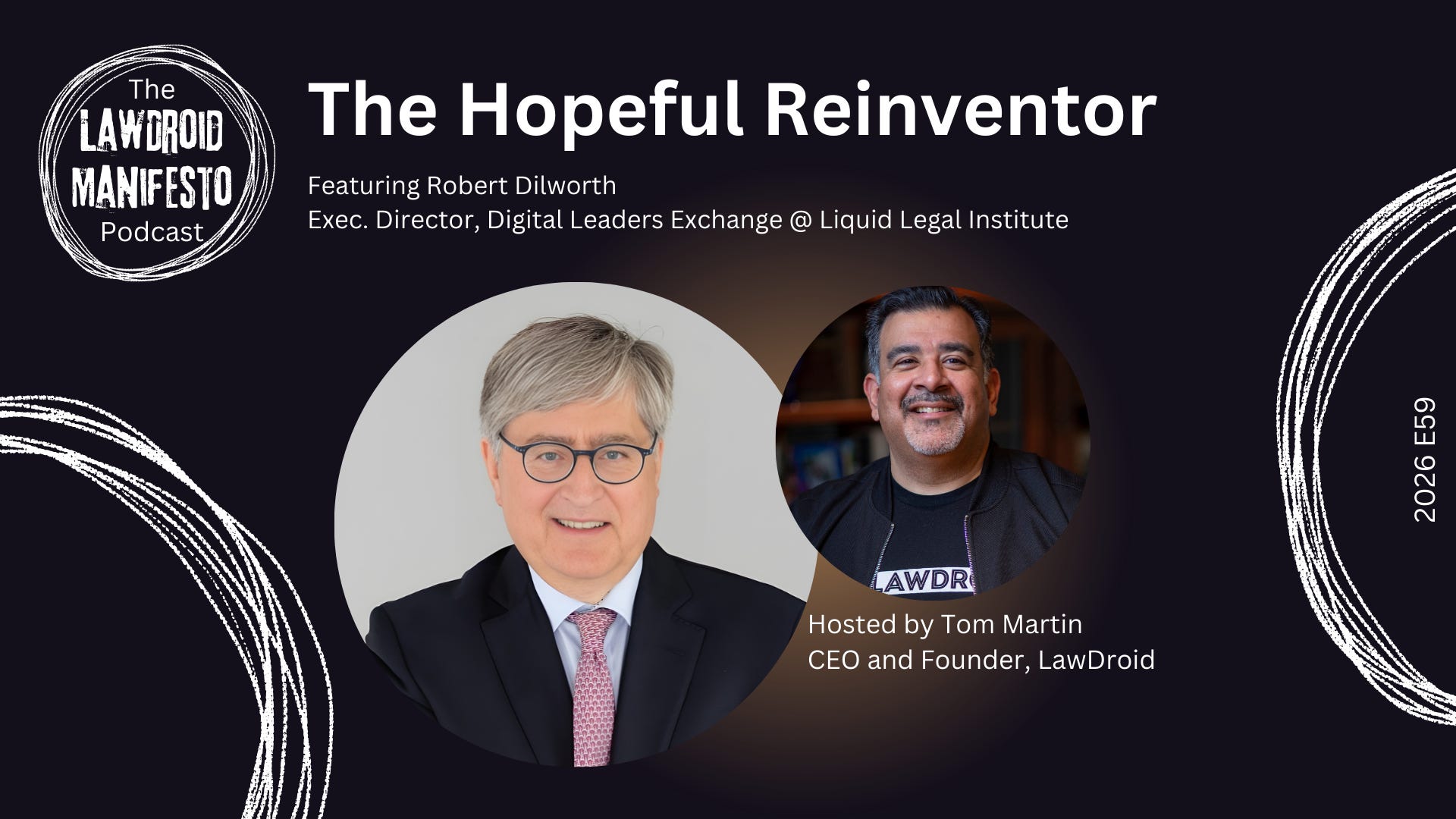
Join me as I interview Robert Dilworth, Executive Director of the Digital Leaders Exchange at the Liquid Legal Institute and Honorary Fellow at Cambridge Judge Business School.
In this insightful podcast episode, Robert shares his remarkable journey from growing up in the Atlanta suburbs to practicing law at Deutsche Bank and Bank of America for nearly three decades, and ultimately reinventing himself in retirement as a global advocate for legal innovation. After relocating to Hamburg, Germany, Robert found himself drawn into the world of legal tech and transformation during the pandemic, and never looked back.
His stories and insights underscore the power of staying curious, embracing optionality, and remaining in motion even when conventional wisdom might suggest otherwise. This episode is a must-watch for anyone who wonders whether their best contributions to the legal profession still lie ahead of them, offering a compelling and practical roadmap for meaningful reinvention at any stage of a legal career.
The Skinny
Robert Dilworth spent 35 years as a corporate lawyer, including 27 years at Bank of America as Managing Director and Associate General Counsel. Rather than retire quietly, he made a deliberate pivot, relocating to Hamburg, Germany, and stepping into a new chapter as Executive Director of the Digital Leaders Exchange at the Liquid Legal Institute, and as an Honorary Fellow at the Cambridge Judge Business School working at the intersection of AI and financial services regulation. Throughout this conversation, Robert reflects on what it means to reinvent yourself with intention, the role that optionality plays in shaping a rich legal career, and why the legal innovation community—filled with hopeful, selfless, and idealistic people—has given him more energy than he ever expected.
His story is a reminder that the best careers don’t end; they evolve.
Key Takeaways
Robert’s pivot from corporate law to legal innovation leadership was driven not just by a push to leave, but by a genuine pull toward something meaningful and new.
The Liquid Legal Institute is an independent, neutral, non-profit global think tank with roughly 1,500 members in more than 20 countries, focused on designing a more human-centered and tech-enabled future for law.
Robert argues that the legal profession is moving from the “weather and the why” of transformation to the “hard yards and the how”—meaning leaders must now focus on practical implementation rather than making the case for change.
Corporations represent more than 50% of global legal spending, which means corporate clients are increasingly the force driving law firms and in-house teams toward innovation.
Robert’s mother instilled in him a foundational belief that there was very little he couldn’t accomplish if he put his mind to it—a mindset that enabled him to take risks, embrace optionality, and stay open to unexpected opportunities throughout his career.
His advice to young lawyers: don’t pre-emptively exclude yourself from opportunities; reach for the opportunity and let life deliver the no.
The pandemic served as a catalyst for Robert’s transformation, a period of enforced stillness that prompted him to ask what role he could play in improving the legal system and strengthening access to justice.
Robert describes himself as “a living experiment in radical adaptation,” and encourages peers to see that it is not too late to reinvent themselves if they are so inclined.
His work mentoring students has been as enriching for him as for those he mentors—perhaps more so.
The key to sustainability in this new chapter is being selective and intentional about what you say yes to, doing fewer things better rather than spreading yourself thin.
Notable Quotes
“Life must be lived forwards, but can only be understood backwards.” - Robert Dilworth, citing Kierkegaard (00:13:53-00:14:01)
“Water goes where it’s needed and in different forms. And the legal system is not as agile—it was more rigid than society really needs.” - Robert Dilworth (00:03:19-00:03:34)
“I knew I couldn’t go from going 200 miles an hour for decades to going zero miles an hour. But I needed to be in motion.” - Robert Dilworth (00:33:21-00:33:31)
“I felt like I’m a living experiment and kind of radical adaptation at my career point in age to kind of pick up everything.” - Robert Dilworth (00:36:37-00:36:47)
“I hope other people can see—and people who are my contemporaries can see—that it’s not too late to reinvent yourself if you’re so inclined.” - Robert Dilworth (00:27:01-00:27:05)
“Be open to recognizing an opportunity and a break when you see it.” - Robert Dilworth (00:17:36-00:17:44)
“I just crafted it so that by the time I left, I felt it’s not just that I’m leaving something—but I also have something that’s pulling me.” - Robert Dilworth (00:31:14-00:31:23)
“They inspire me and they give me a lot of energy—hopeful and optimistic, and many of them pretty selfless with some idealism to them, regardless of the decades they may have been working.” - Robert Dilworth (00:40:02-00:40:13)
Clips
Who Really Buys Legal Work
Bar Associations vs. Legal Innovation
Why All The Effort Is Worth It
What The Liquid Legal Institute Does
Robert Dilworth’s story is one of the most quietly profound I’ve encountered in the legal innovation space. He didn’t arrive here by accident or ambition alone. He arrived by staying curious, by allowing himself to be pulled toward something he believed in, and by having the courage to reinvent himself when most people might have simply coasted. His trajectory—from Atlanta suburbs to Columbia and the Sorbonne, through Deutsche Bank and Bank of America, and now to Hamburg, the Liquid Legal Institute, and Cambridge—is a testament to what happens when you stay in motion with intention.
What stands out most is Robert’s insistence that this chapter of his life isn’t a postscript to his career; it is a full and meaningful continuation of it. He is mentoring young lawyers, shaping the direction of global legal innovation conversations, and contributing to interdisciplinary research at Cambridge—not despite having “retired,” but because he approached retirement as a beginning rather than an end.
Closing Thoughts
Robert’s story landed with me on a personal level. As someone who has spent years championing legal innovation, I know how rare it is to find someone who combines deep institutional experience with genuine humility and openness to the new. Robert has both.
What I find most compelling about his journey is the intentionality behind it. He didn’t stumble into this chapter—he built toward it. During the pandemic, he asked himself some hard questions about his role, his purpose, and whether he had more to give. The answer, clearly, was yes. And so he leaned in: promoted innovation culture inside Bank of America before he left, built relationships in the legal tech community, and arrived at retirement with something pulling him forward rather than just pushing him out the door.
For our Legal Rebels community, Robert’s story is a reminder that reinvention isn’t just for the young. The legal profession gives so much to those who commit to it—and those of us who have benefited from that commitment have an opportunity, and perhaps an obligation, to give something back. Whether that’s mentoring a student, championing a new tool in your department, or making a bold career pivot at 60, the door is open.
Stay hopeful. Stay in motion. And never assume the most exciting chapter of your career is already behind you.


