


Hey there Legal Rebels! 👋 I’m excited to share with you the 60th episode of the LawDroid Manifesto podcast, where I will be continuing to interview key legal innovators to learn how they do what they do. I think you’re going to enjoy this one!
If you want to understand how technology is transforming the pro bono ecosystem and closing the justice gap for tens of thousands of people who desperately need legal help, you need to listen to this episode. Kristen is at the forefront of legaltech innovation for access to justice and brings a unique combination of mission-driven passion and hard-nosed startup experience to this critical challenge.
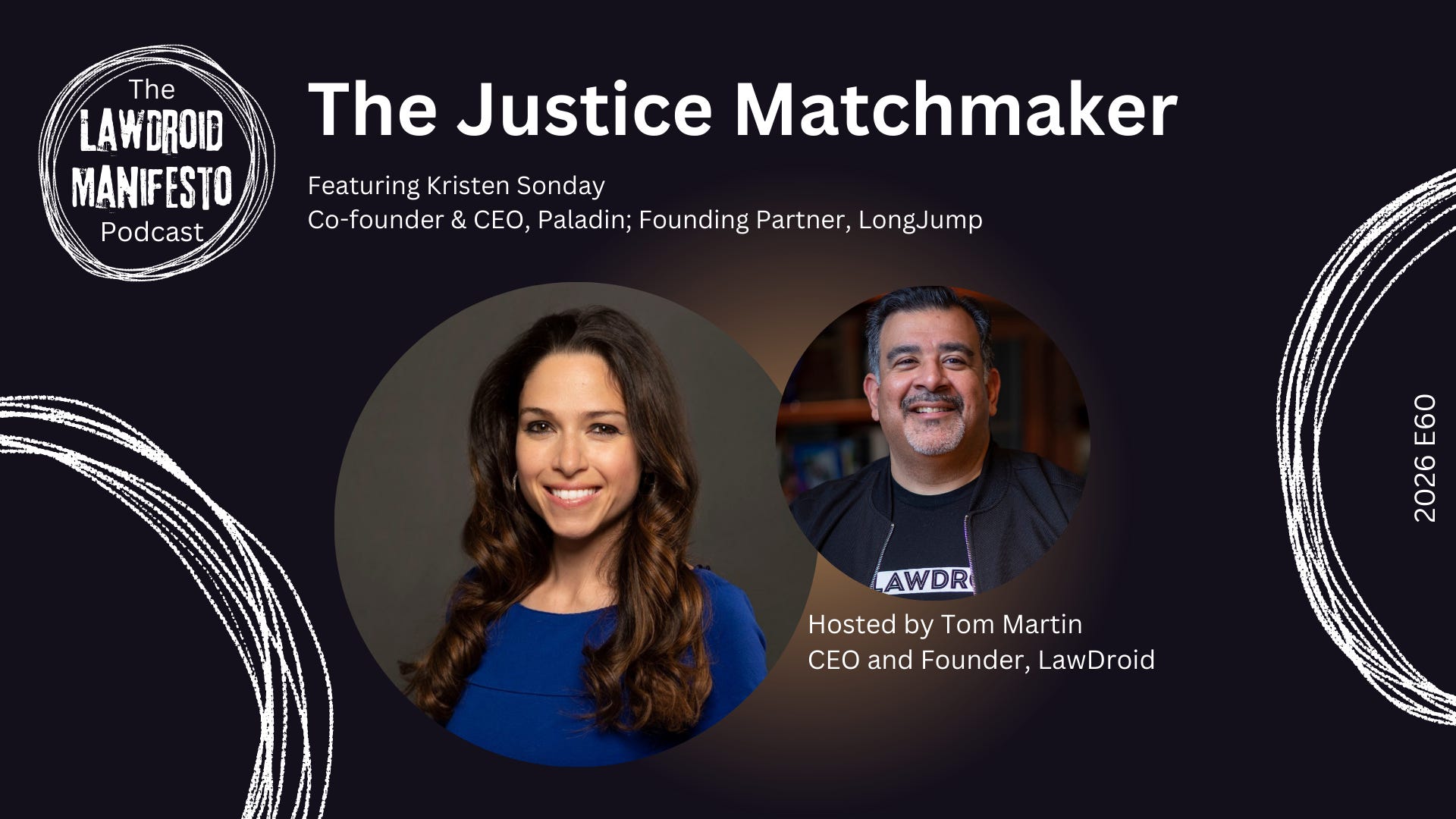
Building the Infrastructure That Pro Bono Always Needed
Join me as I interview Kristen Sonday, co-founder and CEO of Paladin, the leading pro bono management platform.
In this episode, Kristen shares her remarkable journey from first-generation college student in New Jersey to Princeton, the U.S. Department of Justice, and ultimately to building Paladin, a platform that has now facilitated over 55,000 pro bono connections across the country. She dives deep into how Paladin is transforming the pro bono ecosystem by replacing manual emails and spreadsheets with real-time, data-driven infrastructure that connects legal aid organizations with law firms, in-house teams, and law school students nationwide.
Her stories and insights underscore the urgency of the access to justice crisis, where 92% of low-income individuals’ civil legal needs go unmet, and how Kristen believes AI may be the single most powerful development of our generation to help close that gap. This episode is a must-watch for anyone who cares about using technology to democratize legal services and build a more just society.
The Skinny
Kristen Sonday, co-founder and CEO of Paladin, shares her journey from a working-class New Jersey upbringing through Princeton, the U.S. Department of Justice, and a New York tech startup, to co-founding the legal profession’s leading pro bono management platform. Kristen explains how Paladin replaces the fragmented, manual ecosystem of emails and spreadsheets with a real-time database of pro bono opportunities that connects nonprofits and legal aid organizations with big law firms, corporate legal teams, bar associations, and now law schools. With 55,000 pro bono connections made to date, Paladin is demonstrating measurable impact at scale. Kristen also explores how the professionalization of pro bono (through billable credit, CLE integration, and data-driven reporting) is shifting firm culture and engagement. And she makes a compelling case for AI as a transformative force in intake, triage, and case matching, with the potential to finally address the staggering reality that 92% of low-income civil legal needs go unmet.
Key Takeaways:
Paladin was born from the intersection of Kristen’s DOJ experience witnessing justice system barriers and her startup experience building matchmaking technology at Grouper; Paladin is, at its core, a matchmaker for pro bono
Prior to Paladin, the entire pro bono ecosystem ran on manual emails and spreadsheets with no real infrastructure; Paladin built the first real-time national database of pro bono opportunities
Paladin has facilitated over 55,000 pro bono connections to date, serving low-income immigrants, veterans, elderly individuals, children with special needs, tenants, and benefits seekers
The professionalization of pro bono is accelerating, firms are now offering billable credit, incorporating pro bono into performance reviews and CLE requirements, and using data to measure ROI
Paladin boosts attorney engagement in pro bono programs by over 30% in the first year and gives administrators actionable insights they never had before
Paladin launched for law schools this past fall, partnering with over 30 schools and 22,000 students who took on 5,600+ pro bono opportunities in just the first semester
Approximately 92% of low-income individuals’ civil legal needs are unmet, and legal aid organizations must turn away about 50% of people who qualify due to lack of capacity
Kristen believes AI could be the most powerful development of our generation for closing the justice gap, particularly in intake, triage, issue-spotting, and eligibility vetting
Kristen’s nonlinear career path, from DOJ to startup to Paladin, was essential; she argues that diverse early experiences compound into greater impact over time
The key to managing multiple roles and organizations is identifying which balls are glass and which are plastic, and delegating ruthlessly in areas of weakness
Notable Quotes:
“I think AI could be the single most powerful development in our generation to help close the justice gap.” - Kristen Sonday (00:38:18-00:38:25)
“Prior to Paladin, the entire ecosystem was run on emails and spreadsheets that were incredibly manual and ad hoc. And there just hadn’t really been tech investment in this area.” - Kristen Sonday (00:06:27-00:06:38)
“You are 11X more likely to win an immigration case if you have a lawyer with you than not. The statistics are just crazy about how meaningful it is to have representation.” - Kristen Sonday (00:22:45-00:22:57)
“Paladin has helped make over 55,000 pro bono connections. And these are low-income immigrants, veterans, elderly folks, kids with special needs.” - Kristen Sonday (00:43:38-00:43:50)
“The path is never linear. I think of every career experience, especially that you have as someone on the junior side, is really a stepping stone to figuring out where you’re meant to be, what you’re meant to do.” - Kristen Sonday (00:20:54-00:21:07)
“You’re juggling a million balls and you have to figure out which ones are glass and which are plastic because some are bound to drop.” - Kristen Sonday (00:42:40-00:42:50)
“Paladin wouldn’t be as successful as it is if I hadn’t had that nonlinear path of access to justice and technology, because now Paladin is this great intersection of both of them.” - Kristen Sonday (00:29:07-00:29:17)
“These legal aid organizations have to turn away about 50% of people, even who qualify for pro bono, because of a lack of capacity. AI, I believe, can help with both the lack of capacity and the lack of infrastructure.” - Kristen Sonday (00:38:41-00:38:53)
Clips
There Is No Work-Life Balance
Excellence Is How You Change the World
Representation Changes Outcomes
How Paladin Boosts Pro Bono Engagement
Closing Thoughts
What I love most about Kristen’s story is that it is proof of something I deeply believe: the people who change the legal profession aren’t always lawyers. Kristen came at pro bono as an operator, a technologist, and a mission-driven builder, and she saw the gap that those of us inside the profession often take for granted. The fact that the entire pro bono ecosystem was running on emails and spreadsheets before Paladin is both astonishing and all too familiar.
What moves me is the scale of what she’s built. 55,000 pro bono connections. Over 22,000 law students engaging with real cases in their first semester on the platform. Those are not abstract numbers, those are people who got a lawyer when they needed one most. Veterans. Immigrants. Tenants facing eviction. Families navigating systems designed to confuse them.
And then there’s the AI conversation. Kristen put it plainly: 92% of low-income civil legal needs go unmet. That is a crisis hiding in plain sight. For the first time, I genuinely believe technology gives us the tools to do something about it, not just incrementally, but at scale. Intake automation, triage, issue-spotting, case matching, these are not futuristic ideas. They are being deployed right now by organizations like Paladin and LawDroid.
For our Legal Rebels community, Kristen’s episode is both a call to action and a reminder of why we do this work. If your firm doesn’t yet have Paladin, go to joinpaladin.com and change that today. And if you’re a law student, a legal aid attorney, or a corporate counsel wondering how to make your pro bono hours count, Kristen has built the on-ramp. All you have to do is show up.


