


Hey there Legal Rebels! 👋 I’m excited to share with you the 58th episode of the LawDroid Manifesto podcast, where I will be continuing to interview key legal innovators to learn how they do what they do. I think you’re going to enjoy this one!
If you want to understand how legal education can transform the next generation of lawyers through technology and an eternal mindset that values long-term impact over immediate results, you need to listen to this episode. Kenton is at the forefront of academic legal technology education and brings a uniquely mission-driven perspective to preparing future lawyers for modern practice.
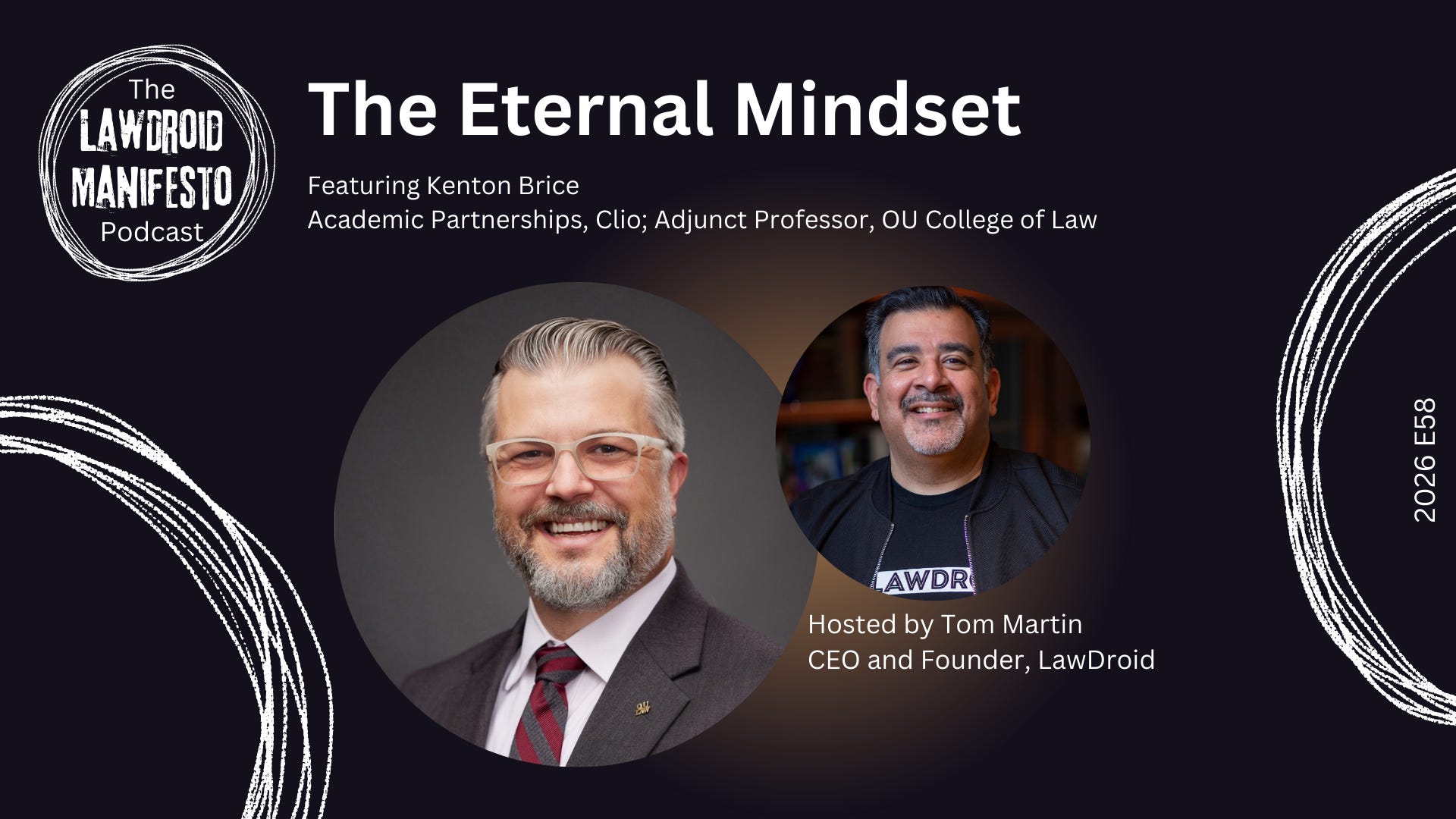
Transforming Legal Education Through Technology and Eternal Impact
Join me as I interview Kenton Brice, Senior Manager of Academic Partnerships at Clio and Adjunct Professor at the University of Oklahoma College of Law.
In this insightful podcast episode, Kenton shares his journey from a small town in western Pennsylvania through teaching high school, pursuing a doctorate in theology, and ultimately finding his calling in legal education. He dives deep into his decade-long experience teaching legal technology at the University of Oklahoma College of Law and his transition to his new role at Clio. Kenton demonstrates how his faith-driven eternal mindset shapes his approach to education, understanding that the seeds planted today may not bear visible fruit for years to come.
His stories and insights underscore his commitment to changing lives through legal technology education, including powerful examples of students who discovered the value of his teaching years after graduation. This episode is a must-watch for anyone interested in the intersection of legal education and technology, offering valuable perspectives on how to measure success in work that creates lasting impact beyond what we can immediately see.
The Skinny
Kenton Brice, Senior Manager of Academic Partnerships at Clio and Adjunct Professor at the University of Oklahoma College of Law, shares his remarkable journey from considering seminary and teaching high school to becoming a pioneering voice in legal technology education. After spending ten and a half years as the Director of the Law Library at the University of Oklahoma College of Law, Kenton recently transitioned to Clio while maintaining his teaching commitment to students. Throughout the conversation, Kenton emphasizes his “eternal mindset,” the understanding that meaningful work often takes years to show results, as evidenced by alumni who reach out eight years after graduation to say they finally understand what he was teaching them. His approach to legal education centers on equipping students not just with technical skills, but with the vision to serve their communities well, whether they’re starting solo practices in small towns or pursuing cross-border transactions at major firms. Kenton’s faith and his experience in theology deeply inform his perspective that success isn’t always measurable in the short term, but that doesn’t make the work any less vital.
Key Takeaways:
Kenton’s journey from theology doctoral studies to legal librarianship and technology education demonstrates how diverse backgrounds can enrich legal education
His decade-long commitment to teaching legal technology at the University of Oklahoma College of Law has impacted hundreds of students, though the results often take years to become visible
The “eternal mindset” concept recognizes that meaningful work may not show immediate fruit, but that doesn’t diminish its importance or impact
Kenton recently transitioned from Director of the Law Library at the University of Oklahoma to Senior Manager of Academic Partnerships at Clio, while continuing to teach as an adjunct professor
His students are increasingly interested in starting their own firms to serve local communities differently, using technology to provide better legal experiences
Success in legal technology education is measured over years, not months, with alumni often reaching out years later to express how the education transformed their practice
Kenton’s approach emphasizes relationship and network effects as ways to change people’s lives for the better, even when the impact isn’t immediately visible
His work focuses on helping both lawyers and clients flourish, envisioning a future where clients feel loved and served well by healthy, balanced lawyers
The integration of faith and professional calling drives Kenton’s commitment to work that has eternal significance beyond career advancement
Notable Quotes:
“I come at the technology from a practical perspective first. When I discovered AI, when ChatGPT first came out, December of 2022, I was in-house counsel at that time. And I was really focused on how can I implement this technology into my practice and then more broadly into the practice of my legal department.” - Kenton Brice (03:04-03:23)
“I had three of them. They’re like, I want to start my own firm because I want to do it differently. And I’m like, awesome. And they’re not talking about going to big market stuff. They want to go back to their local communities, start their firms to serve the local community well, and provide the best possible legal services and experience for their entire community.” - Kenton Brice (05:45-06:04)
“I hope my work is meaningful, that we actually change lives, right? Like, and this goes back to, I mean, what an interesting theme, you know, the eternal mindset, right? Like, there are things we will do today that we may never see the fruit of. That doesn’t mean we don’t do them.” - Kenton Brice (50:43-51:02)
“What I told my students this morning, I get emails from alum. And one graduated from 2018. We’re talking eight years ago. It was like, oh, I get it now. You know? And I’m like... Oh, man. So there may be a hundred of those stories I never hear.” - Kenton Brice (51:38-51:54)
“And I just hope that I’m having an impact to change people’s lives for the better. That there’s something that we can do either tangibly or intangibly through relationship or network effects to change people’s lives for the better. And that’s why we do the work we do.” - Kenton Brice (51:54-52:11)
“I know my work is having an impact even if I don’t see it. And that’s the hope that exists, right? So that’s kind of what drives me. But yeah, I hope to have an impact with my career to see people flourish. I want to see lawyers do better. I want to see our clients do better.” - Kenton Brice (53:05-53:22)
“I hope for the day where even though clients are going through the worst season of their life or sometimes the most exciting season of their life that they would think, man, I felt loved and served well by my lawyer because they’re also healthy.” - Kenton Brice (53:26-53:41)
Clips
A Tragedy That Changed Everything
I'll Choose Family Over Career
Leaving the Law Library
I Don't Even Agree With The Law
Kenton’s journey reflects a deep integration of faith, education, and technology that sets him apart in the legal innovation space. His willingness to pursue a doctorate in theology, teach high school, and explore various paths before finding his calling in legal education demonstrates the value of a winding career path. What emerges is someone who brings theological depth to questions about the purpose and meaning of work in legal education.
What stands out most is Kenton’s patience and long-term thinking in an industry often focused on immediate results. His “eternal mindset” provides a framework for educators and innovators who plant seeds today without knowing when or how they’ll bear fruit. The story of the 2018 graduate reaching out eight years later perfectly encapsulates this perspective, meaningful change often takes time to manifest.
Closing Thoughts
As someone who also teaches legal technology, I deeply resonate with Kenton’s perspective on the long arc of educational impact. His story reminds me why this work matters even when we can’t immediately measure the results. The students sitting in our classrooms today will be practicing law for the next forty years, and the seeds we plant about technology, client service, and professional purpose will shape their entire careers.
What strikes me most about Kenton’s approach is how his faith informs his professional calling without diminishing the practical, tangible work he does. He’s not just theorizing about legal technology, he’s been in the trenches for over a decade, teaching students, managing a law library, and now scaling that impact through Clio’s academic partnerships. His transition to Clio while maintaining his teaching role shows his commitment to working at multiple levels: individual students in the classroom and systemic change through broader partnerships.
For our Legal Rebels community, Kenton’s story offers a refreshing counter-narrative to the constant pressure for immediate results and measurable outcomes. Some of the most important work we do (mentoring, teaching, relationship building, vision casting) may not show results for years. That doesn’t make it less valuable. In fact, work with eternal significance often requires this kind of patient, long-term investment.
As legal technology continues to evolve rapidly, we need more people like Kenton who bring both practical expertise and a philosophical framework for understanding why this work matters. His vision of clients feeling loved and served well by healthy lawyers captures what technology should ultimately enable, not just efficiency, but humanity and flourishing for everyone involved in the legal system.


