


Hey there Legal Rebels! 👋 I’m excited to share with you the 51st episode of the 2025 season of the LawDroid Manifesto podcast, where I will be continuing to interview key legal innovators to learn how they do what they do. I think you’re going to enjoy this one!
I have had the pleasure of working with Scheree Gilchrist for a few years now and her ingenuity and resourcefulness have always been impressive. I welcomed the chance to learn more about her in this interview and what makes her tick. Because of her mission-driven dedication to helping people access justice, I have dubbed her, “The Fearless Catalyst.”
If you want to understand how to transform legal aid delivery through fearless innovation and truly center services around the people who need them most, you need to listen to this episode. Scheree is at the forefront of legal aid innovation and brings a uniquely purposeful and compassionate perspective to leveraging technology for access to justice.
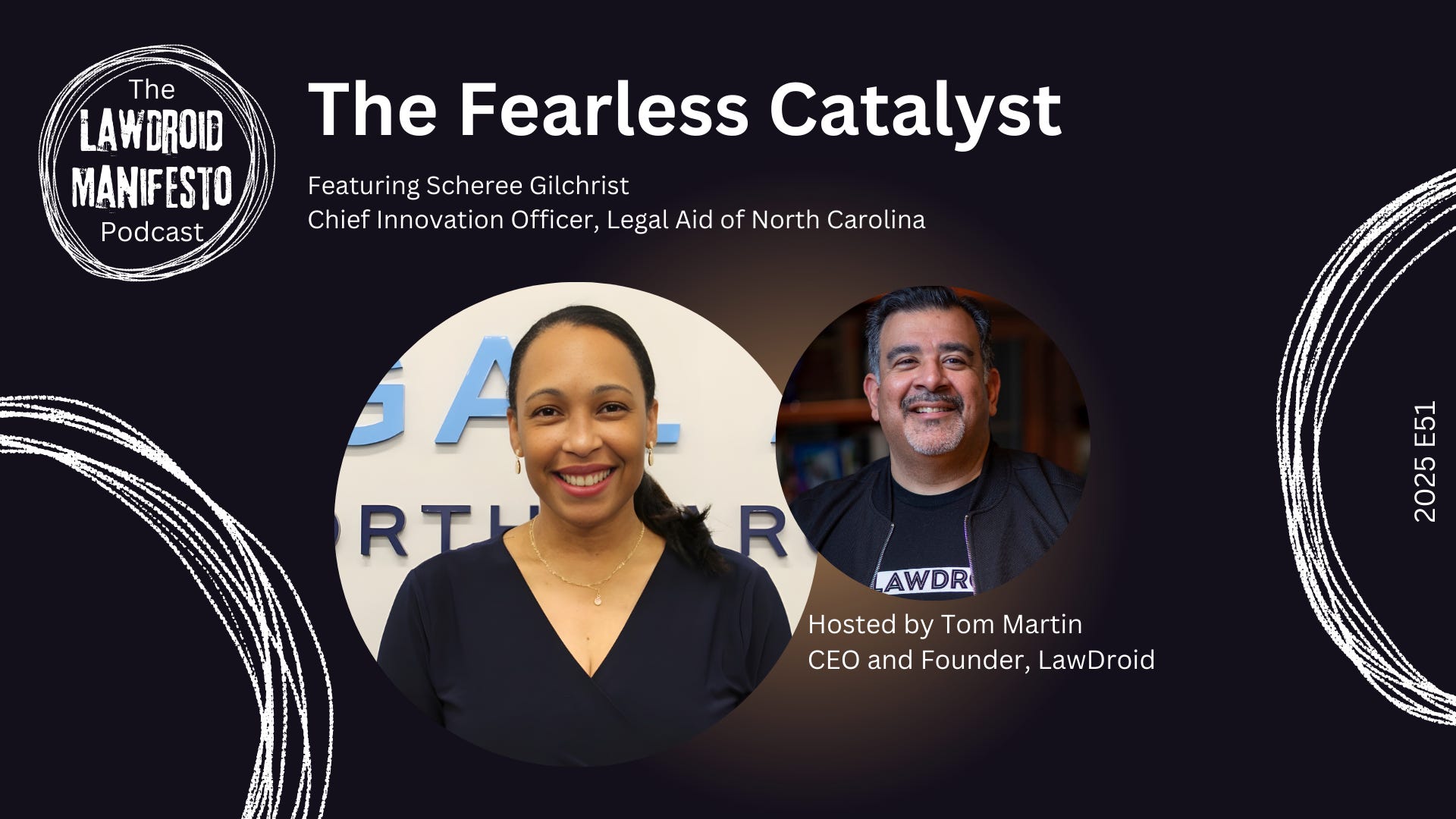
Scaling Justice Through Fearless Client-Centered Innovation
Join me as I interview Scheree Gilchrist, Chief Innovation Officer at Legal Aid of North Carolina.
In this insightful podcast episode, Scheree shares her journey from growing up between Jamaica and the United States to becoming a pioneering force in legal aid innovation. She dives deep into how she’s transforming the way vulnerable North Carolinians access critical legal services through technology, including the Justice Hub portal that integrates AI chatbots, client messaging, document management, and resource referrals into a seamless experience. Scheree demonstrates how her team is meeting clients where they are—whether that’s at 2 a.m. on a Wednesday or any other time they need help.
Her stories and insights underscore her fearless approach to innovation, rooted in her experiences as a junior lawyer in rural North Carolina where she witnessed firsthand the circuitous nature of legal aid work. This episode is a must-watch for anyone curious about how technology can break down barriers to justice and create meaningful impact for underserved communities.
The Skinny
Scheree Gilchrist, Chief Innovation Officer at Legal Aid of North Carolina, shares her journey from splitting her childhood between Jamaica and the United States to becoming a transformative force in legal services innovation. With a deeply client-centered philosophy developed during her time as a junior attorney in rural North Carolina, Scheree demonstrates how she’s leading the development of Justice Hub—a comprehensive portal that integrates intake, AI assistance through Leah, client communications, document management, and resource referrals. Throughout the conversation, Scheree emphasizes that her work is driven by a singular mission: solving problems for people who would otherwise have no access to legal information or the courts, breaking the endless cycle of poverty that traps vulnerable communities. Her Jamaican resilience and optimism, combined with her strategic use of technology and unwavering focus on client needs, exemplifies what fearless innovation looks like in the legal services space.
Key Takeaways:
Scheree’s client-centered philosophy stems from her early experiences as a junior lawyer witnessing clients caught in a circuitous cycle of returning for help because their interconnected legal, social, and other needs weren’t fully addressed
Justice Hub represents a comprehensive approach to client services—a “MyChart for legal” that allows clients to apply for services, message attorneys, upload documents, chat with the AI assistant Leah, and access resources all in one portal
The portal meets clients where they are, enabling them to access services at 2 a.m. or whenever they need help, eliminating barriers like taking time off work to visit physical offices
Cherie grew up splitting time between Jamaica, New York, and Florida, attending school and law school in Jamaica, which shaped her culturally Jamaican identity and resilient, optimistic approach to challenges
Her path to innovation began as a practicing attorney questioning “how can we make this better?” rather than accepting the status quo of legal service delivery
The work-life balance myth: Cherie candidly shares that true balance doesn’t exist—instead, it’s about prioritizing what matters each day, having strong support systems, and being honest about the full investment required to achieve meaningful goals
Her motivation remains focused on the end goal: helping people who would otherwise have absolutely no access to legal services or courts, moving them out of the endless cycle of poverty
Jamaicans are warm, friendly, and optimistic by nature—cultural traits that inform Cherie’s approach to her work and her resilient response to challenges
Notable Quotes:
“We’re in the middle of trying to launch our new intake portal and get that off the ground and also deal with the holidays. You know, I said it’s kind of like you got to hurry up before you could take some time off. Like you got to accelerate before you decelerate.” - Scheree Gilchrist (00:01:17-00:01:29)
“I like to think of it as my chart for legal. It’s not quite there yet. But if you think of what that could be, where somebody who is applying for services at a legal aid program has just anything they need done, they can get it done in their portal, right?” - Scheree Gilchrist (00:02:02-00:02:17)
“We’re meeting people where they are. If it’s the middle of the night and they need to get something to us, they can do that. If they need to shoot off a message, that message will be there in the morning.” - Scheree Gilchrist (00:03:11-00:03:20)
“One of the things that struck me was just the circuitous nature of our work as a legal services attorney, because we were dealing just with the legal problems, but our clients come to us as sort of the intersection of legal, social, and other needs.” - Scheree Gilchrist (00:04:05-00:04:24)
“I have always questioned, how can we make this better? How can we help our clients? How can we meet them where they are? How can we solve as many problems for them as we can, knowing that we’re attorneys and we’re not gonna be able to address everything, but how can we solve them or at least direct them in the right path?” - Scheree Gilchrist (00:04:33-00:04:53)
“I actually grew up in Jamaica. I split my time between Jamaica, New York and Florida. So my mom has always lived here in the U.S. and my dad lived in Jamaica. And so I’ve always split my time between the U.S. and Jamaica. But I went to school in Jamaica, went to law school in Jamaica. I feel more Jamaican.” - Scheree Gilchrist (00:05:47-00:06:07)
“Jamaicans are resilient people, right? We’re warm and friendly and optimistic by nature. I think that’s just culturally who we are.” - Scheree Gilchrist (00:06:26-00:06:35)
“This is my opinion. There is no work-life balance. There is prioritizing. And what takes priority, that changes day to day.” - Scheree Gilchrist (00:42:03-00:42:13)
“I think it’s a disservice for anybody who is driven and successful, and that drive allowed them to be successful to then say, Oh, you should have work-life balance. Because I guarantee you, if you look at their path to success, there was no balance on that path to success.” - Scheree Gilchrist (00:43:37-00:43:52)
“You cannot realize a goal without a full investment and commitment to get into that goal. But I think along the way, you have to figure out how do you juggle? How do you manage your priorities? What sort of support system you need to have around you?” - Scheree Gilchrist (00:44:26-00:44:43)
“I think at the end of the day, it’s still the people that we serve. I get a lot of satisfaction from solving problems for people who I know were their last hope in some situations, right?” - Scheree Gilchrist (00:45:42-00:45:58)
“I look at our clients and the people that we work with, but for legal aid attorneys and others who are willing to give up their time, pro bono volunteers and others who are willing to give up their time and efforts, you’re talking about people who would have absolutely no access to basic legal information, no access to the courts, and just they would be stuck in an endless cycle of poverty.” - Scheree Gilchrist (00:45:58-00:46:27)
Clips
Balance Is Misleading For The Driven
There Is No Balance—Prioritize
Why Rental Assistance Matters
Curiosity Beats Conformity
Scheree’s journey reflects the power of questioning the status quo and refusing to accept that “this is how we’ve always done it.” From her earliest days as a junior lawyer in rural North Carolina, she saw the limitations of a system that only addressed one piece of her clients’ complex, interconnected problems. Rather than accept this reality, she made it her mission to transform how legal aid serves vulnerable communities.
What stands out most is Scheree’s unwavering focus on the people she serves. Every technological innovation, every process improvement, every strategic decision is filtered through one lens: does this help people who would otherwise have no access to justice? This clarity of purpose, combined with her Jamaican resilience and optimism, makes her a truly fearless catalyst for change in the legal services space.
Closing Thoughts
As someone who’s worked with Scheree and Legal Aid of North Carolina, I can tell you that her fearless approach to innovation isn’t just talk—it’s deeply embedded in everything she does. What makes her particularly effective is that her innovations aren’t driven by technology for technology’s sake. They’re driven by a fundamental commitment to the people who need help most.
The Justice Hub portal she’s launching represents something profound in legal services: a recognition that clients are consumers too, and they deserve the same level of convenience and accessibility that they experience in other parts of their lives. Why should someone have to take time off work and physically visit an office when they could access help at 2 a.m. from their phone?
What strikes me most about Scheree’s perspective on work-life balance is her honesty. Too often, successful people present a sanitized version of their journey, suggesting that you can achieve extraordinary things without extraordinary commitment. Scheree tells it like it is: achieving meaningful goals requires full investment, strategic prioritization, and strong support systems. It’s not balance—it’s the juggle.
For our Legal Rebels community, Scheree’s story offers both inspiration and a practical blueprint. Real innovation in legal services doesn’t come from grand theories or expensive consultants. It comes from lawyers who care enough about their clients to ask “how can we make this better?” and then have the courage to actually change things.
As we close out 2024 and head into 2025, Scheree’s work reminds us what this is all about: breaking down barriers, expanding access, and ensuring that vulnerable people aren’t stuck in endless cycles of poverty because they can’t access basic legal help. That’s the kind of fearless, purposeful innovation our profession desperately needs.


