


Hey there Legal Rebels! 👋 I’m excited to share with you the 1st episode of the 2026 season of the LawDroid Manifesto podcast, where I will be continuing to interview key legal innovators to learn how they do what they do. I think you’re going to enjoy this one!
If you want to understand how to build a sustainable legal practice while expanding access to justice through subscription and flat fee models, you need to listen to this episode. Kim is at the forefront of transforming legal service delivery and brings years of experience building client-centered solutions that work.
Revolutionizing Legal Service Delivery Through Subscription Models
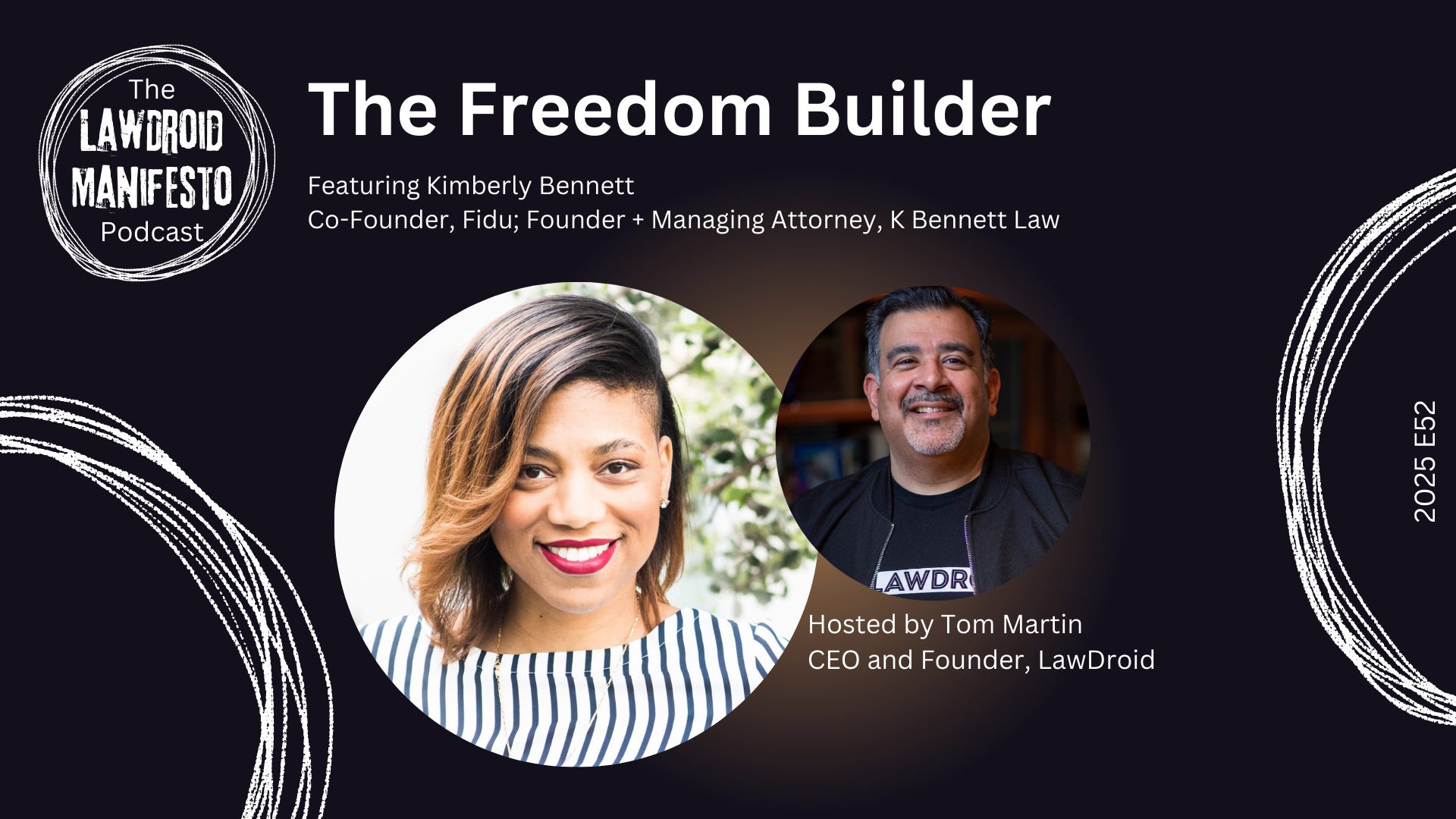
Join me as I interview Kim Bennett, co-founder of Fidu and managing attorney of Kay Bennett Law.
In this insightful podcast episode, Kim shares her journey from traditional legal practice to becoming a pioneer in subscription and flat fee legal services. She dives deep into how her platform Fidu serves as the operating layer for law firms transitioning away from billable hours to value-based pricing models. Kim demonstrates how this approach not only creates more sustainable practices for lawyers but also dramatically expands access to legal services for underserved communities.
Her stories and insights underscore the critical shift happening in legal service delivery, from firm-centered to client-centered approaches. Kim’s work addresses the fundamental problem that our legal system has been “specifically and intentionally designed” to deny access to those who need it most. This episode is essential viewing for anyone interested in building a more equitable and sustainable legal practice.
The Skinny
Kim Bennett, co-founder of Fidu and managing attorney of Kay Bennett Law, shares her transformative approach to legal practice through subscription and flat fee models. With deep experience in both traditional practice and legal entrepreneurship, Kim has developed Fidu as the comprehensive operating layer that supports law firms transitioning from billable hours to value-based pricing. Throughout the conversation, Kim emphasizes the importance of centering clients in legal service delivery, designing practices that work for lawyers’ authentic selves, and addressing the intentional barriers that prevent access to justice. Her platform handles everything from engagement to disengagement, including onboarding, service delivery, usage tracking, scope management, billing, and client experience optimization. Kim’s passion stems from her grandmother’s influence and her recognition that the legal industry must evolve to serve both practitioners and communities more effectively.
Key Takeaways:
Fidu serves as the complete operating layer for subscription and flat fee law firms, handling everything from client engagement to service delivery and billing
The traditional legal system has been “specifically and intentionally designed” to deny access to justice for those who need it most
Client-centered legal services require dedicated platforms that think about the client journey from the client’s perspective, not just the firm’s
Lawyers need to design practices that align with their authentic selves, including work schedules and service delivery methods that feel natural
The shift from billable hours to subscription models is accelerating due to AI and technology creating downward pressure on traditional pricing
Building sustainable practices requires leveraging all life experiences and getting support to recognize when you’re doing too much
The freedom that comes from running your own practice allows for better work-life integration and the ability to serve clients who match your values
Success in legal entrepreneurship comes from testing and iterating, not waiting for perfect solutions before starting
Notable Quotes:
“So Fidu is the operating layer for a subscription in a flat fee law firm or legal adjacent business, legal business, right? We support law firms who are selling subscription or flat fee legal services to their clients, and we do everything that supports from engagement to disengagement.” - Kim Bennett (04:07-04:23)
“We take the position that we want to center the client. And so we’re bringing this idea of what client-centered legal services actually looks like.” - Kim Bennett (05:43-05:47)
“Because we have specifically and intentionally designed it [the legal system] for them [ordinary people] not to have access to it.” - Kim Bennett (46:43-46:47)
“I think ultimately the activist side of me still lives for my grandmother, you know, for caring about justice, and I don’t think the industry today actually lives up to what it’s supposed to.” - Kim Bennett (47:28-47:35)
“I think design the life for you. Show up the way that feels good for you. You know, be authentically you because there’s so many other things that you have to maybe put up.” - Kim Bennett (44:35-44:43)
“The only thing that’s keeping people from moving to where they want to be is just testing the thing. It doesn’t have to be perfectly built. You just have to try it.” - Kim Bennett (48:33-48:39)
“It gives me the freedom to take time off when I need. I have a 99-year-old, about to be a 100-year-old grandfather, and having this, my own business, has given me the ability to see him multiple times this year, to travel with him.” - Kim Bennett (45:29-45:42)
“With the changes that are taking place, we’ve talked about the billable hour for years, but right now there’s a lot of downward pressure on that because of AI and technology and where we’re headed.” - Kim Bennett (03:40-03:50)
Clips
Why I Switched to Monthly Subscription
AI is Pressuring the Billable
Stop Funding the Same People
You Had to Prove Yourself More
Kim’s journey reflects a fundamental shift in how we think about legal practice, from maximizing billable hours to maximizing client value and access to justice. Her approach combines the business acumen needed to build sustainable practices with the social justice mission of expanding access to legal services. What makes her perspective particularly compelling is how she’s built systems that benefit both lawyers and clients simultaneously.
The platform she’s created with Fidu addresses a critical gap in legal technology. While most legal tech focuses on helping lawyers be more efficient at traditional tasks, Kim’s work reimagines the entire client experience from engagement through service delivery. This client-centered approach represents the future of legal practice, where technology serves both efficiency and access goals.
Closing Thoughts
As someone who’s been advocating for legal innovation for years, I find Kim’s work particularly significant because it addresses both sides of the legal industry’s challenges. She’s created solutions that help lawyers build more sustainable, fulfilling practices while simultaneously expanding access to justice for communities that have been systematically excluded.
What strikes me most about Kim’s approach is how she’s proven that doing good and doing well aren’t mutually exclusive. Her subscription and flat fee models create predictable revenue for lawyers while making legal services more accessible and transparent for clients. This alignment between business sustainability and social impact represents exactly the kind of innovation our profession needs.
For our Legal Rebels community, Kim’s story demonstrates that transforming legal practice doesn’t require abandoning profitability, it requires reimagining how we create and deliver value. Her emphasis on authenticity and designing practices that work for individual lawyers’ natural rhythms shows that innovation can be both personally fulfilling and professionally successful.
The urgency of this work has only increased with advances in AI and technology putting pressure on traditional billing models. As Kim points out, we’re at a moment where the alternatives to billable hours aren’t just nice to have, they’re becoming necessary for survival. Those who embrace this transition thoughtfully, as Kim has done, will be best positioned to thrive in the evolving legal landscape.


