


Hey there Legal Rebels! 👋 I’m excited to share with you the 50th episode of the 2025 season of the LawDroid Manifesto podcast, where I will be continuing to interview key legal innovators to learn how they do what they do.
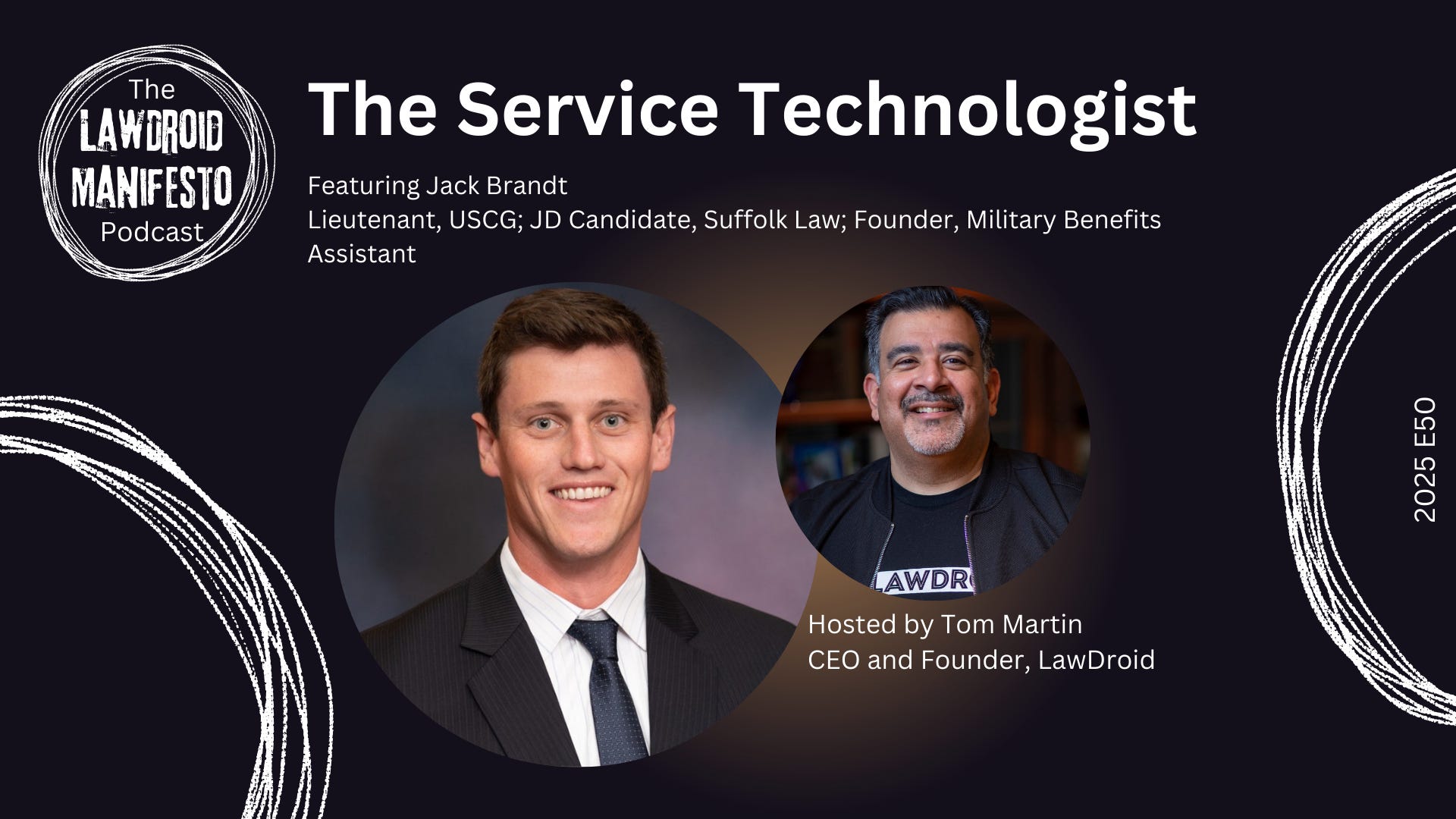
I’m excited for you to listen to this episode with Jack Brandt. Jack is a Lieutenant in the US Coast Guard, an AI tool builder, and a law student ay Suffolk University Law School. I am honoured to have had Jack as a student in my “Generative AI and the Delivery of Legal Services” course. He has a genuine drive to help people and that’s why I’ve given him the moniker, “The Service Technologist.” I think you’re going to enjoy this one!
If you want to understand how dedication to service can drive legal innovation and how rule-based logic often beats the shiniest AI tools, you need to listen to this episode. Jack is building practical solutions that democratize access to military benefits while juggling the demands of Coast Guard service, law school finals, and entrepreneurship.
Building Technology That Serves Those Who Serve
Join me as I interview Jack Brandt, U.S. Coast Guard Lieutenant, Suffolk Law 3L, and founder of Military Benefits Assistant.
In this insightful podcast episode, Jack shares his journey from growing up in South Jersey to attending the Coast Guard Academy, serving on ships and overseas, and now building AI-powered tools to help military members access their education benefits. He dives deep into the evolution of Military Benefits Assistant from a custom ChatGPT chatbot to a sophisticated guided interview tool built on Gavel. Jack demonstrates how understanding the problem deeply, gained through his experience as an education services officer in Bahrain, led him to build the right solution rather than just the flashiest one.
His stories and insights underscore the importance of service-oriented technology development, including helping 19 out of 27 crew members access education benefits during his deployment. This episode is a must-watch for anyone interested in the intersection of legal technology and access to justice, offering valuable perspectives on building tools that genuinely serve users rather than showcasing technical capabilities.
The Skinny
Jack Brandt, U.S. Coast Guard Lieutenant and Suffolk Law 3L, shares his journey from a wooded New Jersey neighborhood where sports and Catholic faith shaped his upbringing to the Coast Guard Academy and now to the forefront of legal technology innovation. Through his role as education services officer in Bahrain, Jack discovered that military members often don’t know about or understand how to access their education benefits—a problem he experienced firsthand when he paid out of pocket for his first semester at Michigan State University. This led him to create Military Benefits Assistant, initially as a custom ChatGPT chatbot, which has evolved into a rule-based guided interview tool built on Gavel that helps service members, veterans, and their families navigate the complex world of GI Bill benefits, tuition assistance, and education entitlements. Jack’s practical approach emphasizes choosing the right tool for the problem rather than the newest technology, demonstrating that sometimes traditional rule-based logic serves users better than generative AI. His commitment to service is woven throughout his work, anchored by clear priorities: faith first, then family, friends, and work integrated throughout.
Key Takeaways:
Jack’s path to legal tech innovation was shaped by his service experience, particularly discovering his own lack of knowledge about education benefits he was entitled to use
Military Benefits Assistant started as a custom GPT but evolved into a Gavel-based guided interview tool after Jack realized rule-based logic better served users than a chatbot for navigating complex eligibility rules
As education services officer in Bahrain, Jack helped 19 out of 27 crew members access education benefits—from plumbing certifications to master’s degrees—by presenting information comprehensively for the first time
The tool addresses a real access to justice problem: service members often don’t know what benefits they’re eligible for or how to access them despite abundant but scattered information online
Jack’s involvement with Suffolk Law’s Legal Innovation & Technology Clinic and studying Python gave him the technical foundation to build practical solutions despite not being a “tech guy”
He’s taking an atypical path by participating in the New York Pro Bono Scholars Program, taking the bar in February and spending his final semester working at Veterans Legal Services in Boston
On his first day volunteering at Veterans Legal Services, Jack was asked to review their new AI policy—demonstrating how new lawyers with tech skills can contribute at levels previously reserved for senior attorneys
Jack emphasizes that legal tech innovation doesn’t require being a technologist—it requires understanding the problem deeply, being curious, and choosing appropriate solutions
His approach to work-life balance centers on priorities: keeping faith, family, and friends foremost while weaving work throughout in service of those core values
The project demonstrates how technology can democratize access to benefits that service members have earned but may not know how to claim
Notable Quotes:
“Military Benefits Assistant is an AI-powered tool that enables military members, veterans, and the entire military community, including families, to figure out what benefits they have access to.” - Jack Brandt (24:34-24:41)
“What I found was that a chat bot wasn’t the right tool for this. And I think that’s what’s so exciting about artificial intelligence and legal tech is it’s not always the new shiny thing that’s the right tool for the particular solution that we’re trying to solve for.” - Jack Brandt (26:06-26:21)
“What this needed was rule-based logic, guided interview. Who are you? Are you active duty or no? Are you a dependent? Are you a service member? Are you retired? What’s your discharge status? Are you honorable, dishonorable?” - Jack Brandt (26:23-26:37)
“I paid for my first semester at Michigan State out of pocket because I didn’t know that I could take advantage of this benefit.” - Jack Brandt (27:17-27:23)
“By the end of our tour, 19 people had either fully started school, had a concrete plan to start school, or had gotten one of their spouses enrolled in a program, which was so, so valuable. I mean, you’re talking about a plumbing certification to pursuing a master’s degree.” - Jack Brandt (27:54-28:08)
“The feedback I received from them was no one had presented the information all together like that, and they appreciated it. So what I learned from that was, if people have access to this, they will take advantage of it.” - Jack Brandt (28:12-28:22)
“I talked to David and Quentin I was like what can I, I’m not a tech guy I want to be not necessarily a software developer but how do I get engaged with this stuff. So I started a Python class. And then I created a chat GPT account started kind of bouncing around different ideas with that.” - Jack Brandt (28:31-28:47)
“My first day, my supervisor said to me, Hey, we’re writing a new AI policy, and I know you do this. Can you review it for us? In what world does that happen to an intern? So cool, an honor to be able to review it, but I think that highlights where AI is going and what this new generation of lawyers can do.” - Jack Brandt (42:57-43:09)
“It’s my family. I love making my family proud. It’s also the future. I love thinking about the future that I could build for myself and my own family someday and be able to give them opportunities to live out the American dream.” - Jack Brandt (51:44-51:56)
“Faith comes first, God comes first, followed by family, friends, and then work is all throughout that. And I think when we can keep all of those things kind of all in a straight line and weave our work through that, then I think that’s what’s going to keep me centered throughout life.” - Jack Brandt (52:25-52:39)
Clips
A Chatbot Wasn’t The Right Tool
How Optionality Shaped His Career
One Decision That Changed Everything
Why Suffolk Felt Like Home
Jack’s journey reflects an essential truth about legal technology innovation: the best solutions come from deeply understanding the problems you’re trying to solve. His experience as education services officer in Bahrain gave him firsthand knowledge of the barriers service members face in accessing their benefits. Rather than building technology for technology’s sake, Jack focused on creating a tool that genuinely serves its users.
What stands out most is Jack’s evolution from custom GPT to guided interview, a decision that demonstrates maturity in thinking about technology solutions. He recognized that while generative AI is powerful, sometimes traditional rule-based logic better serves users navigating complex eligibility requirements. This willingness to choose the right tool over the flashy tool marks the difference between technologists who build and innovators who serve.
Closing Thoughts
As someone who’s taught legal technology at Suffolk Law, I’m incredibly proud to see students like Jack taking what they learn and building real solutions to real problems. Jack represents the best of what legal innovation can be—grounded in service, informed by experience, and focused on access to justice.
What excites me most about Jack’s work is how it demonstrates that you don’t need to be a “tech guy” to build meaningful legal technology. You need to understand the problem, be willing to learn, maintain curiosity, and stay focused on serving users rather than showcasing technical prowess. Jack’s decision to move from a chatbot to a guided interview shows this kind of user-centered thinking. It’s a maturity that many seasoned technologists lack—the wisdom to choose effectiveness over novelty.
The moment when Veterans Legal Services asked Jack to review their AI policy on his first day as a volunteer speaks volumes about the opportunities available to new lawyers who understand technology. This is the arbitrage I mention in class—a unique window where understanding both law and technology creates extraordinary value. Jack is capitalizing on this moment while staying grounded in the values that will sustain him long after this technological transition becomes mainstream.
For our Legal Rebels community, Jack’s story offers important lessons. First, the best legal tech innovations often come from lived experience with a problem. Second, choosing the right tool matters more than using the newest technology. Third, service—whether military service or service to clients and communities—can be the foundation for transformative innovation. And finally, keeping your priorities straight—faith, family, friends—provides the foundation for work that truly matters.
As Jack prepares to take the bar in February and work with Veterans Legal Services, he’s demonstrating another truth: legal innovation and service to those in need aren’t separate paths. They can and should reinforce each other. The future of law belongs to people who can integrate technology, service, and practical problem-solving while maintaining the human values that give our work meaning—exactly what Jack is doing with Military Benefits Assistant.


