


Hey there Legal Rebels! 👋 I’m excited to share with you the 70th episode of the LawDroid Manifesto podcast, where I will be continuing to interview key legal innovators to learn how they do what they do. I think you’re going to enjoy this one!
If you want to understand the scale of the justice gap in America and how AI and intentional collaboration can help close it, you need to listen to this episode. Ron is at the forefront of the civil legal aid movement and brings a uniquely national perspective on what’s working, what’s not, and what must be built next.
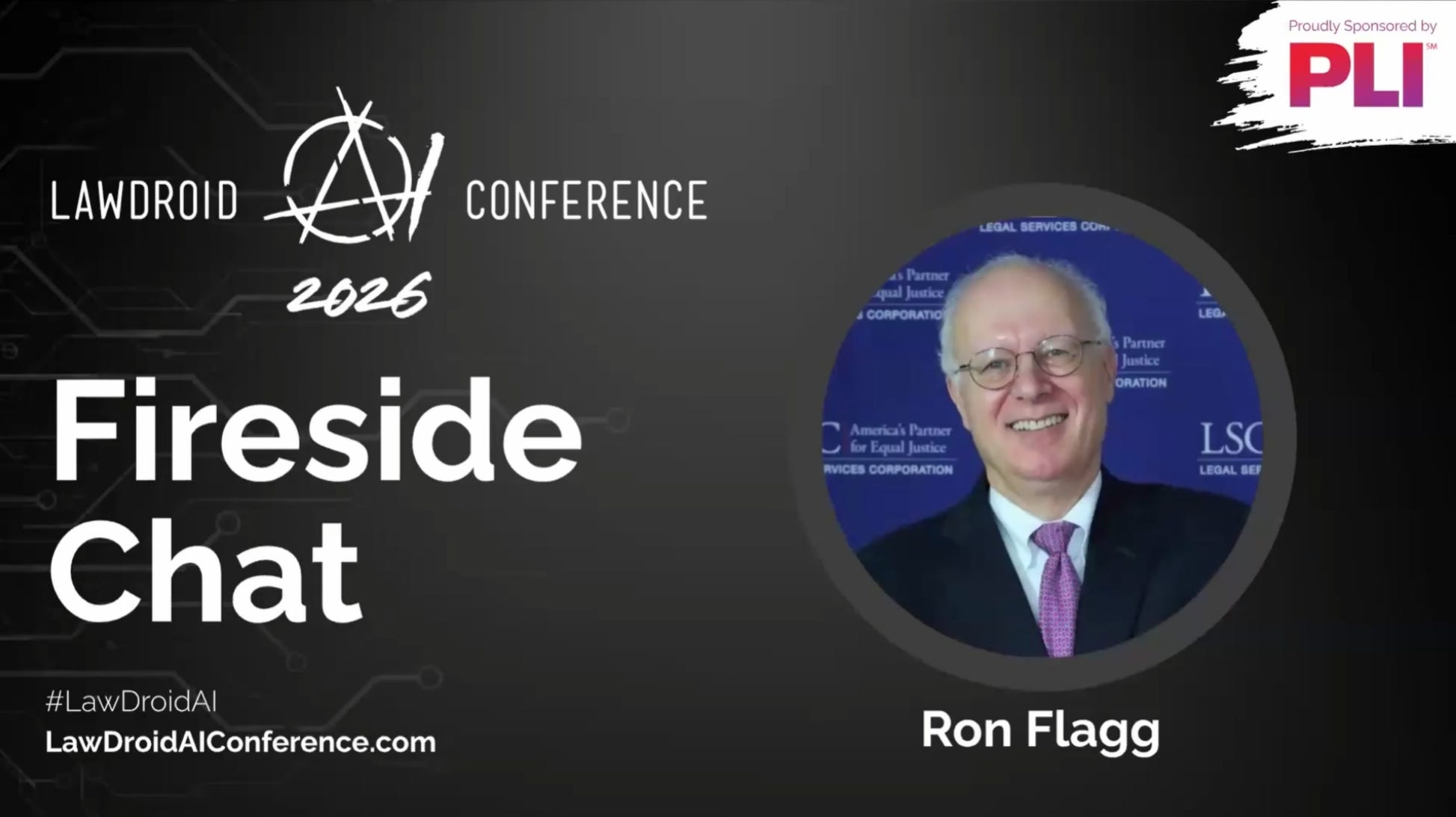
Building a More Accessible and Equitable System of Justice
Join me as I interview Ron Flagg, President of the Legal Services Corporation (LSC).
In this episode, Ron shares his vision for how AI can help address one of the most pressing crises in American law: the justice gap. As the head of the nation’s largest funder of civil legal assistance, Ron brings an unparalleled vantage point: one that spans hundreds of grantee organizations, millions of underserved clients, and the halls of Congress. He dives deep into why funding alone can never close the justice gap, and why the answer lies in the innovators, not just the innovations.
Ron also shares insights from LSC’s landmark eviction report, revealing how the patchwork of local eviction laws across the country produces wildly different outcomes for tenants, and how technology, collaboration, and even landlord partnerships can be part of the solution. This episode is a must-listen for anyone who cares about access to justice, legal innovation, and the role technology can play in building a fairer legal system.
The Skinny
Ron Flagg, President of the Legal Services Corporation, delivers a compelling keynote and fireside chat recorded at the LawDroid AI Conference 2026. With clarity and conviction, Ron lays out why the justice gap — 92% of the civil legal needs of people living in poverty go unmet — cannot be closed by funding or technology alone. He makes the case that it is the community of innovators, not any single innovation, that holds the key. Drawing on LSC’s deep grantee network and its culture of collaboration, Ron describes a field that isn’t hesitating in the face of AI: it’s hungry. He outlines the most promising internal use cases for AI in legal aid, from streamlining intake and triage to reducing administrative burden on staff. Ron also walks through LSC’s recent eviction report, highlighting the enormous variation in local eviction laws, the ripple effects of housing instability, and the surprising economic case for landlords to partner with tenants rather than evict them. He closes with a clear-eyed update on LSC’s funding outlook and a rallying call: collaboration is a multiplier, and this year is a year to build, intentionally, together.
Key Takeaways:
The justice gap is staggering: 92% of the civil legal needs of people experiencing poverty go unmet, and LSC grantees are forced to turn away roughly half of all eligible applicants due to lack of resources
No single solution, whether funding or technology, can close the justice gap; the answer lies in a community of innovators who build, test, refine, and share
LSC’s grantee network is not hesitating in the face of AI, programs across the country are experimenting with tools to reduce administrative burden, streamline intake, and increase organizational capacity
Legal aid organizations are a proving ground for responsible AI: high-stakes, resource-constrained environments where accuracy, trust, and ethics are non-negotiable
Developers should build with legal aid, not just for it, engaging practitioners early and often leads to better, more usable, more trusted tools
AI represents an evolution, not a replacement; it builds on prior innovations like computers, the internet, and e-filing, but moves faster and has lower barriers to entry
LSC’s eviction report reveals how dramatically local laws shape eviction outcomes, and underscores that eviction, representing 35% of LSC grantee caseloads, has cascading consequences for housing, employment, education, and health
Landlords are potential partners in housing stability, not just adversaries. Eviction is often a poor business model, and AI can help facilitate alternatives
LSC secured $540 million in congressional appropriations for FY2026 despite significant political headwinds, reflecting broad bipartisan support for civil legal services
Collaboration is a multiplier: the legal aid community’s existing culture of sharing and learning from one another is a strategic advantage in adopting AI
Notable Quotes:
“The question is no longer whether AI will shape the future of legal services. It already is.” — Ron Flagg (00:01:06–00:01:14)
“It’s the innovators rather than the innovation itself that hold the key. It’s a community that builds, tests, refines, and shares for the benefit of all.” — Ron Flagg (00:03:44–00:03:53)
“What we’re seeing across the country is not hesitation, but hunger.” — Ron Flagg (00:05:17–00:05:24)
“Legal Aid is not just a user of technology. It’s a proven ground.” — Ron Flagg (00:07:12–00:07:20)
“In the immediate moment, we need to think about integration, not disruption. How does a tool fit into existing workflows? How does it reduce the burden of those workflows rather than adding to it?” — Ron Flagg (00:15:33–00:15:49)
“What other economic endeavor in America has as a model throwing out your customers?” — Ron Flagg (00:26:34–00:26:45)
“Collaboration is a multiplier. Our field already does it well. Build on that collaborative nature. Stay focused on purpose. This is not innovation for its own sake — it’s about making our justice system more accessible and more fair.” — Ron Flagg (00:30:18–00:30:35)
“If we get this right, we won’t just be building better tools. We’ll be building a stronger, more capable system of justice — one that meets people where they are and delivers on the promise that justice should be accessible to all.” — Ron Flagg (00:09:07–00:09:27)
Clips
Landlords, Don’t Evict Your Customers
Build for Integration, Not Disruption
AI Where It Actually Happens
Why Eviction Laws Matter
Ron’s perspective is shaped by decades at the intersection of law, public service, and institutional leadership, and what comes through most clearly is his refusal to accept the status quo. The justice gap he describes is not abstract: it is half a million people turned away from legal help every year, families losing their homes without representation, veterans unable to access benefits they earned. His call to action is not a lament; it is a blueprint.
What makes this conversation especially timely is Ron’s framing of AI not as a threat to legal services, but as a long-awaited force multiplier for a field that has always done more with less. The legal aid community, he argues, has been innovating under constraint for decades. AI is simply the next tool in that tradition, and if deployed intentionally, it could be the most powerful one yet.
Closing Thoughts
Sitting across from Ron Flagg, even in a conference setting, you feel the weight of what he carries. He leads an organization responsible for ensuring that the most vulnerable people in America have access to the legal system. And he does it with a combination of intellectual rigor, institutional savvy, and genuine humility that I find rare in any leader, let alone one navigating the political pressures he faces.
What stayed with me most from this conversation is his insistence that the innovators matter more than the innovations. We spend so much time in the legal tech world talking about tools, which AI model is best, which workflow to automate, which firm is deploying what. Ron reminded me that the real work is about community. It’s about people choosing to collaborate, to share what works and what doesn’t, to build with clients and not just for them.
For our Legal Rebels community, Ron’s message is a challenge and an invitation. If you’re building technology, are you building it with the people who will actually use it? If you’re practicing law, are you leaning into experimentation even when it’s uncomfortable? If you’re a researcher or funder, are you helping the field measure what actually matters?
The justice gap is real. It is large. And it will not close by accident. But as Ron made clear, we have the community, the culture, and now the tools to make a real dent in it. This is our year to build, and I hope this episode inspires you to build something that lasts.


