


Hey there Legal Rebels! 👋 I’m excited to share with you the 66th episode of the LawDroid Manifesto podcast, where I will be continuing to interview key legal innovators to learn how they do what they do. I think you’re going to enjoy this one!
If you want to understand how a bias toward action — not endless deliberation — is what actually moves the needle on access to justice, you need to listen to this episode. Sam is at the forefront of legal innovation and brings a rare combination of practitioner experience, entrepreneurial grit, and systems-level thinking to the challenge of making justice work better for everyone.
From Courtroom to Code: How One Lawyer Decided to Build the Tools Justice Needed
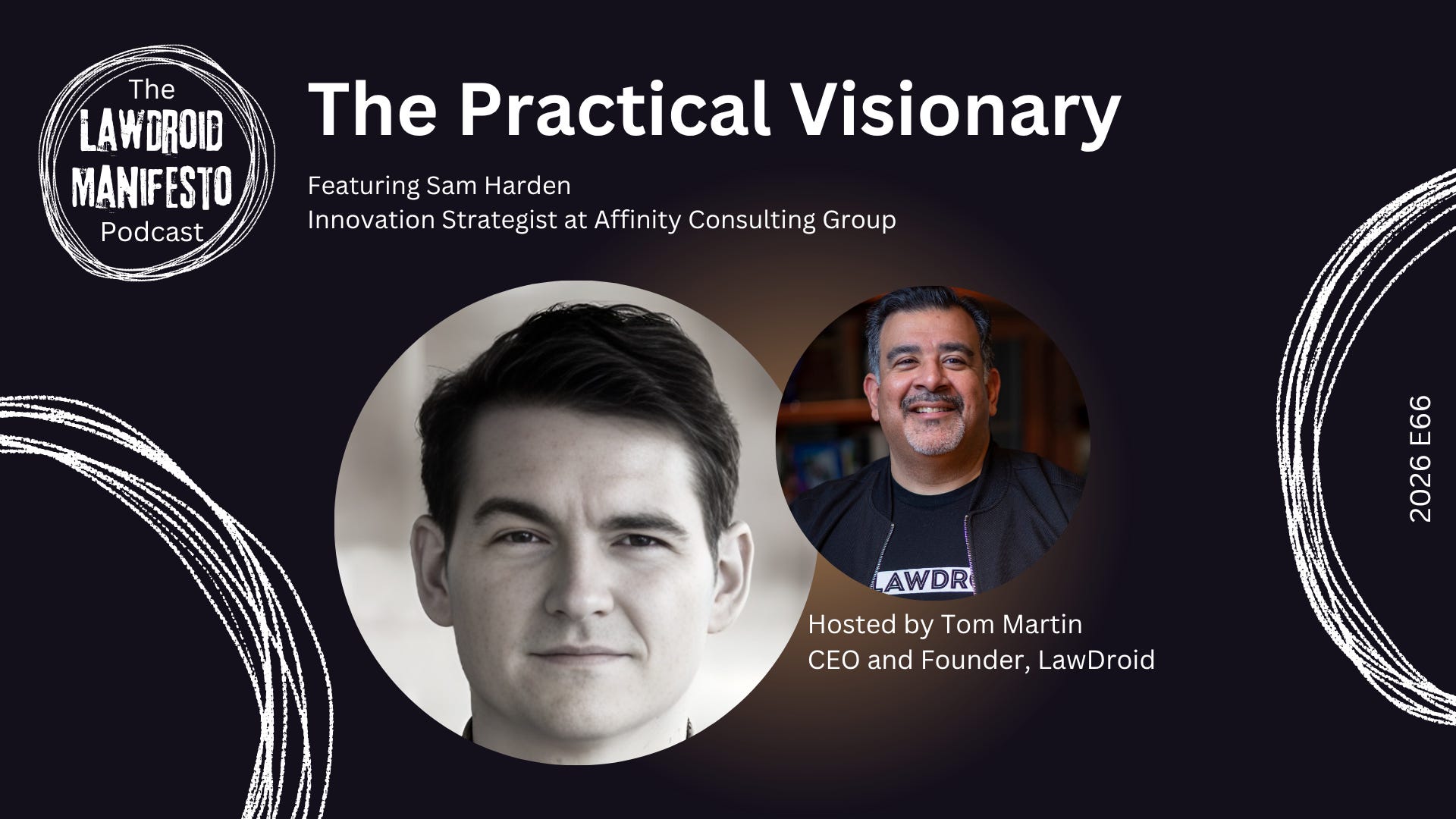
Join me as I interview Sam Harden, Innovation Strategist at Affinity Consulting Group.
In this insightful podcast episode, Sam shares his winding path from Birmingham, Alabama to the forefront of legal technology — from teaching himself Python to build a court date search tool, to lobbying for criminal justice data reform, to helping legal aid organizations and law firms harness the power of AI. He dives deep into what he calls “Law Town,” a provocative vision of a future where lawyers supervise AI agents handling routine tasks so they can focus on what actually matters: counseling, advocacy, and human connection.
His stories and insights underscore a powerful philosophy — that the justice system is an ecosystem, and that small, well-placed interventions can ripple outward in ways that change lives. This episode is a must-listen for anyone who believes technology has a role to play in closing the justice gap, and wants a pragmatic, honest take on where AI can help and where the hard work still falls to us.
The Skinny
Sam Harden, Innovation Strategist at Affinity Consulting Group, brings a rare résumé to the legal tech world: criminal defense lawyer, self-taught coder, legal analytics entrepreneur, access-to-justice advocate, lobbyist, and now consultant to law firms and legal aid organizations navigating the AI era. Raised in Birmingham, Alabama by a family of pharmacists, Sam found his way to law through a passion for advocacy and a desire to push for justice in whatever form that took. His pivot away from trial law came not from a lack of passion but from burnout — and led him to build courtdatesearch.com, a tool designed to prevent the cascading spiral that a single missed court date can set off for vulnerable defendants. Throughout the conversation, Sam articulates a clear-eyed view of AI’s potential: it has made many things cheap and fast, but the hard problems — organizational culture, siloed law firms, human capacity constraints at legal aid organizations — remain stubbornly hard. His “Law Town” concept imagines lawyers as supervisors of their own AI workforce, freeing them to deliver the counseling and advocacy that no algorithm can replicate. Sam’s north star is simple: if the justice system is better ten years from now, it was worth it.
Key Takeaways:
Sam’s “bias toward action” philosophy — being on “Team Do Something” rather than “Team Commission a Study” — has driven every chapter of his career, from building his first legal tech tool to advocating for criminal justice data reform
A single missed court date can trigger a devastating spiral: warrant issued, arrest, job loss, eviction. Sam built courtdatesearch.com specifically to interrupt that chain of consequences for vulnerable defendants
The justice system functions like an ecosystem, where small, targeted interventions, like reintroducing wolves to Yellowstone, can produce outsized, lasting change
Legal aid organizations are not resource-limited in motivation or talent; they are human-capacity limited, and AI represents a genuine opportunity to extend their reach
AI has made many legal tasks fast and cheap, but the hard organizational problems, siloed law firms, broken workflows, institutional resistance, are not solved by flipping the AI switch
Sam’s “Law Town” concept envisions lawyers as supervisors of AI agent teams, offloading rote tasks like document review so they can focus on counseling, advocacy, and client relationships
The greatest risk of AI in law is that lawyers become rubber-stampers, automating the drudgery without reclaiming the work that actually matters
Work-life balance in the AI era is genuinely difficult; keeping up with the pace of change often means sleepless nights, and Sam is refreshingly honest about that struggle
Notable Quotes:
“If a problem is really bad and everybody agrees that the problem is bad, the best thing to do is do something. I’m on team do something. I’m not on team let’s talk about it, let’s commission a study and then write a report and then not do anything.” - Sam Harden (04:28-04:51)
“What if there was an easy way for people to just put in their name or their case number and check their upcoming court date? People are getting mailed a summons to court. A lot of people in the criminal justice system don’t have a fixed address.” - Sam Harden (20:52-21:12)
“You may start out with a driving while license suspended case. You don’t show up for your hearing, so the judge issues a warrant. And if you get pulled over, you go to jail. And while you’re waiting in jail, the job that you were working is going, where is this person?” - Sam Harden (23:05-23:35)
“I think the justice system is kind of like an ecosystem where small changes can have big impact years later. That’s kind of where I hope I have an impact — figuring out where I can push and where I can pull in the justice ecosystem to make it better.” - Sam Harden (46:07-46:29)
“AI has made a lot of things cheap. The hard things still are hard. You can automate a ton of stuff now, but figuring out how the pieces fit together is still really hard. And it takes time, it takes effort, and it takes experimentation, frankly.” - Sam Harden (34:53-37:49)
“The practice of law is the counseling, is the advocacy, is the handholding, is the talking to the client, making the client understand their options, being that personal helper for people.” - Sam Harden (39:39-39:54)
“Could a lawyer take all of the things that they don’t want to do — the rote document review — and have an AI agent run their playbook? And then the lawyer takes that and goes to the client and says, here’s how I would counsel you. And instead of charging by the hour for that, maybe it’s a different kind of value delivery.” - Sam Harden (40:07-41:09)
“The thing that makes it worth it to me is feeling like I’m having some sort of impact on the delivery of justice. If the justice system is better ten years from now, I’m happy.” - Sam Harden (45:04-46:35)
Clips
AI’s Hallucinated Case Law
AI Won’t Fix Lawyer Fiefdoms
Bias Towards Action
AI Can Draft Court Pleadings Now
Sam Harden’s career is a case study in what it looks like to take justice personally — not just as a professional obligation, but as a design challenge. His court date search tool didn’t change the law; it changed the information flow, and that was enough to interrupt a cycle of harm for people who had no other lifeline. That is systems thinking applied with humanity, and it is exactly the kind of ingenuity the legal sector needs more of.
What I find most compelling about Sam’s perspective is his refusal to be either a techno-utopian or a skeptic. He has used Claude Code, tested Google’s agentic tools, worked inside legal aid organizations, and consulted with law firms — and his conclusion is nuanced: AI lowers the floor on what’s possible, but raises the stakes for getting the organizational and human factors right. The “Law Town” vision is not a fantasy of lawyers replaced by robots. It is a vision of lawyers finally freed to do the work that only humans can do.
Closing Thoughts
Conversations like this one remind me why I started LawDroid in the first place. Sam Harden is not a theorist, he is someone who saw a problem, taught himself to code, and built something. The fact that courtdatesearch.com made zero dollars and still found its way onto the county clerk’s own website is exactly the kind of story I want our Legal Rebels community to carry with them. Impact doesn’t always look like a unicorn startup.
What strikes me most about Sam is his clarity about where AI fits and where it doesn’t. He is not selling a silver bullet. He is doing the hard, unglamorous work of helping organizations figure out how to actually use these tools, not just adopt them in name. That distinction matters enormously as our profession navigates what may be the most consequential technological shift in the history of law.
The “Law Town” framework is one I think every lawyer should sit with. Ask yourself: what are the things in my practice that I wish I never had to do again? Those are your candidates for automation. Now ask: what are the things I do that no AI can replicate — the moments where a client needs a human being who understands their situation, their fear, their options? That is your value. Protect it. Build toward it.
Sam’s north star — a justice system that is measurably better a decade from now — is one I share. I believe technology is one of the most powerful levers we have to get there. But as Sam makes clear, the lever only works if the people pulling it are thoughtful, honest, and relentlessly biased toward action.


