


Hey there Legal Rebels! 👋 I’m excited to share with you the 64th episode of the LawDroid Manifesto podcast, where I will be continuing to interview key legal innovators to learn how they do what they do. I think you’re going to enjoy this one!
If you want to understand how AI is fundamentally disrupting legal client acquisition, why lawyers are getting ripped off by outdated marketing models, and what a scientist-turned-tech-founder sees that most lawyers are missing, you need to listen to this episode. Edward is at the forefront of rethinking how lawyers connect with clients and brings a uniquely cross-disciplinary perspective that cuts through the noise.
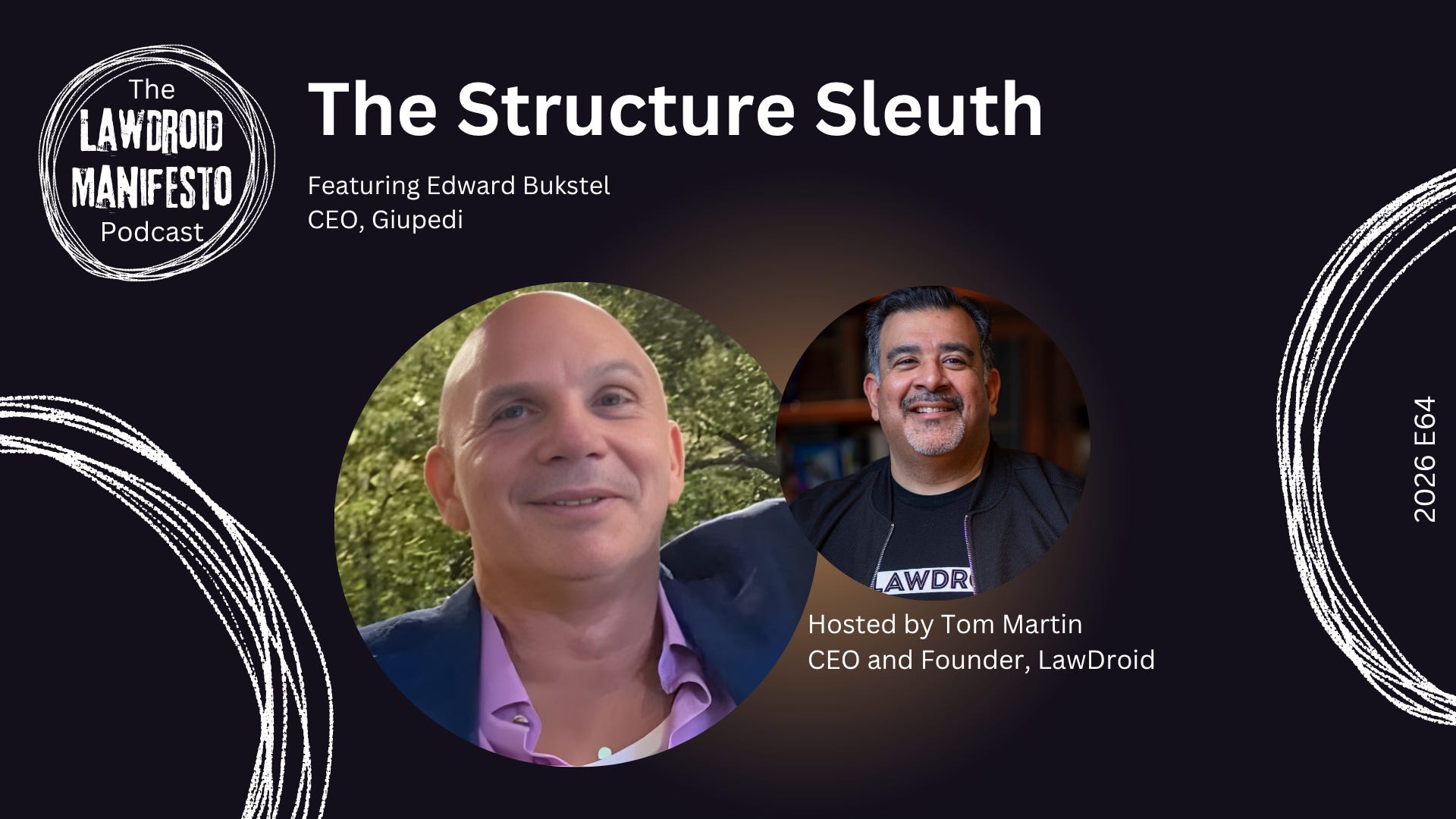
Following the Money: How AI Is Rewiring Legal Client Acquisition
Join me as I interview Edward Bukstel, CEO of Giupedi, Inc., a legal client acquisition platform built at the intersection of healthcare data, AI, and access to justice.
In this insightful podcast episode, Edward traces an extraordinary journey: from building one of the first networked electronic health records in 1987, to going toe-to-toe with a pharmaceutical giant over stolen software, to applying that same structural thinking to the crisis quietly unfolding in how lawyers attract and acquire clients. He reveals how Google’s AI overviews are already siphoning 56% of clicks that used to land on law firm websites, and why most lawyers are still paying the same marketing bills with dramatically less to show for it.
His stories and insights expose the mechanics of a broken system, from geofencing hospitals to generate personal injury leads, to the way legal directories like Avvo, FindLaw, and Martindale-Hubbell disproportionately serve high-ROI cases while leaving everyday people with limited legal options with nothing. This episode is a must-watch for anyone who wants to understand what’s really happening beneath the surface of legal AI, and where the real opportunities lie.
The Skinny
Edward Bukstel, CEO of Giupedi, Inc., brings a perspective on legal AI that few in the industry can match. With a background spanning molecular biology, early electronic health records, WebMD, and a personal legal battle against a pharmaceutical company that stole his software, Edward has spent decades seeing how technology intersects with broken systems, and figuring out how to fix them. In this conversation, he maps the structural forces reshaping legal client acquisition: AI overviews eating 56% of law firm web traffic, legal marketing companies charging the same fees while delivering less, and a $14 billion industry built around feeding high-value contingency cases while leaving underserved clients largely invisible. His platform, Giupedi, is built on the insight that the real moment of legal need begins not with a Google search, but at the point of injury: in ERs, urgent care facilities, and clinics. Edward also digs into the Bloomberg GPT effect, the UPL question no one is asking about AI foundational models, and why the legal profession needs to lead on AI adoption before the models do it for them.
Key Takeaways:
AI overviews are now capturing 56% of clicks that previously went to law firm websites, while marketing companies continue charging the same rates, lawyers are paying more for far less
Traditional legal SEO and directory-based marketing (FindLaw, Avvo, Martindale-Hubbell) are losing their effectiveness, and most law firms have no in-house marketing director to navigate the shift
ChatGPT and other LLMs are now a meaningful source of legal referrals, 40% of people who ask an AI for a lawyer recommendation will choose one of the AI’s suggestions, compared to 2–4% conversion under old Google SEO
The real origin point of a personal injury or workers’ comp legal need is the moment of injury, at the ER or urgent care, not a billboard or a Google search, which is the founding insight behind Giupedi
The Bloomberg GPT effect demonstrates that more capable base models outperform older models fine-tuned on massive domain-specific datasets, meaning the smartest general model will often beat a “specialized” one trained on more data
Legal directories like Avvo and FindLaw lavish resources on high-ROI contingency cases while underserved clients, such as tenants facing eviction, are nearly invisible in the same platforms
If the legal profession doesn’t lead on democratizing AI-assisted legal help, foundational models will fill the gap on their own terms, raising real unauthorized practice of law questions that no one is yet asking
Edward maintains balance amid nonstop entrepreneurial demands through open-mic comedy, gym time, and the grounding reminder of his two daughters
Notable Quotes:
“Lawyers are getting ripped off and there’s a better way to do it.” — Edward Bukstel (08:14-08:17)
“56% of the clicks that would normally have gone to a law firm website is now going to an AI overview.” — Edward Bukstel (04:52-05:05)
“40% of the time, someone that asked ChatGPT ‘tell me the best personal injury lawyer in Philadelphia’ will make a decision and choose one of the ones recommended by ChatGPT — as opposed to the old Google SEO days where it was maybe 2% and 4% was considered really good.” — Edward Bukstel (07:40-08:07)
“The smart lawyer is going to outperform the one that’s not so smart. And that’s what we’re seeing with the models. The most up-to-date models are going to always outperform.” — Edward Bukstel (32:43-32:54)
“If you go ahead and take a look in those same directories for folks that are concerned about getting evicted, you don’t even have pictures of lawyers. It’s like, we don’t want you to contact us because we know we’re not going to make any money on you.” — Edward Bukstel (35:36-35:52)
“Why haven’t some of the big law firms out there sued these models — not just over copyright issues, but over what really does look like an unauthorized practice of law?” — Edward Bukstel (36:50-37:03)
“If we’re not going to provide those same kind of gilded on-ramps and services to folks that really need it with a human lawyer, then why not provide them with an LLM?” — Edward Bukstel (35:59-36:20)
“You gotta hit some singles before you go ahead and take that big swing.” — Edward Bukstel (41:05-41:11)
Clips
Lawyers Are Getting Ripped Off
Too Big To Sue
Chat GPT Becomes The New Source of Leads
Lawyers Geofence Hospitals
Edward’s perspective is rare in the legal tech conversation because it comes entirely from outside the legal profession. He’s not a lawyer theorizing about disruption; he’s a builder who has created real systems, fought real battles, and watched real industries get restructured by technology. His analysis of what’s happening in legal client acquisition isn’t speculative; it’s grounded in data he’s actually collected, from website traffic studies to conversion rate comparisons between Google and ChatGPT.
What makes this episode particularly timely is Edward’s attention to the access-to-justice dimension. The same market forces that are enriching legal marketing companies and personal injury firms are systematically underserving the clients who most need help: people facing eviction, workers’ compensation claims, and other legal needs that don’t generate the contingency-fee returns that attract premium directory placement. His argument is simple: if the legal profession won’t close that gap voluntarily, AI will close it anyway.
Closing Thoughts
Conversations like this one remind me why I started LawDroid in the first place. Edward isn’t a lawyer, and that’s exactly what makes his perspective so valuable. He sees the legal industry the way a scientist sees a system: following the structure, following the money, and asking questions that people inside the profession are too close to ask.
The numbers he shared stayed with me. Fifty-six percent of clicks gone to AI overviews. Forty percent of people taking action on an AI’s lawyer recommendation. Billions spent on legal marketing while legal aid organizations beg for a fraction of that to serve the people who need it most. These aren’t abstract trends, they are reshaping the economics of legal practice right now, and most lawyers I talk to still haven’t fully reckoned with what that means.
Edward’s work with Giupedi is a bet that the future of legal client acquisition starts at the point of need, not at a search bar. That’s a structural insight, and structural insights tend to be right. For our Legal Rebels community, the takeaway is clear: the game has changed. The firms that understand where clients are actually coming from, and who build authentic, substantive presence in AI systems, are going to win. Those who keep paying for the old playbook are going to keep getting ripped off.
The access-to-justice piece matters too. AI is going to fill the legal help vacuum whether the profession leads or follows. I’d rather we lead.
If you liked this podcast, you’ll love the LawDroid AI Conference 2026. April 28–29, virtual, and completely free — two days of keynotes, panels, and workshops on AI and the legal profession. I’d love to see you there.


