


Hey there Legal Rebels! 👋 I’m excited to share with you the 68th episode of the LawDroid Manifesto podcast, where I will be continuing to interview key legal innovators to learn how they do what they do. I think you’re going to enjoy this one!
If you want to understand how empathy, storytelling, and technology can converge to make legal services accessible to people who need them most, you need to listen to this episode. Jonathan is at the forefront of access-to-justice innovation and brings a decade of hard-won, on-the-ground experience to this conversation.
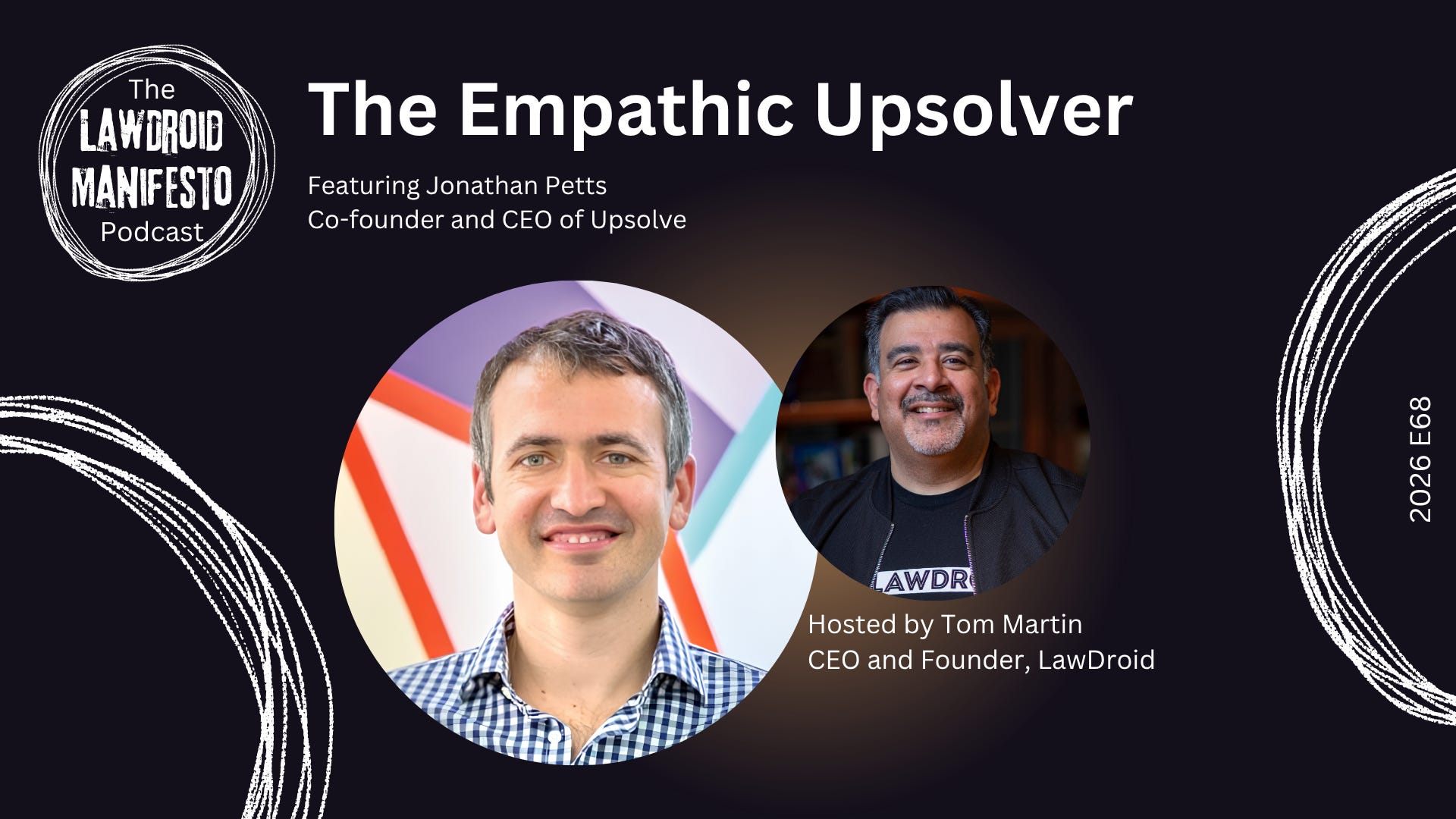
Turning Empathy Into Access: How Upsolve Is Rewriting the Rules of Bankruptcy Law
Join me as I interview Jonathan Petts, co-founder and CEO of Upsolve.
In this insightful podcast episode, Jonathan shares his journey from the Upper East Side of Manhattan to the clerk’s offices of Brooklyn bankruptcy court , and ultimately to building one of the most impactful legal tech nonprofits in the country. He dives deep into how Upsolve has evolved from a manual spreadsheet operation into an AI-powered platform that helped 115% more people get a fresh financial start last year alone. Jonathan also walks us through how their AI Paralegal tool is deflecting 50% of support questions and enabling each paralegal to serve four times the number of people they once could.
His stories and insights reveal what it truly takes to close the access-to-justice gap, not with theory, but with practical, iterative, deeply human-centered design. This episode is a must-watch for anyone who believes that technology should serve people first, offering a powerful model for what legal innovation looks like when empathy leads the way.
The Skinny
Jonathan Petts, co-founder and CEO of Upsolve, has spent the last decade building what he describes as a “TurboTax for bankruptcy” for low-income Americans who can’t afford lawyers. In this conversation, Jonathan traces his path from growing up on Manhattan’s Upper East Side, shaped by an English father who prized education and a California mother who modeled social ease, through an English degree at the University of Pennsylvania, to law school and a pivotal summer interning in a Brooklyn bankruptcy court clerk’s office during the chaotic lead-up to the 2005 bankruptcy law reform. That experience, watching overwhelmed people wade through 100 pages of dense legalese with Staples-bought form packets, left him both inspired and angry at how unnecessarily hard the system made it to access a constitutional right. After being let go from two large law firms, Jonathan found his footing by returning to serve, eventually co-founding Upsolve with Harvard undergrad Rohan Pavluri after a chance meeting at a pro bono lunch. A Y Combinator alum, Upsolve has now helped thousands find a fresh financial start, and with the addition of an AI Paralegal tool, the organization saw the number of people each paralegal could serve quadruple last year, with users of the AI finishing the process at three times the rate of those who don’t use it.
Key Takeaways:
Upsolve’s AI Paralegal tool now deflects approximately 50% of questions that previously required human paralegal response, allowing staff to serve dramatically more people
Users who engage with the AI Paralegal complete the bankruptcy filing process at a three times higher rate than those who don’t
Last year, U.S. bankruptcy filings rose 15%, but the number of people Upsolve helped get a fresh start rose 115%, a gap largely attributed to the AI tool and operational improvements
Jonathan’s formative experience in a Brooklyn bankruptcy court clerk’s office during the 2005 reform period revealed the human cost of bureaucratic complexity and set him on his mission
The AI Paralegal is context-aware, it understands where a user is in the filing process and tailors its responses accordingly, making support feel less like a chatbot and more like a knowledgeable guide
Jonathan’s advice to new legal tech builders: think carefully about distribution from day one, because building a solution is now easier than ever, but getting it into the hands of people who need it remains the hardest challenge
Focus beats expansion: when Upsolve tried to expand to immigration and debt lawsuits simultaneously, their core bankruptcy service suffered, a reminder that doing one thing well is harder than it looks
Jonathan is candid about his own struggles with work-life balance as a founder with two young daughters, and is planning a three-month sabbatical to mark Upsolve’s 10-year anniversary this summer
Notable Quotes:
“We have 56,000 people each year who start this tool and don’t get to the end of it. Part of the reason is because they can’t get the support they need.” - Jonathan Petts (00:01:44-00:01:58)
“People that use the AI are finishing at a three times higher rate. All of that gives us a lot of conviction that this AI tool to empower folks to unblock themselves is a really high leverage way to increase access.” - Jonathan Petts (00:06:32-00:06:49)
“Why is it so hard? Why do you have to fill out 100 pages of dense legalese in order to access this legal process that’s guaranteed by the Constitution?” - Jonathan Petts (00:18:39-00:18:47)
“These forms were designed by well-intentioned experts, but those experts weren’t talking to the folks that I was talking to in Brooklyn who couldn’t afford lawyers. And they weren’t designed with those folks in mind. And that, I believe, is the cardinal sin of so much of our consumer legal system in the U.S.” - Jonathan Petts (00:18:51-00:19:23)
“When you have no confidence, the thing to do is to find someone you can serve because service connects you with everything you have to give. And that builds confidence.” - Jonathan Petts (00:21:24-00:21:37)
“It’s never been easier to create useful solutions and never been cheaper. And the question is, are you going to be able to get that solution in the hands of the people that need it?” - Jonathan Petts (00:28:33-00:28:45)
“Building one good access to justice tool — if it’s not getting better, it’s getting worse. That’s a big learning for me.” - Jonathan Petts (00:32:55-00:33:05)
“Every day or every other day, I’ll wake up to a new Google review from someone who I’ve never met, in who knows what part of the country, that talks about how Upsolve guided them through one of the darkest times of their life to a better future.” - Jonathan Petts (00:35:18-00:35:32)
Clips
The Cardinal Sin of Legal Design
Built a Non-Profit TurboTax
AI Tripled Completion Rates
YC Forced Us to Think Big
Jonathan’s story is ultimately a story about what happens when you design legal tools for the people who actually need them. From spending a summer watching desperate filers wrestle with $29.99 Staples packets to building an AI-powered platform that quadruples paralegal capacity, he has never lost sight of the human being on the other end of the process. His approach, start by doing things that don’t scale, learn deeply, then build, is as applicable to legal innovation as it is to any startup.
What stands out most is Jonathan’s insistence on focus. The temptation to expand Upsolve’s model to other legal domains was real, and the pilot revealed a hard truth: doing two things at once can make both worse. That discipline, staying close to the mission, improving incrementally, and letting the impact compound, is what has allowed Upsolve to outpace the rising tide of financial distress in this country and actually move the needle for real people.
Closing Thoughts
Jonathan’s journey is one that I find genuinely moving. He didn’t start from a place of certainty, he was fired from two law firms, told he shouldn’t be a lawyer, and had to rebuild his sense of purpose from scratch. What he found when he returned to serving people was something we talk about a lot in the Legal Rebels community: that the legal profession, at its best, is a calling to help people through their hardest moments.
What strikes me about Upsolve’s AI Paralegal isn’t just the impressive numbers: 50% question deflection, a 3x completion rate, paralegals serving four times as many people. It’s what those numbers represent: real families who got a fresh start because someone decided that the bureaucratic complexity of our legal system wasn’t acceptable, and then built something to fix it.
For those of us building in legal tech, Jonathan’s story is both a challenge and an invitation. The tools have never been more powerful. The access-to-justice gap has never been more visible. And the model Upsolve has pioneered, empathetic design, iterative improvement, ruthless focus, is one any of us can apply in our own corner of the profession.
The future of legal services belongs to those who keep the human being at the center of everything they build. Jonathan Petts and the Upsolve team are showing us exactly what that looks like.
LAST CHANCE! — the LawDroid AI Conference 2026 starts tomorrow: April 28–29, virtual, and completely free — two days of keynotes, panels, and workshops on AI and the legal profession. I’d love to see you there.


