


Hey there Legal Rebels! 👋 I’m excited to share with you the 65th episode of the LawDroid Manifesto podcast, where I will be continuing to interview key legal innovators to learn how they do what they do. I think you’re going to enjoy this one!
If you want to understand how human-centered design and conscious self-awareness can help lawyers navigate the AI transformation without losing themselves in the process, you need to listen to this episode. Mia is at the forefront of legal design and AI adoption and brings a uniquely grounded, human-first perspective to one of the most urgent conversations in our profession.
Designing a Human Future for Law in the Age of AI
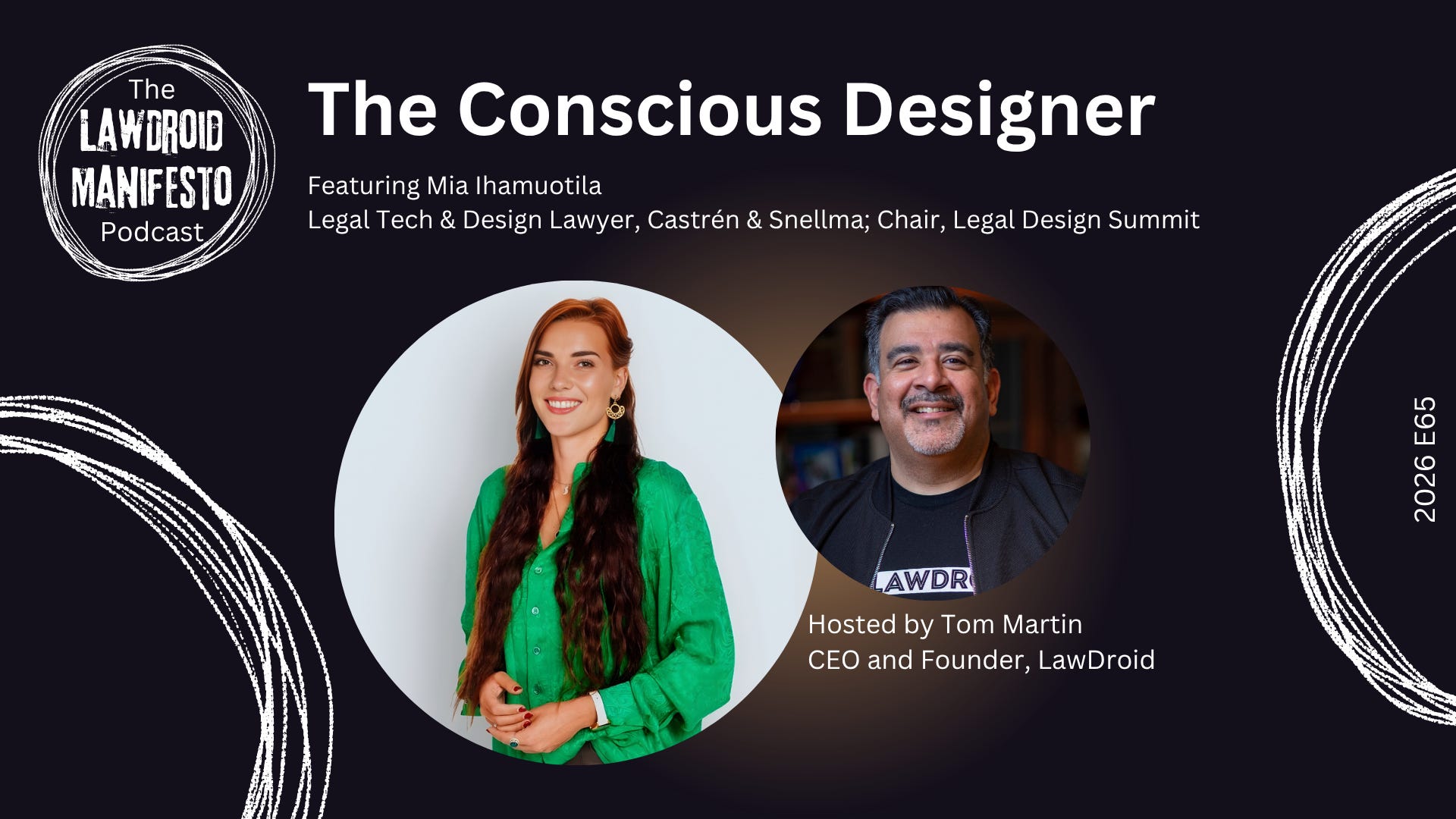
Join me as I interview Mia Ihamuotila, Legal Tech & Design Lawyer at Castrén & Snellman and Chair at the Legal Design Summit.
In this insightful podcast episode, Mia shares her journey from a childhood rooted in dance and creativity near Helsinki, through her studies in law and legal design, to building a hybrid role that bridges legal practice, design thinking, and AI strategy. She dives deep into her framework for the human-machine symbiosis, arguing that the real risk of AI is lack of intentionality in how we engage with it.
Her stories and insights underscore the importance of self-awareness, process thinking, and mindset in successfully navigating legal transformation. This episode is a must-watch for any lawyer curious about what it truly means to work alongside AI, not just how to use the tools, but how to remain grounded, creative, and deeply human while doing so.
The Skinny
Mia Ihamuotila, Legal Tech & Design Lawyer at Castrén & Snellman and Chair at the Legal Design Summit, shares her remarkable journey from a childhood spent dancing near Helsinki to building one of the most thoughtful and human-centered approaches to legal AI in the profession today. Raised outside the city with deep ties to nature, dance, and creativity, Mia was drawn to law for its power to shape society and its potential for transformation. After early traineeships in legal design with mentor Antti and a formative exchange year studying legal tech in Hong Kong, she wrote her master’s thesis at her current firm, empirically testing how legal design could improve the transparency and understandability of privacy policies. What sets Mia apart is her conviction that the human-machine relationship is not adversarial but symbiotic: that AI has the potential to elevate human thinking if we engage with it consciously, with self-awareness, and through multi-step collaborative processes. Her work now includes AI workshops and transformation consulting for both her firm’s lawyers and their clients, with the Legal Design Summit serving as a global platform to expand this conversation.
Key Takeaways:
Mia’s path to legal innovation was shaped by a lifelong commitment to dance, creativity, and human connection: qualities she now brings directly into her legal design and AI strategy work
Her origin story includes early burnout and a period of depression that led her to self-awareness practices like breathwork and meditation, which now form the foundation of her approach to balance and conscious design
She argues for a symbiosis between human depth and machine breadth, when combined, these two dimensions create an entirely new dimension of capability
The real risk of AI is not the technology but unconsciousness: the danger arises when people engage with AI without awareness, intention, or a structured process
Practical AI adoption starts with mindset, not tools, mapping the lawyer skill set to include creativity, data literacy, interdisciplinarity, and design thinking before moving into tool use
Mia conducts AI and design workshops for both internal lawyers and clients, framing this as a shared transformation journey rather than a one-directional education
Legal design and legal tech are not separate disciplines: they are complementary life forces that belong under the broader umbrella of legal innovation
The Legal Design Summit is evolving toward a chapter-based model with country-level ambassadors to maintain a coherent, year-round global community
Balance is not just work vs. rest, it requires designing your environment around your nervous system’s needs, knowing when you need solitude, creativity, or social engagement
Mia begins every day with breathwork, meditation, and movement, refusing to engage with the world before first centering herself
Notable Quotes:
“I usually talk about the symbiosis or the synthesis between the human and the machine and how it becomes kind of a wavy flow between those two. So it’s not about like man versus machine.” - Mia Ihamuotila (27:34-27:45)
“The machine has enormous capability to create breadth... but then as a human we have an immense capability to create depth in things. And I think these two dimensions, when combined, create a new dimension.” - Mia Ihamuotila (27:48-28:18)
“I really honestly believe that AI has the potential to elevate our thinking as human beings if we allow it to do so. And I think the tool for that is self-awareness.” - Mia Ihamuotila (28:23-28:36)
“I see this as a conscious evolution that is happening.” - Mia Ihamuotila (29:01-29:04)
“I don’t see the risks and the fear in there. I think the risk is this unconsciousness—the lack of consciousness in people in that case.” - Mia Ihamuotila (30:56-31:07)
“Everything starts from this mindset and the attitude and the mapping of skills, the lawyer skill set.” - Mia Ihamuotila (33:17-33:24)
“I don’t want to jump into the waves of the world before saying hi to myself.” - Mia Ihamuotila (44:08-44:14)
“I get to do transformation as the main driver in my career. And that’s been the main driver of my personal life forever. So that’s perfect.” - Mia Ihamuotila (46:21-46:35)
Clips
Death, Rebirth, and New Beginnings
Design and Tech: Inseparable Forces
Human-AI Symbiosis
Use Process Thinking Without AI
Mia’s story is a reminder that the legal profession’s transformation is not just technological, it is deeply personal. Her journey from dance studios and burnout to building a hybrid law career grounded in design thinking and conscious AI adoption reflects the kind of inner work that most transformation conversations leave out entirely. She brings to the table something rare: a framework for remaining human not despite the AI revolution, but through it.
What makes her perspective especially compelling is the practical dimension. It’s not enough to talk about consciousness and symbiosis in the abstract. Mia is in law firms, running workshops, mapping skills, and guiding lawyers and clients through the early and middle stages of this transformation, meeting people where they are and building the capacity they need to move forward. Her work at the Legal Design Summit amplifies this further, building a global community of practice that embodies the very transformation it champions.
Closing Thoughts
Talking with Mia was genuinely one of those conversations that changes how I think about what we’re doing in this space. As someone who has been building legal technology for years, I sometimes get caught up in the tools: the capabilities, the models, the use cases. Mia reminded me that the foundation of all of that has to be the human being holding it.
Her concept of conscious engagement with AI is something I want every lawyer in our community to hear. The technology is not the problem and it is not the solution. The quality of our attention, intention, and self-awareness is what determines what we build with it and what it does to us. That’s a profound reframe.
What inspires me most is the way Mia has integrated who she is, dancer, designer, lawyer, meditator, into a coherent whole rather than treating these as separate identities. That kind of integration is, I think, exactly what the profession needs right now. Not lawyers who bolt AI onto existing practice, but lawyers who are willing to grow into a fuller version of themselves and let their work reflect that.
For our Legal Rebels community, Mia’s story is both a challenge and an invitation. The invitation is to approach this transformation consciously, to start with mindset before tools, to design your environment around your nervous system, and to begin the day by saying hi to yourself before jumping into the waves of the world. The challenge is to do that inner work consistently, even when the pace of change makes it tempting to skip it.
The future of law belongs to those who can hold both depth and breadth, who can be fully human while working alongside machines that are becoming more capable by the day. Mia is living proof that this is not only possible but extraordinarily exciting.


