


Hey there Legal Rebels! 👋 I’m excited to share the 41st episode of the 2025 season of the LawDroid Manifesto podcast, where I will be continuing to interview key legal innovators to learn how they do what they do. I think you’re going to enjoy this one!
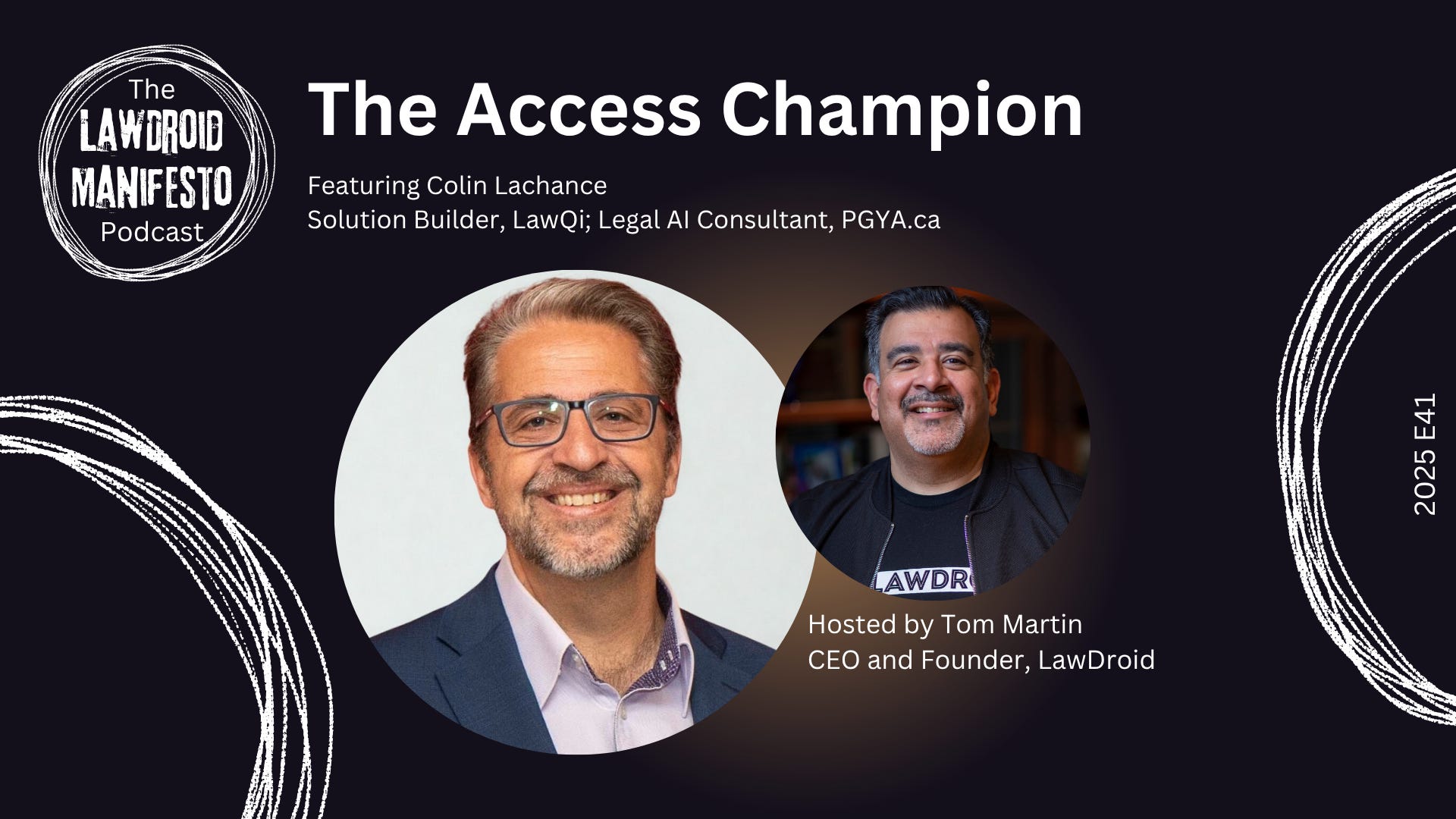
I’ve known Colin Lachance for years and he’s always been one of those people that I just vibe with. It may be because we are Gen X and get the same cultural references. It may be because we’re both kinda nerdy and love tech. It may be because we share the same values about access to the law for everyday people. Or, it’s likely all of those things combined. I’ve dubbed Colin, “The Access Champion” because that’s who he is. I hope you enjoy our conversation as much as I did.
If you want to understand how to bridge the gap between AI theory and practice while ensuring no lawyer gets left behind, you need to listen to this episode. Colin is at the forefront of democratizing legal AI education and has successfully brought practical AI learning to thousands of lawyers across North America.
Transforming Legal Education Through Hands-On AI Learning
Join me as I interview Colin Lachance, principal consultant at PGYA and co-founder of LawQi. Colin shares his remarkable journey from growing up in Winnipeg to becoming a leading voice in legal AI education. He dives deep into how he’s developed innovative learning platforms that use AI to teach lawyers about AI, making advanced technology accessible to solo practitioners and small firms who don’t have big firm resources. Colin also demonstrates his unique approach of maintaining three interconnected roles (consultant, educator, and practicing attorney) to ensure he truly understands the challenges lawyers face when adopting AI.
His stories and insights underscore the critical importance of hands-on learning over passive webinars, and his commitment to ensuring that hundreds of thousands of lawyers aren’t left behind as AI transforms the profession. This episode is a must-watch for anyone interested in the intersection of legal education and AI, offering valuable perspectives on how bar associations can serve their members through practical, affordable AI training.
The Skinny
Colin Lachance, principal consultant at PGYA and co-founder of LawQi, shares his journey from small-town Winnipeg through telecom regulation to becoming a champion of accessible legal AI education. With a career that spans running CanLII (Canada’s most-used legal research platform), founding multiple legal tech ventures, and now working part-time at a small personal injury firm, Colin brings a uniquely grounded perspective to AI implementation.
His latest venture, LawQi, emerged from his work as innovator-in-residence at the Ontario Bar Association, where he developed an AI-powered learning platform that uses a digital twin to help lawyers learn AI through hands-on experience. The platform can be deployed to bar associations for as little as $1 per member per year, addressing the critical gap where hundreds of thousands of solo and small firm lawyers have no institutional support for understanding AI. Colin emphasizes that this is no longer just about technology learning; it’s about transformational change that requires lawyers to become educated consumers who can evaluate vendors and understand how AI actually works.
Key Takeaways:
Colin’s career demonstrates the power of working “at arm’s length from an engineer,” constantly learning from technical colleagues across telecom, software, and AI domains
He founded PGYA (”Please Govern Yourself Accordingly”) as a consultancy focused on helping legal organizations navigate transformation, with exclusive focus on AI in recent years
Under Colin’s leadership, CanLII became the most professionally used legal research tool in Canada, funded by lawyers through their bar dues at roughly $40-50 per year
The Legal Innovation Data Institute (LIDI) was created to make legal data available to partners experimenting with AI and machine learning applications
LawQi grew from Colin’s work as Ontario Bar Association’s innovator-in-residence, creating an online learning platform where an AI digital twin helps lawyers learn AI
The platform uses Claude (originally GPT-3.5, now Claude 4) to power hands-on learning from basic prompts to vibe coding, all within a safe learning environment
LawQi can be deployed to bar associations for as little as $1 per member per year, making comprehensive AI education accessible to even small county bars
Colin maintains three interconnected roles (consultant, educator, and part-time practicing attorney) to stay grounded in the realities lawyers face
Traditional webinars fail on two fronts: attendees don’t develop practical skills, and the majority of bar members never attend
The focus must shift from technology learning to transformational change—buying an app won’t protect firms for the next 12 months
Notable Quotes:
“I come at the technology from a practical perspective first. When I was exposed to the evolution of internet protocol and web standards, I’m learning and writing constantly about this because I have to argue it. I have to, as an internal counselor, I have to explain the rules back to the business.” - Colin Lachance (18:22-18:42)
“I would describe it to Americans often as an upside down Fastcase. Whereas Fastcase built out something that went to bars to sell it, in Canada, the concept began with the bars, the mandatory bars, the regulators, deciding that digital legal information is essential to professional competence.” - Colin Lachance (23:05-23:26)
“I swore after finishing my LLM that I would never write anything longer than five pages again. And so my way of doing that is I love indulging my academic side by reading the papers, whether it’s legal papers, technical papers, AI papers. But turning it into something that I can deliver back.” - Colin Lachance (30:50-31:03)
“I said to the OBA, I’m going to create an online learning platform for lawyers where everything that they, I think they need to know and everything that they think they need to know about AI is a resource in a traditional online environment. But LawQi will be the digital twin inside that of me as the advisor to help them navigate the material and try everything.” - Colin Lachance (33:27-33:48)
“Lockheed has become the environment where we can turn small bar associations up to a complete AI learning environment, all the material, all the prompt training courses, all of this, and the AI for as little as, depending on how we package it, for them as little as $1 per member per year.” - Colin Lachance (34:57-35:13)
“Law firms are entering a period of heavy transformational change. This isn’t technology learning. It was technology learning two years ago. And it needs to be a little bit of technology learning now so that they can recognize the need for transformational change.” - Colin Lachance (37:07-37:20)
“Every webinar they hold, they get two results. They hold a webinar, 50, 100 people show up, pay them, you know, $150. And it’s okay, but nobody comes away having learned practically what to do, having developed the skills. They’ve been told, but they haven’t internalized it. And secondly, well, what about the other 1,000 or 2,000 members of their bar who didn’t show up?” - Colin Lachance (36:26-36:41)
“As much as you want to indulge your curiosities, you have to identify what’s the most important thing to you. So it took me a long time to really make sure that I wasn’t letting my work take away from my life.” - Colin Lachance (38:52-39:08)
Clips
Law Firms: Apps Won’t Save You
Driven by Fixing What’s Broken
How Canada Beat Paid Databases at Legal Research
Why Most Canadian Legal Data Isn’t Public
Colin’s journey reflects a consistent theme: identifying broken systems and figuring out how to fix them. From recognizing that Canada needed free access to quality legal research, to understanding that lawyers can’t learn AI through passive webinars, Colin has repeatedly found ways to democratize access to essential legal resources. His approach of maintaining three interconnected roles, big picture consulting, hands-on education, and actual legal practice, ensures he never loses touch with the real challenges lawyers face.
What stands out most is Colin’s commitment to the hundreds of thousands of lawyers who lack institutional support for learning AI. By creating a platform that bar associations can deploy for as little as $1 per member per year, he’s ensuring that solo practitioners and small firm lawyers aren’t left behind as the profession transforms. His emphasis on hands-on learning over passive consumption reflects a deeper understanding that this moment requires more than technology adoption: it demands fundamental transformation in how lawyers think about their work.
Closing Thoughts
As someone who’s been in the legal tech space for years, I find Colin’s approach particularly compelling because he’s addressing the most critical challenge we face: the vast majority of lawyers who have done nothing and know nothing about AI. While much of the conversation in our industry focuses on cutting-edge implementations at large firms, Colin is focused on the long tail, the thousands of small practitioners who need accessible, affordable, practical education.
What excites me most about Colin’s work with LawQi is that it demonstrates how AI can be used to teach AI. The digital twin concept (where lawyers can ask questions and get immediate, contextualized help while learning) represents exactly the kind of scaffolded learning experience that actually creates competence. Traditional webinars may generate revenue for bar associations, but they don’t create the muscle memory that comes from hands-on practice.
For our Legal Rebels community, Colin’s story serves as a reminder that meaningful innovation often comes from understanding the full stack, from technical fundamentals to business models to the lived experience of end users. His willingness to work part-time at a small personal injury firm while running a consultancy and building an education platform shows the kind of commitment required to truly understand the problems you’re trying to solve.
As AI continues to advance exponentially, the gap between those who understand it and those who don’t will only widen. Colin’s work with LawQi represents one of the most important bridges being built across that gap, ensuring that access to transformational technology isn’t limited to those with big firm resources.


