


Hey there Legal Rebels! 👋 I’m excited to share with you the 48th episode of the 2025 season of the LawDroid Manifesto podcast, where I will be continuing to interview key legal innovators to learn how they do what they do. I think you’re going to enjoy this one!
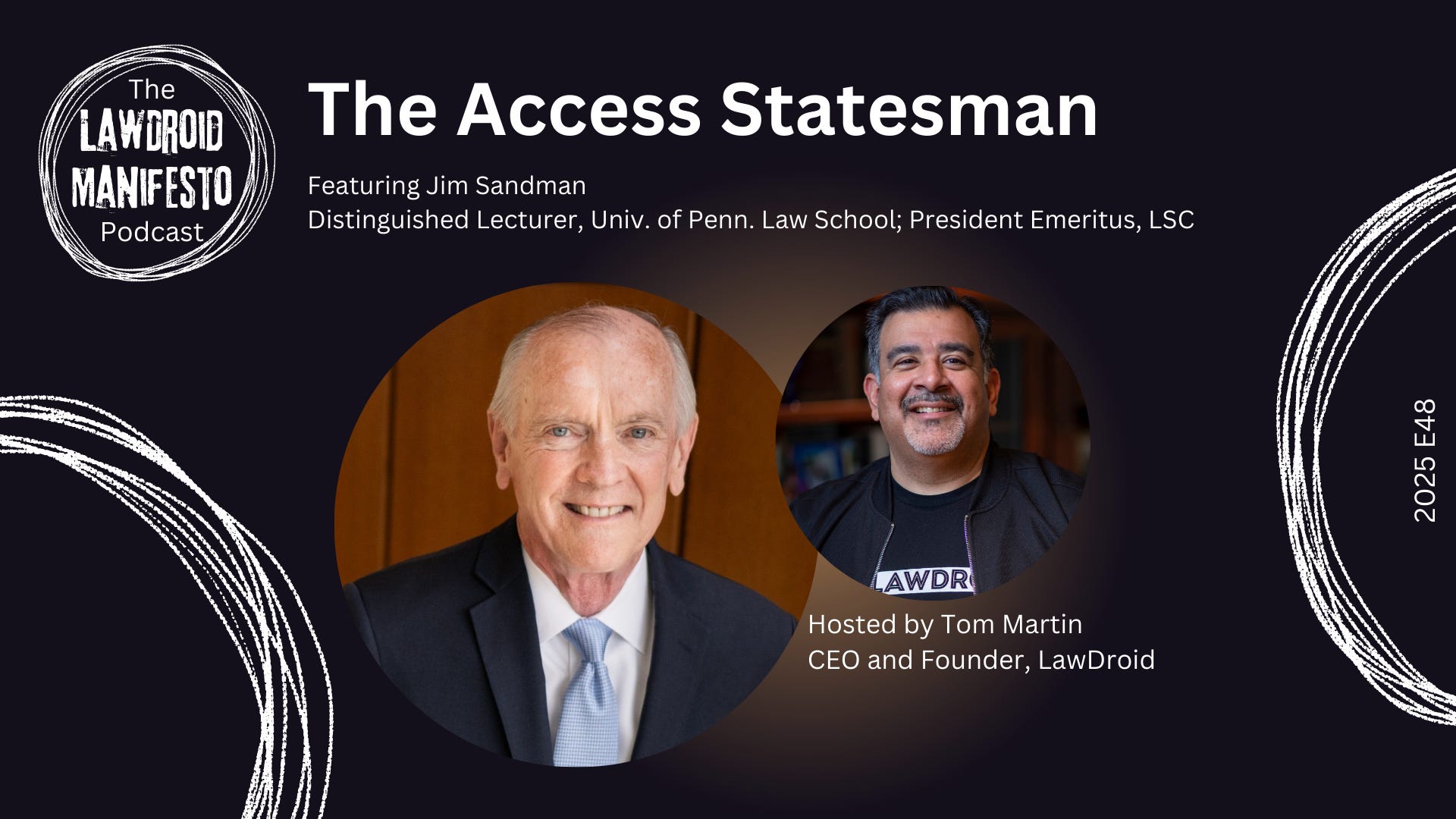
Jim Sandman is a titan of the access to justice movement and a rare figure who brings the credibility of three decades leading Arnold Porter to the front lines of serving the underserved. He commands respect in both Big Law boardrooms and legal aid offices, bridging worlds that rarely speak the same language with the wisdom, dignity, and collaborative leadership that defines a true statesman; that’s why I gave him the moniker, “The Access Statesman.”
If you want to understand how artificial intelligence can become a game changer for access to justice and learn from someone who spent decades building institutions that serve the underserved, you need to listen to this episode. Jim is at the forefront of leveraging AI for access to justice and brings a unique perspective from his journey through big law leadership to becoming a champion for civil legal aid.
From Big Law Leadership to Access to Justice Champion
Join me as I interview Jim Sandman, President Emeritus of Legal Services Corporation and current faculty member at the University of Pennsylvania Law School.
In this deeply moving podcast episode, Jim shares his extraordinary journey from growing up in Albany, New York, through 30 years at Arnold & Porter (including as managing partner), to discovering his true calling as president of the Legal Services Corporation. He reveals how his early influences, from his parents’ emphasis on service to others, to his work with Vista volunteers, to his pro bono litigation experiences, planted seeds that would eventually blossom into a passionate commitment to access to justice. Jim also discusses his current work teaching AI and Access to Justice at Penn Law and his optimistic vision for how artificial intelligence can fundamentally transform legal service delivery.
His stories and insights underscore the power of finding your calling, even if it comes later in your career, and the importance of mission-driven work in achieving true happiness and fulfillment. This episode is a must-watch for anyone interested in the intersection of law, technology, and social justice, offering valuable perspectives on leadership, career transformation, and the future of legal services.
The Skinny
Jim Sandman, President Emeritus of Legal Services Corporation and current University of Pennsylvania Law School faculty member, shares his remarkable journey from a childhood in Albany shaped by parents who emphasized service, through 30 years at Arnold & Porter where he became managing partner, to finding his true calling leading the nation’s largest civil legal aid funder. Throughout the conversation, Jim reveals pivotal moments that shaped his path, from early pro bono work defending Vista volunteers to a chance conversation with a D.C. schools chancellor that led to his general counsel role there, ultimately preparing him for his transformative work at LSC. Jim’s optimism about AI’s potential to expand access to justice is grounded in decades of experience understanding the gap between those who can afford legal services and those who cannot. He now teaches courses on AI and Access to Justice, professional responsibility, and leadership in law, while continuing to advocate for regulatory reform, simplified procedures, and the wise use of technology to put the law in the hands of the people.
Key Takeaways:
Jim spent 30 years at Arnold & Porter, becoming managing partner while maintaining strong pro bono commitments and learning invaluable lessons about leadership and law firm management
His parents’ emphasis on service to others, particularly his father’s example as a lawyer who took cases for people who couldn’t afford representation, profoundly shaped his values
Early experiences with Vista volunteers and pro bono litigation defending them planted seeds that would later blossom into his access to justice work
A chance lunch conversation with a D.C. schools chancellor led to an unexpected role as general counsel of D.C. Public Schools, broadening his perspective beyond traditional law practice
Jim views AI as having greater potential to expand access to justice than any other development he’s seen in his career
AI can impact access to justice in two ways: improving efficiency of legal aid organizations and, ultimately, putting the law directly in the hands of people in clear, comprehensible terms
The access to justice problem is significantly about lack of access to reliable legal information by people who don’t have lawyers
Nothing scales access to information like technology. Jim believes the possibilities are endless as generative AI quality improves for legal applications
A multi-pronged approach is needed: better funding for legal aid, regulatory reform to allow non-lawyers to provide certain services, simplified procedures, and wise use of AI
Work-life balance requires taking the long view, finding work you’re passionate about, and having family that shares your values and supports what you do
Jim found his true calling in access to justice work relatively late in his career—proving it’s better late than never
Notable Quotes:
“I’m an optimist about the use of artificial intelligence to improve access to justice. I think it can be a game changer. I think it has greater potential to make a bigger difference in widely expanding access to justice than any other development I’ve ever seen.” - Jim Sandman (00:05:07-00:05:24)
“I think that nothing scales access to information like technology. There’s nothing comparable. And I think that as the quality of artificial intelligence, generative artificial intelligence improves, particularly in terms of its application to legal matters, I think the possibilities are endless.” - Jim Sandman (00:06:28-00:06:49)
“The problem of access to justice is in significant part a lack of access to information by people who don’t have lawyers. They have no idea what the law is and no idea how to access it in a reliable way.” - Jim Sandman (00:06:01-00:06:15)
“I think law lags other professions in innovation. The practice of law today looks not that much different from how it looked when I started out in practice. I think we need to be more forward-thinking.” - Jim Sandman (00:03:17-00:03:29)
“My parents were all about service to others. That was my upbringing. That was what we talked about at home. That was what we valued.” - Jim Sandman (00:09:06-00:09:13)
“It’s only later in retrospect that you look back at your career and you recognize things that were totally formative, that without which you would be a totally different person.” - Jim Sandman (00:18:59-00:19:10)
“I’ve always approached it from a position of what I call enlightened self-interest. I believe that every lawyer needs to be a contributor in order to have self-respect and credibility with the public.” - Jim Sandman (00:22:34-00:22:46)
“I’m a big believer in simplifying procedures in the courts, particularly in high volume areas where large numbers of people appear without lawyers. Complicated procedures are a barrier to access to justice and I think we can do a lot better than we’re doing.” - Jim Sandman (00:41:34-00:41:49)
“Work-life balance isn’t just about how many hours you spend on work and how many hours you spend on other activities. It’s about how you feel and whether you’re—I’d call it happiness more than work-life balance. I’m happy, I’m a happy lawyer.” - Jim Sandman (00:47:10-00:47:21)
“I feel like I found my calling, my real calling later in my career and that’s okay. Better late than never.” - Jim Sandman (00:48:17-00:48:25)
Clips
Keep Your Childhood Friends
Starting Out Rolling Pennies
The Ritual That Made a Mentor
The Scale of the Access to Justice Problem
Jim’s journey is a testament to the power of values instilled early in life and the importance of remaining open to unexpected opportunities. From his childhood in Albany where service to others was emphasized, through his decades at a major law firm where he balanced high-level management with meaningful pro bono work, to his transformative leadership at Legal Services Corporation, Jim has consistently sought ways to make legal services more accessible to those who need them most.
What makes Jim’s perspective particularly compelling is his combination of practical experience at the highest levels of both private practice and public service. He understands the constraints and realities facing lawyers in all settings, yet maintains an optimistic vision for how technology, particularly artificial intelligence, can fundamentally change the equation for access to justice. His current work teaching at Penn Law and serving on various boards and commissions reflects his ongoing commitment to preparing the next generation of lawyers while actively shaping policy and practice.
Closing Thoughts
As someone deeply committed to using technology to democratize legal services, I find Jim’s story both inspiring and instructive. His journey shows that it’s never too late to find your true calling and that the experiences we accumulate along the way, even when they seem tangential, often prepare us for the work we’re meant to do.
What resonates most with me is Jim’s grounded optimism about AI’s potential for access to justice. This isn’t theoretical speculation from someone on the sidelines; it comes from decades of experience understanding the massive gap between legal need and legal services, and seeing firsthand what works and what doesn’t. His vision of AI ultimately putting the law directly in people’s hands, in terms they can understand and use, aligns perfectly with what we’re building in the legal tech community.
Jim’s emphasis on the multi-pronged approach needed to truly expand access to justice is also crucial. We need better funding for legal aid, regulatory reform to allow qualified non-lawyers to provide certain services, simplified court procedures, AND the wise use of artificial intelligence. No single intervention will solve the problem, but together, these approaches can make a real difference.
For our Legal Rebels community, Jim’s career offers important lessons about leadership, work-life balance, and finding fulfillment in your work. His annual trips with each of his children, his emphasis on mission-driven work, and his honest reflection that happiness matters more than a perfect daily balance; these insights come from someone who has navigated the challenges we all face and emerged with wisdom worth sharing.
As we continue to develop and deploy AI tools for legal services, let’s keep Jim’s vision in mind: technology that doesn’t just make lawyers more efficient, but that genuinely scales access to legal information and ultimately puts justice within reach of everyone who needs it. That’s the future worth building.


