


Hey there Legal Rebels! 👋 I’m excited to share with you the 63rd episode of the LawDroid Manifesto podcast, where I will be continuing to interview key legal innovators to learn how they do what they do. I think you’re going to enjoy this one!
If you want to understand how technology can be used as a force for access to justice, and what it really takes to build a mission-driven legal tech nonprofit from scratch, you need to listen to this episode. Amanda is at the forefront of justice technology in Louisiana and brings a rare combination of legal expertise, product thinking, and deep community roots to this work.
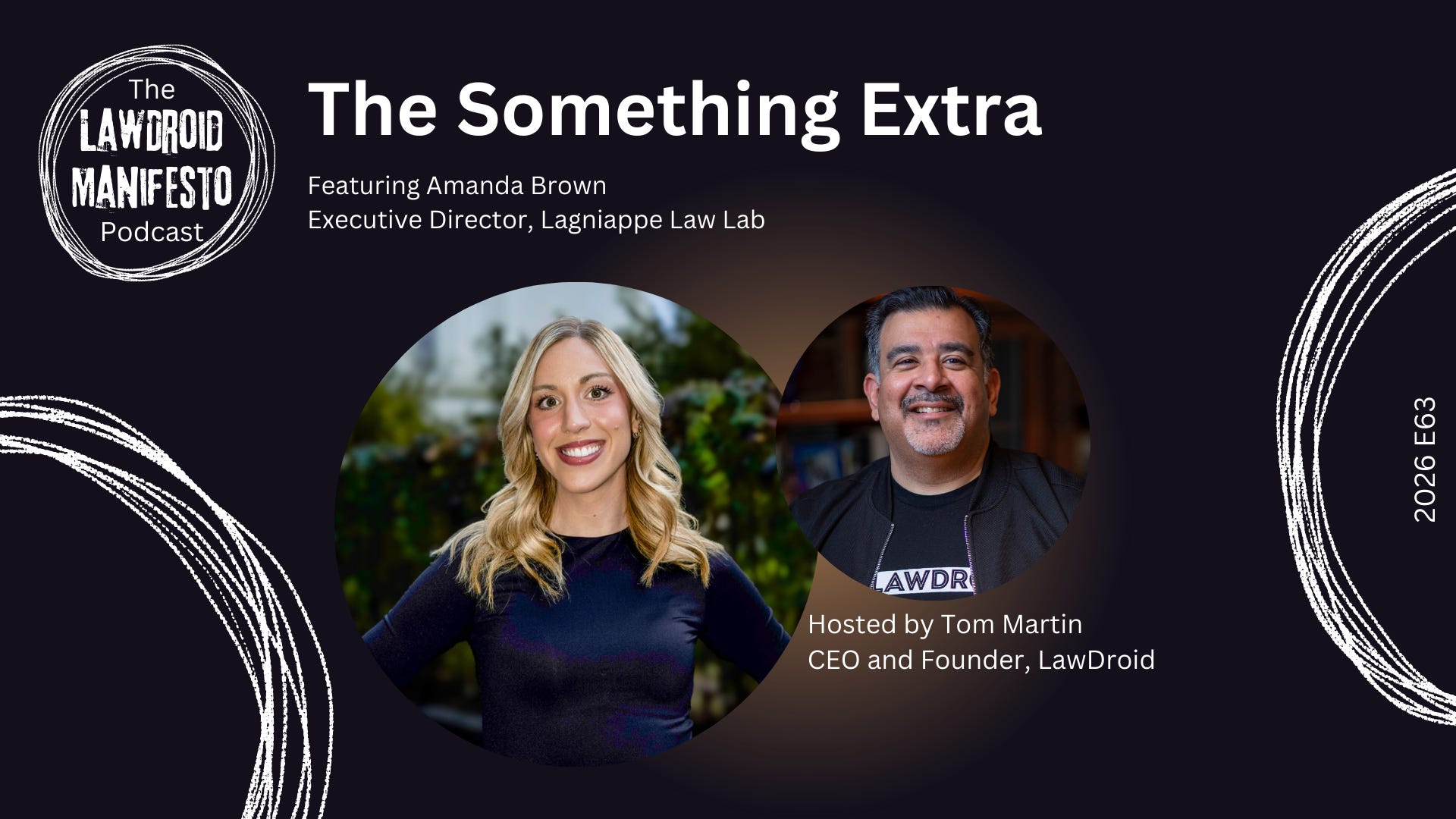
The Something Extra: Amanda Brown
Where I interview Amanda Brown, Executive Director of Lagniappe Law Lab, about building a statewide justice technology nonprofit from the ground up and using AI to expand access to justice across Louisiana.
Hey there Legal Rebels! 👋 I’m excited to share with you the 63rd episode of the LawDroid Manifesto podcast, where I will be continuing to interview key legal innovators to learn how they do what they do. I think you’re going to enjoy this one!
If you want to understand how technology can be used as a force for access to justice — and what it really takes to build a mission-driven legal tech nonprofit from scratch — you need to listen to this episode. Amanda is at the forefront of justice technology in Louisiana and brings a rare combination of legal expertise, product thinking, and deep community roots to this work.
From Rural Louisiana to the Forefront of Justice Technology
Join me as I interview Amanda Brown, Executive Director of Lagniappe Law Lab in New Orleans, Louisiana.
In this insightful podcast episode, Amanda shares her remarkable journey from a small, impoverished rural community in central northern Louisiana to a fellowship at Microsoft, and ultimately to founding Lagniappe Law Lab, a statewide justice technology nonprofit dedicated to helping legal aid organizations across Louisiana serve more people through smarter technology. She dives deep into how vibe coding is transforming her ability to prototype tools in real time, how she thinks about AI as a new layer in a complex system rather than a silver bullet, and why building technology thoughtfully — with the full picture in mind — is the only way to close the access to justice gap for real.
Her stories and insights underscore the power of approaching legal technology with both humility and ambition. This episode is a must-watch for anyone passionate about access to justice, legal innovation, and the enormous potential of AI to help the people who need legal help the most.
The Skinny
Amanda Brown, Executive Director of Lagniappe Law Lab, traces her path from growing up in a small, under-resourced town in rural Louisiana to earning a law degree at Loyola University New Orleans, completing a Microsoft fellowship focused on the Legal Navigator portal, and ultimately founding a statewide nonprofit dedicated to justice technology. Amanda reflects on how her economics background, her grandfather’s influence, and a formative litigation technology clinic in law school planted the seeds for a career at the intersection of law, access to justice, and technology. Throughout the conversation, she shares how she is using vibe coding to rapidly prototype tools for legal aid organizations, challenges the misconception that AI simply reduces workload, and emphasizes the importance of thinking holistically about technology as just one layer in a broader system. Her deep passion for the mission, and her honest acknowledgment of what is and is not known about where AI is headed, make this one of the most grounded and genuine conversations about legal technology you will hear.
Key Takeaways:
Amanda grew up in a small, impoverished rural community in central northern Louisiana, an experience that deeply shapes her commitment to access to justice and Lagniappe’s focus on serving rural areas across the state
Her grandfather, who never earned a high school diploma, was the key figure who pushed her toward college and ultimately toward law school, instilling a lifelong sense of justice and integrity
A litigation technology clinic in her final year at Loyola University New Orleans was the pivotal moment where she first saw the connection between technology and scaling legal services
A fellowship at Microsoft from 2017–2018, working on the Legal Navigator portal with the ABA Center for Innovation and the Legal Services Corporation, gave her the technical credibility and product management skills to launch Lagniappe
Lagniappe Law Lab functions as a centralized, statewide technology resource for Louisiana’s legal aid ecosystem, solving the problem of organizations duplicating effort without coordinating
Amanda is actively using vibe coding to prototype tools in near real time, describing the ability to go from a stakeholder meeting to a working prototype in under an hour as genuinely unfathomable compared to the past
Her biggest pushback on AI misconceptions: AI does not reduce work, it creates different work, and the legal profession lives at “the edges of novelty” where human judgment will always be essential
She is clear-eyed that nobody, not even the leading experts, truly knows where AI is headed, and that curiosity and openness are better responses than fear or hype
Work-life balance, for Amanda, is a practice: clear work hours, time for exercise, travel, reading, and relationships, all of which she connects back to being able to show up fully for the mission
Lagniappe derives its name from a Louisiana Creole word meaning “a little something extra,” and Amanda sees that spirit of going beyond as central to what justice technology can offer
Notable Quotes:
“I think technology is not the end all be all. It’s an additional layer on top of the core things that we’re doing. And so this version of technology, this tool is another layer that we have to think about.” - Amanda Brown (00:03:58-00:04:16)
“We have to really think of this holistically if we’re going to design and create technology systems that don’t further entrench problems that exist out there.” - Amanda Brown (00:06:25-00:06:39)
“My grandfather, he looked at me, he’s like, you know, that’s what lawyers do. That still sticks with me to this day, this concept of like the law is an instrument for justice.” - Amanda Brown (00:13:25-00:13:35)
“I think life is boring if you have a plan. A lot of life is kismet and accidents and how things fit together that we don’t expect. And that’s what makes it interesting.” - Amanda Brown (00:14:11-00:14:23)
“Being able to go from one meeting and listen to what problems people are having and what it is they actually need and want to — I’m looking at a prototype of what I built in response to that conversation right now on my screen. It’s unfathomable.” - Amanda Brown (00:27:36-00:28:07)
“The biggest misconception that you’re going to offload everything in your entire life to software. We’re in the legal profession. I think we live at the edges of novelty. AI is not good at novelty.” - Amanda Brown (00:31:39-00:32:11)
“Maybe the biggest one is that anybody knows what’s gonna happen. We don’t. Nobody knows what’s gonna happen. Don’t let Elon Musk tell you what’s gonna happen.” - Amanda Brown (00:32:33-00:32:44)
“Lagniappe — it’s the magic of a little something extra. In the early days, technology was extra. I don’t think it’s extra now. I think it’s actually essential.” - Amanda Brown (00:39:07-00:39:17)
Clips
AI Won’t Eliminate Novelty Jobs
AI Doesn’t Reduce Work
Why Rapid Prototyping Changes Everything
Work That Feeds the Soul
Amanda’s story is one of the most compelling I’ve heard in this space, not because it follows a straight line, but precisely because it doesn’t. She took the long way around, through economics, disaster recovery law, and a corporate fellowship in Redmond, Washington, before finding her calling building infrastructure for justice. And in doing so, she has helped ensure that legal aid organizations across an entire state don’t have to navigate the technology landscape alone.
What resonates most from this conversation is Amanda’s insistence on honesty. Honest about the complexity of the access to justice problem. Honest about what AI can and cannot do. Honest about the fact that nobody has all the answers. In a space that can be dominated by hype and grand promises, that clarity is both refreshing and necessary.
Closing Thoughts
What I love most about talking with people like Amanda is the reminder that the best legal tech work is rooted in something real — a community, a problem, a mission that goes far deeper than any particular tool or platform. Amanda didn’t set out to become a justice technology leader. She followed her sense of what was right, found the places where law and technology intersect in ways that actually help people, and built something that her state genuinely needed.
The vibe coding conversation was a highlight for me. The ability to move from a stakeholder conversation to a working prototype in under an hour is exactly the kind of practical empowerment I’ve been excited to see more lawyers and legal professionals embrace. It lowers the barrier to building, which ultimately lowers the barrier to access.
And I appreciate Amanda’s honest take on AI misconceptions. It creates different work, not less work. It is not magic, and it is not the end of legal professionals. But approached thoughtfully, as one layer in a broader, human-centered system, it is one of the most powerful tools we have for closing the justice gap.
For our Legal Rebels community, Amanda’s journey is both an inspiration and a model. You don’t need a perfect plan. You need integrity, curiosity, and the willingness to keep asking how can we do this better. That’s the something extra that makes the difference.


