


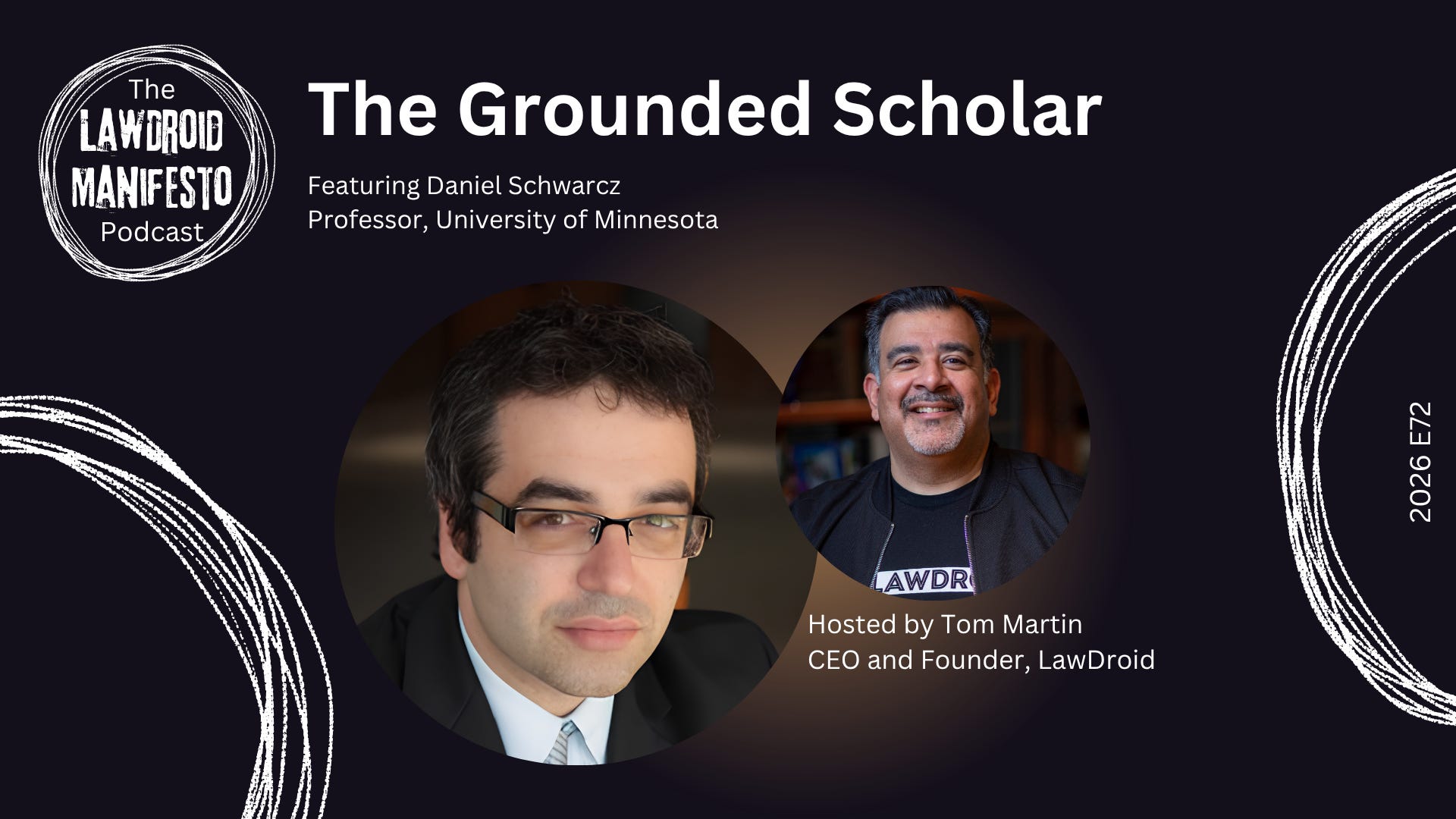
Hey there Legal Rebels! 👋 I’m excited to share with you the 72nd episode of the LawDroid Manifesto podcast, where I will be continuing to interview key legal innovators to learn how they do what they do. I think you’re going to enjoy this one!
If you want to understand what the data actually says about AI’s effect on legal reasoning, and why the conversation around lawyers and AI is long overdue for a reality check grounded in evidence, you need to listen to this episode. Daniel is at the forefront of empirical legal scholarship and brings a rigorously grounded, nuanced perspective to one of the most debated questions in legal tech today.
Does AI Dull a Lawyer’s Thinking? The First Empirical Answer Is Here
Join me as I interview Daniel Schwarcz, professor of law at the University of Minnesota and graduate of Harvard Law School.
In this insightful podcast episode, Daniel shares his journey from growing up in Scarsdale, New York, shaped by two lawyer parents, through Amherst College and Harvard Law School, to becoming one of the country’s leading empirical scholars on AI and the legal profession. He dives deep into his landmark randomized controlled trial of 100 law students, the first study of its kind to produce hard empirical evidence on whether using AI for one part of a legal task undermines a lawyer’s reasoning on the rest.
His stories and insights underscore his commitment to grounding the AI conversation in data rather than intuition, including a result that upended his own hypothesis: students who used AI actually performed better even after the AI was taken away. This episode is a must-watch for anyone who cares about the future of legal education, the development of lawyering skills, and how we build an evidence-based understanding of AI’s real impact on the profession.
The Skinny
Daniel Schwarcz, professor of law at the University of Minnesota and a Harvard Law School graduate, has spent nearly two decades building a scholarly career at the intersection of law, economics, and empirical research. His interest in AI predates the generative AI moment by over a decade, rooted in his early work on how machine learning was reshaping insurance underwriting and discrimination. When ChatGPT arrived, Daniel was uniquely positioned to turn that analytical lens onto one of the legal profession’s most pressing anxieties: does using AI make you a worse lawyer?
In a randomized controlled trial of approximately 100 upper-level law students, Daniel and his co-authors tested whether using AI to synthesize legal materials in one stage of a task would undermine performance in a subsequent stage where AI was no longer available. The hypothesis (intuitive, widely held, and seemingly well-supported by evidence from other domains) turned out to be wrong. Students who used AI in stage one not only outperformed the control group when they had AI, they continued to outperform them even after the AI was removed. The mechanism, Daniel explains, is straightforward: AI helped students develop a more accurate, robust understanding of the law, and that superior understanding carried forward.
The episode is a masterclass in how rigorous empirical thinking can cut through the noise of the AI debate and offer lawyers, educators, and legal innovators something genuinely rare: real evidence.
Key Takeaways:
The first randomized controlled trial of its kind found that law students who used AI to process legal materials performed better in a subsequent AI-free task—the opposite of the prevailing fear
The mechanism behind the result is intuitive in retrospect: AI helped students synthesize the law more accurately in stage one, and a better understanding of the law carried forward into stage two
Daniel is careful to scope his findings precisely: the study does not address long-term skill degradation from repeated AI use, a concern he still takes seriously and wants to see tested
Cognitive fatigue emerged as a potentially important moderating variable: students using AI at the end of a three-hour experiment appeared to use it less critically, with negative consequences for those who had already produced strong work
The finding that AI helped weaker performers but may have hurt stronger performers in the revision stage points to the importance of how and when AI is introduced, not just whether it is used
Daniel’s decade-plus background in AI and insurance, studying how machine learning tools affected underwriting and discrimination, primed him to think rigorously about AI’s real-world consequences long before generative AI arrived
His academic philosophy is built on grounded, practical relevance: he deliberately chose insurance law because it was important, understudied, and tangibly affected millions of people, the same spirit animates his AI research
Setting clear personal rules and treating them as binding is Daniel’s approach to work-life balance, a discipline he argues is especially necessary for academics, who lack the external structure of a typical workplace
Notable Quotes:
“There was still sort of a lot of hesitation among lawyers, because of this fear that using AI will make us worse lawyers. And I take that fear very seriously, and so it’s something I wanted to empirically investigate.” - Daniel Schwarcz (02:43-02:56)
“The folks who had AI, their brain was much less engaged. And so there’s something intuitive to me about that.” - Daniel Schwarcz (04:30-04:51)
“Our hypothesis going in was that the folks who used AI in stage one to help them make sense of the materials would perform less well once we took the AI away from them. But we found the opposite result.” - Daniel Schwarcz (25:34-26:32)
“The effect really was that AI helped you synthesize the rule, helped you get the rule accurately and see the nuances in stage one. And then even when you no longer had AI and you’re applying it to a new situation, having the rule in an accurate, robust fashion was helpful even when the AI was no longer available.” - Daniel Schwarcz (38:21-38:47)
“I think there’s good reason to think that when you’re using AI and you sort of have cognitive fatigue, you’re tired, you’re overwhelmed, maybe then actually the AI is more likely to push out critical thinking than if you’re using AI sort of when you’re fresh and you’re motivated.” - Daniel Schwarcz (34:32-34:49)
“I always want to sort of caution against saying we’ve definitively proven AI is not a risk. No. I think though that relative to my views on this before doing the study, I have less concern that using AI necessarily or inevitably dulls your capacity to perform when you’re not using it.” - Daniel Schwarcz (35:16-35:45)
“I really try to treat my own internal rules as binding because if you don’t, then there’s no point in setting those rules.” - Daniel Schwarcz (44:12-44:22)
“Part of why I like doing practical things is I like that it’s relevant to people. I don’t want to be relevant not just to a small group of ivory tower folks, but I want work that’s relevant to people that people find interesting and helpful in their daily lives.” - Daniel Schwarcz (44:48-45:03)
Clips
RCT Finds Surprising AI Effect
AI Improved Legal Skill Even After Removal
When AI Helps Some and Hurts Others
AI Helps — But Lawyers Worry
Does AI Really Make You A Better Lawyer?
Daniel Schwarcz’s work represents something the legal profession badly needs right now: empirical grounding in a conversation that has been dominated by intuition, fear, and hype in equal measure. His finding that AI use did not undermine, and in fact improved, subsequent AI-free performance challenges the most common argument offered by those skeptical of AI adoption in legal education and practice. But what makes this episode especially valuable is Daniel’s own intellectual honesty about what his study does and does not prove. He is not an AI booster. He is a scientist who followed his data, and whose data happened to push back against a widely held assumption.
What stands out most is the nuance he brings to the question of context. Whether AI helps or hurts legal reasoning may depend on factors like cognitive fatigue, the quality of work already produced, and how critically the tool is used. Those are not simple answers, but they are honest ones, and they point toward the kind of sophisticated, situation-specific thinking that lawyers are actually well equipped to do.
Closing Thoughts
What I love about this conversation with Daniel is that it does what the best scholarship always does: it takes a question seriously enough to actually test it. The fear that AI is quietly hollowing out lawyers’ reasoning skills is real and widespread, and it deserves a real answer. Daniel’s study provides one, even if it is a partial and carefully qualified one. And the answer, at least for now, is more reassuring than most people expected.
For me, this gets to something I’ve believed for a long time: we need to stop making decisions about AI in the legal profession based on speculation and start making them based on evidence. Daniel is doing that work. And the results are more nuanced, more interesting, and ultimately more useful than the hot takes dominating our feeds.
What also struck me is how Daniel embodies the very thing that makes a great legal scholar: intellectual rigor combined with genuine care for practical relevance. He chose insurance law because it mattered to real people. He chose to study AI’s effect on lawyers because that question matters to real people. That through line (grounded, practical, consequential) is exactly what the legal profession needs more of as we navigate this moment.
For our Legal Rebels community, the takeaway is not that AI is risk-free. Daniel himself would push back on that. The takeaway is that the risks are more specific, more contextual, and more manageable than the doom-and-gloom narrative suggests. Use AI when you’re sharp. Verify what it gives you. Understand the law it’s helping you synthesize. Do that, and the evidence suggests you may actually come out ahead.
Link to Daniel’s paper:
Bednar, Nicholas and Cleveland, David R. and Erbsen, Allan and Schwarcz, Daniel, Artificial Intelligence and Human Legal Reasoning (April 05, 2026). Minnesota Legal Studies Research Paper 2026-21, Available at SSRN: https://ssrn.com/abstract=6525800 or http://dx.doi.org/10.2139/ssrn.6525800


