


Hey there Legal Rebels! 👋 I’m excited to share with you the 74th episode of the LawDroid Manifesto podcast, where I will be continuing to interview key legal innovators to learn how they do what they do. I think you’re going to enjoy this one!
If you want to understand how human-centered design and lived experience can transform AI into a genuine access-to-justice engine, you need to listen to this episode. Claire is at the forefront of legal tech product development and brings a uniquely grounded perspective, rooted in years of working directly with the people she now builds for.
Encoding Empathy into AI: How Upsolve Is Rewriting Access to Justice
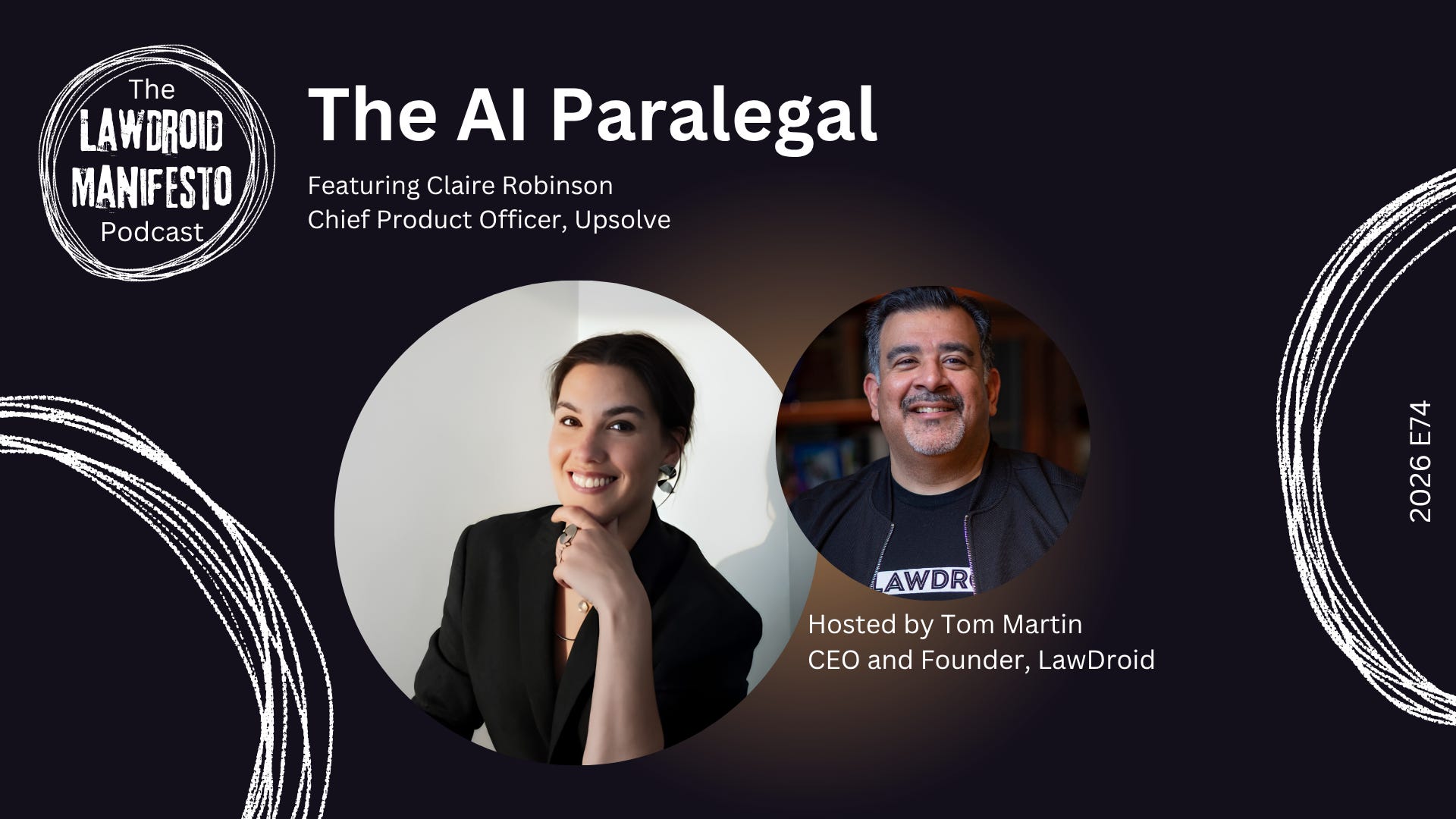
Join me as I interview Claire Robinson, Chief Product Officer at Upsolve.
In this podcast episode, Claire shares her remarkable journey from growing up in the Redwood forests of Humboldt County to becoming the product mind behind one of the most impactful legal AI tools in the country. She dives deep into how her time as a paralegal, sitting across from low-income Americans navigating bankruptcy, gave her the exact knowledge needed to design an AI tool that truly helps rather than just answers questions. Claire also walks us through how Upsolve’s AI Paralegal works: a context-aware assistant embedded directly inside the app that can see what users see and guide them through the process in real time.
Her stories and insights underscore the power of starting with people, not technology. This episode is a must-watch for anyone curious about how access-to-justice organizations are harnessing AI to do more for the people who need it most, and what it takes to build legal tech that actually works at scale.
The Skinny
Claire Robinson, Chief Product Officer at Upsolve, brings a rare combination of frontline legal experience and product leadership to one of the most important access-to-justice platforms in the country. Upsolve functions as a TurboTax-style tool for Chapter 7 bankruptcy, and has helped over 23,000 families discharge more than $1.1 billion in debt, mostly medical bills and past-due credit cards. Claire began her career at Upsolve as a paralegal, spending thousands of hours helping low-income Americans navigate the bankruptcy process, before transitioning into product leadership and ultimately becoming CPO. That lived experience is the foundation of Upsolve’s AI Paralegal: a context-aware assistant embedded inside the app that can see the same screen as the user, answer questions about the interface in real time, and guide people through a complex legal process on a cell phone, often at night, while managing their families. The tool proved so effective that in November 2024, Upsolve had to shut off new signups for two weeks because demand overwhelmed their human paralegal quality-check team. Claire’s approach, treating AI as an accelerant of good human-centered design, not a replacement for it, offers a powerful model for the broader legal tech world.
Key Takeaways:
Claire’s origin story, growing up in rural Humboldt County, working in the Bay Area Justice Corps, and helping wildfire survivors, shaped a deep commitment to access-to-justice work that has driven every career decision since
Her time as a paralegal at Upsolve gave her thousands of conversations with real users, which became the foundation for designing an AI tool that anticipates actual user needs and friction points
Upsolve’s AI Paralegal goes far beyond a standard chatbot: it is context-aware, meaning it can see what screen the user is on and answer questions about what they are actually experiencing in the app
The tool proved so effective that Upsolve had to temporarily pause new signups in November 2024, an unprecedented move, because so many people were completing the process that the human paralegal quality-check team couldn’t keep pace
Upsolve has helped over 23,000 families discharge more than $1.1 billion in debt, and views bankruptcy as the social safety net of last resort for low-income Americans
Claire’s philosophy is that AI is an accelerant, not inherently good or bad, meaning it amplifies whatever design choices are already baked into the product
She deliberately took a detour into startup sales at Ditto before joining Upsolve, which gave her breadth of experience that now shows up in her product thinking and cross-functional leadership
Work-life balance, in Claire’s view, is best measured across a year rather than a week; she structures her life in sprints and finds that doing meaningful work generates more energy, not less
Notable Quotes:
“I’m a big fan of the thinking that AI is an accelerant, but not necessarily always a positive accelerant. Just whatever you’re doing, it’s going to be more of that.” - Claire Robinson (05:53-05:59)
“So many people were able to get through as a result of the AI chatbot that we had in app that we did actually have to turn off the app for two weeks to any new signups, which was unprecedented in Upsolve history.” - Claire Robinson (02:29-02:41)
“We have helped just over 23,000 families relieve, I think now 1.1 billion in debt, mostly medical bills, past due credit cards for basic living expenses.” - Claire Robinson (03:08-03:22)
“I wanted to think about what was this tool uniquely positioned to do? And how could we use this as an opportunity to not just provide help, but provide really good help?” - Claire Robinson (27:31-27:42)
“If I was entering my name and I entered my first name, but I didn’t enter my last name and that continue button at the bottom was grayed out... I could ask the AI tool, why can’t I move forward? And it would tell me, you need to put in your last name before you can click continue.” - Claire Robinson (28:53-29:04)
“As someone who early in my career had to look every day—we could help 20 people and usually about 60 people would show up—when I started playing around with early versions of AI, it was just revolutionary to have this opportunity to not have to turn people away.” - Claire Robinson (26:28-26:50)
“I think we have a moral responsibility to make our tool as good as possible as quickly as possible. So if we are in an unfortunate situation where more people need that resource, we’re available to meet that demand.” - Claire Robinson (32:03-32:11)
“I do think that there is such a thing as work life balance, but over the course of the year, not a week.” - Claire Robinson (33:44-33:48)
Clips
AI Overwhelmed the App
Balance Happens in Sprints
How a Wild Childhood Shaped Claire
We Have a Moral Responsibility
Claire Robinson’s story to me is ultimately about what happens when the right person builds the right tool at the right time, and makes sure the technology never loses sight of the human being on the other end of the screen. Her path from paralegal to Chief Product Officer is not a detour; it’s a direct line, because every role she held deepened her understanding of what vulnerable people actually need when they’re facing one of the most stressful events of their lives.
What makes Upsolve’s AI Paralegal stand out in a crowded field of legal chatbots is precisely what Claire insists on: the tool knows where you are, what you’re looking at, and what’s tripping you up, because someone spent years in that chair, answering exactly those questions. That embedded empathy is what turned an AI assistant into something capable of overwhelming its own team with success.
Closing Thoughts
What Claire is doing at Upsolve is exactly the kind of work that gets me excited about where legal technology is heading. She’s not building AI for its own sake, she’s building it because she’s sat across from real people who needed help, and she refused to accept the status quo as the permanent state of affairs.
Imagine: Upsolve had to shut its doors to new users because the AI worked too well. That is a remarkable problem to have. It tells you that when you design from genuine human understanding, when your product team has lived the experience your users are living, the results can scale in ways that outpace your own capacity.
For our Legal Rebels community, Claire’s story is a reminder that the most powerful legal technology doesn’t start with the technology. It starts with the person on the other side of the process. The lawyers and legal innovators who will thrive in the years ahead are the ones who hold onto that insight even as the tools get more sophisticated and the temptation to be dazzled by capability grows stronger.
Upsolve has helped 23,000 families be freed from over $1.1 billion in debt. That number is going to keep climbing, and it will do so because someone cared enough to really understand the problem before they tried to solve it.


