


Hey there Legal Rebels! 👋 I’m excited to share with you the 78th episode of the LawDroid Manifesto podcast, where I will be continuing to interview key legal innovators to learn how they do what they do. I think you’re going to enjoy this one!
If you want to understand why so much law firm marketing spend produces so little actual marketing, and why the tools promising to replace your strategist keep falling short, you need to listen to this episode. Tifiny sits at the intersection of hands-on tech and practical strategy, and she has a clear-eyed view of what AI can and can’t do for a firm.
The Human in the Loop: Why Marketing Still Needs an Owner
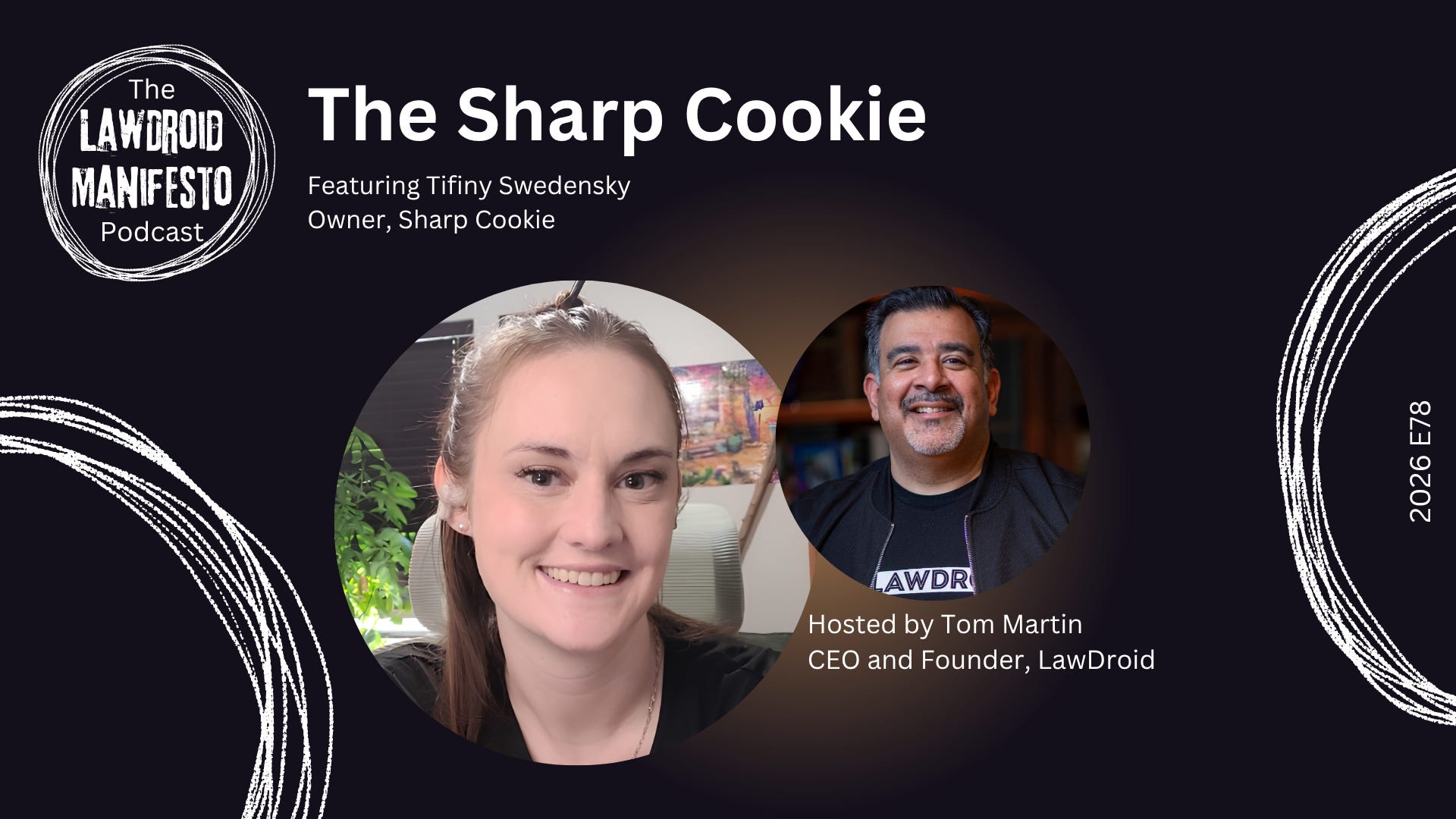
Join me as I interview Tifiny Swedensky, owner of Sharp Cookie, a technomancer and fractional CMO who came up through web development before taking ownership of law firm marketing departments.
In this episode, Tifiny walks through her path from teaching herself HTML, CSS, JavaScript, and PHP while stuck job-hunting in Northern Virginia, to a seven-year dual role with Ben Glass and Great Legal Marketing, to building Sharp Cookie into a fractional CMO practice with a team behind it. Along the way she unpacks two ideas that frame the whole AI moment for professionals, the Doorman Fallacy and the Gell-Mann Amnesia Effect, and explains why she tried to automate herself out of a job and learned exactly where the tools break.
This one is for any lawyer wondering whether they can hand their marketing to a chatbot, and for any marketer trying to articulate the value they add beyond a printed page of advice.
The Skinny
Tifiny Swedensky owns Sharp Cookie, a fractional CMO practice serving law firms. She reached legal marketing by an unusual route, an English literature and creative writing start, a pivot to marketing and communications, and a self-taught detour through web development that made her marketable enough for Ben Glass and Great Legal Marketing to hire her as a digital marketing specialist. After roughly seven years in a dual role across the agency and the law firm, she struck out on her own for more control over her life and less time commuting, and gradually turned a solo freelance operation into a systematized company with a team.
The heart of the conversation is ownership. Tifiny frames a fractional CMO as someone who takes ownership of the marketing department, coordinating the team, guiding strategy, and, in her own words, acting as the glue between the normally disconnected pieces of a firm’s marketing. She contrasts that with the common reality where an SEO vendor is effectively the firm’s entire marketing department, with a scope far narrower than most attorneys realize. When a lawyer asks why they need a CMO if they can just ask an AI to build a strategy, her answer is grounded in the Doorman Fallacy, reducing a role to its most visible function and eliminating everything invisible that made it work. AI will happily generate a list of things to do, but someone still has to do them, follow through, and drive toward the goal. That follow-through, she argues, is the whole job.
Key Takeaways
A fractional CMO takes ownership of the marketing department, coordinating team and vendors, guiding strategy, and providing data, rather than acting as a glorified marketing assistant.
The Doorman Fallacy explains why replacing a role with automation can be a net negative, the outsider sees only the primary function and misses everything else the person quietly handled.
The Gell-Mann Amnesia Effect is a useful check on AI output, we spot every flaw in coverage of our own expertise, then trust the same source completely on topics we don’t know.
AI can hand you a to-do list, but it won’t execute it, follow through, or think through the big picture, the value a strategist adds is in the doing and the driving.
For many firms, an SEO vendor has quietly become the entire marketing department, and the scope of a typical SEO contract is far narrower than the firm assumes.
Substack can function as an accessible, low-cost marketing list and near-CRM, a place to build an audience of potential referrers rather than chase one-to-one transactions.
The transactional mindset many lawyers bring to content is the wrong one, the point is to be social, let people get to know you, and open relationships that may lead somewhere later.
Structure and routine compound, Tifiny credits a disciplined personal turnaround with teaching her the habits that now anchor her work-life balance and her business systems.
Notable Quotes
“They look at somebody in that role and they say, well, we can install a machine that’ll open doors so we don’t need that person. And then things start falling through the cracks.” Tifiny Swedensky [04:11 to 04:38]
“Whenever you’re an expert in a topic and you read a publication that’s writing about that topic, you’re really quick to point out the flaws, but later you might read an article from that same publication and accept everything in the article as truth.” Tifiny Swedensky [05:14 to 05:33]
“It’s going to give you a list of things to do, but you have to do them. And AI isn’t autonomous.” Tifiny Swedensky [35:43 to 35:50]
“We’re acting as kind of a glue, bringing together all these normally disconnected pieces of a law firm marketing department.” Tifiny Swedensky [30:16 to 30:24]
“Most law firms are spending a lot, but there’s not a lot that’s happening that’s actually marketing.” Tifiny Swedensky [38:05 to 38:12]
Clips
Why SEO Alone Fails
I Lost 50 Pounds and Transformed My Business
The Sharp Cookie Way
Why AI Hype Is Overblown
Tifiny’s throughline is that marketing is not a document, it is a discipline. The Doorman Fallacy and the Gell-Mann Amnesia Effect are two sides of the same caution, we underrate the invisible work a role performs, and we overtrust confident output the moment it leaves our own area of expertise. A fractional CMO earns her place precisely in the gap AI leaves open, taking ownership, connecting the disconnected pieces, and making sure the twenty unglamorous tasks behind any strategy actually get done. The tools are genuinely useful, but they are insufficient at execution and big-picture critical thinking, and a firm that mistakes a to-do list for a marketing department will feel the difference.
Closing Thoughts
Every so often on this show I talk with someone whose sober realism is more exciting than any hype. Tifiny is one of those people. She has actually tried to automate herself out of a job, which is exactly why her skepticism carries weight, it comes from doing the work, not from fearing it. What stays with me is her framing of a fractional CMO as the glue, the owner who turns strategy into shipped work and holds a firm’s scattered marketing pieces together. In a moment when it’s fashionable to imagine an agent can simply replace a role, the Doorman Fallacy is a needed corrective, and the Gell-Mann Amnesia Effect is a reminder to stay humble about the confident answers we accept outside our expertise. If you’re a lawyer weighing whether a chatbot can run your marketing, listen to how Tifiny answers that question, then try following through on exactly what the tool tells you to do. The results will teach you everything you need to know.


