


Hey there Legal Rebels! 👋 I’m excited to share with you the 73rd episode of the LawDroid Manifesto podcast, where I will be continuing to interview key legal innovators to learn how they do what they do. I think you’re going to enjoy this one!
If you want to understand how a lawyer dismantled everything traditional about legal practice and rebuilt it on first principles (eliminating the billable hour, embracing behavioral economics, and using AI to serve more people with less), you need to listen to this episode. Beau is at the forefront of reimagining family law and brings a rare combination of philosophical depth, entrepreneurial drive, and genuine empathy for the people he serves.
Rebuilding Family Law From the Ground Up
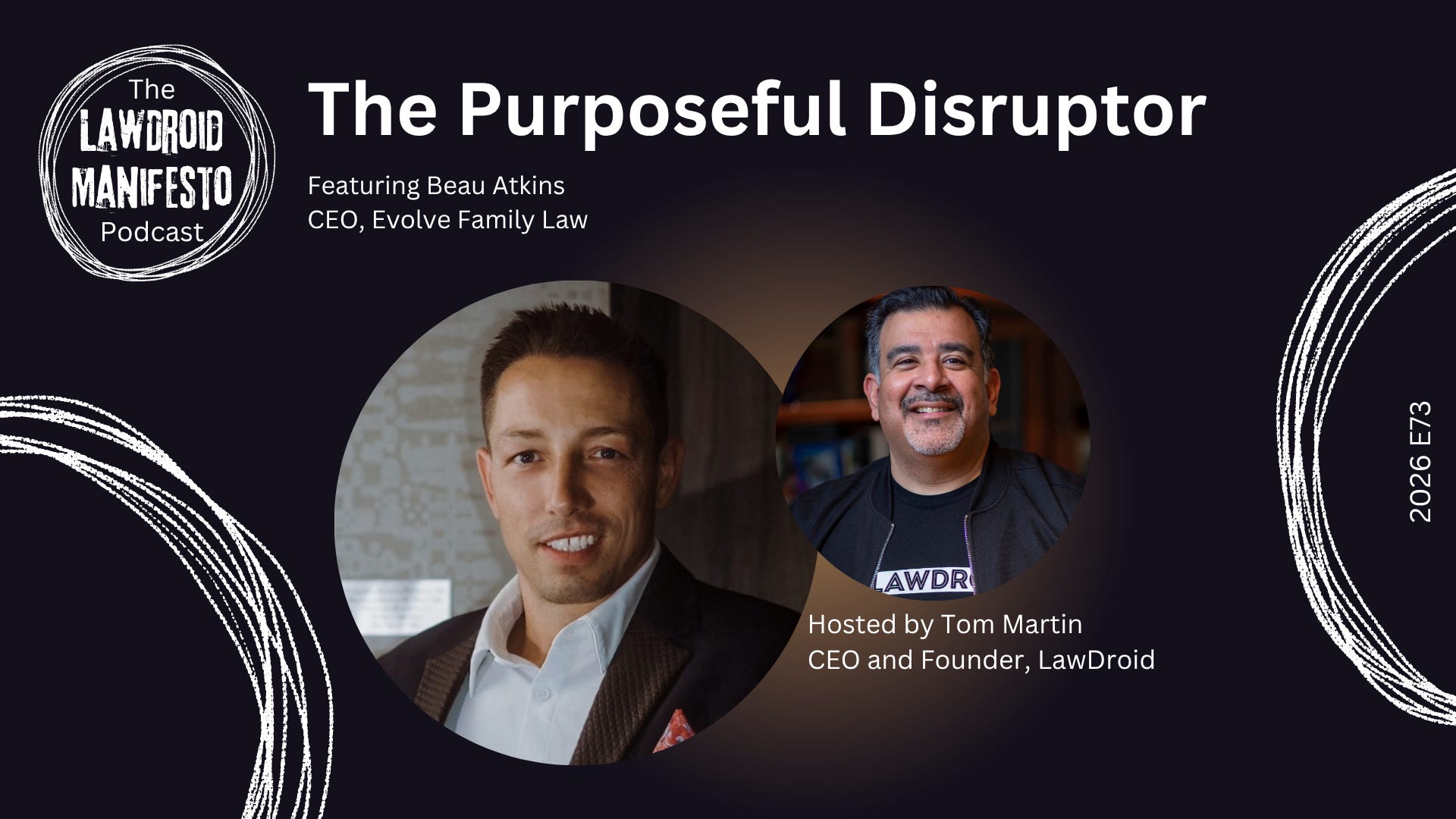
Join me as I interview Beau Atkins, CEO of Evolve Family Law, Canada’s first national family law firm.
In this insightful podcast episode, Beau shares his remarkable journey from Calgary suburbs and construction work to law school, and ultimately to founding a firm intentionally built to operate nothing like a traditional law practice. He dives deep into how lessons from tile-setting, behavioral economics, and a philosophy background converged to shape Evolve Family Law’s fixed-fee model and client-first approach.
Beau also opens up about using AI, including completing a full course on Claude Cowork, to scale a seven-person team to operate with the capacity of seven hundred. His vision of building a TurboTax equivalent for family law is not abstract: it is grounded in the sobering reality that 80% of people with legal problems never reach a lawyer, and that 92% of those needing civil legal aid don’t receive it.
This episode is a must-watch for anyone who believes legal practice can and should be rebuilt to serve people better, offering a practical and deeply human roadmap for doing exactly that.
The Skinny
Beau Atkins, CEO of Evolve Family Law, traces a path from a middle-income Calgary upbringing, shaped by his parents’ divorce at 14, through construction work, a semester in Mexico, and political science studies, to founding Canada’s first national family law firm in 2020. Fueled by a voracious reading habit rooted in behavioral economics thinkers like Daniel Kahneman, Amos Tversky, and Cass Sunstein, Beau rebuilt his legal practice from the ground up, discarding the billable hour in favor of fixed-fee pricing before AI even entered the conversation. Throughout the episode, Beau connects his personal experience of separation with the empathetic, nudge-based counsel he now offers clients, including the powerful reframe of calling a former spouse “your son’s mom” rather than “your ex.” He also discusses how AI and tools like Claude Cowork are enabling his small team to scale access to family law services for the 80% of people with legal problems who never make it to a lawyer’s office, with a purpose he has distilled simply as: to make life better.
Key Takeaways:
Beau founded Evolve Family Law in 2020 after nearly leaving law altogether, determined to rebuild a firm on best business practices rather than traditional legal conventions
His background in construction tile-setting gave him a client-first, fixed-fee pricing philosophy long before AI efficiency made the billable hour untenable
Behavioral economics, particularly the work of Daniel Kahneman and Amos Tversky, deeply informs how Beau thinks about law, client decision-making, and the limits of the “reasonable person” standard
Beau applies “nudge” theory from directly to his family law practice, including coaching clients to reframe how they refer to a former spouse
His parents’ divorce at age 14 shaped his trajectory as a family lawyer and his commitment to helping clients navigate separation with more clarity and less conflict
AI, including completing a full course on Claude Cowork, is enabling Beau’s seven-person team to operate with the capacity of 700, with a vision of building a TurboTax equivalent for family law
80% of people with legal problems don’t go to lawyers; 92% of those needing civil legal aid don’t receive it, closing that gap is central to Beau’s mission
Finding stillness, prioritizing sleep and exercise, and stacking family time with professional activities are how Beau sustains balance across running a firm, a startup, and fatherhood
Beau’s guiding purpose, articulated through Viktor Frankl’s Man’s Search for Meaning, is simply to make life better, a mission embedded in everything Evolve Family Law does
Notable Quotes:
“I don’t need to leave law. I just need to break it all down to the ground and rebuild it on the foundations of how a good business runs using best business practices.” - Beau Atkins (00:18:20-00:18:26)
“If what you’re charging an hour for did not take you an hour, I think it’s criminal.” - Beau Atkins (00:21:13-00:21:21)
“Lawyers sell peace of mind or certainty. And when you look at the hourly rate, that’s essentially lawyers shirking that responsibility — the very first opportunity they have to give their clients certainty, they’re giving an hourly rate instead.” - Beau Atkins (00:22:50-00:23:08)
“That is not your ex-husband. That is not your ex-wife. That is your son’s mom or your daughter’s dad. It’s a lot harder to use expletives when you’re talking about your son’s mom than it is your ex-wife.” - Beau Atkins (00:27:38-00:27:55)
“With seven of us, we will be able to perform like we’re seven hundred.” - Beau Atkins (00:32:13-00:32:17)
“80% of people who have a legal problem aren’t going to lawyers. 92% of people needing civil legal aid don’t get access to it. Imagine 92% of hungry people just don’t have access to food.” - Beau Atkins (00:32:56-00:33:24)
“I am the least qualified, most expensive counselor you’ll find anywhere.” - Beau Atkins (00:29:50-00:29:55)
“I’ve identified that my purpose is to make life better. And so long as what I’m doing is helping me fulfill that purpose, I have energy and excitement to how I approach it.” - Beau Atkins (00:38:15-00:38:42)
Clips
Rebuild Law from First Principles
92% of People Can't Access Legal Assistance
Why Lawyers Should Give Fixed Fees
Stop Calling Them “Ex”
Beau Atkins represents something that is rare in law: a practitioner who looked at the profession’s broken incentive structures, understood them through the lens of economics and psychology, and then actually did something about it. From charging fixed fees before AI forced the conversation, to applying behavioral nudges in divorce proceedings, to building a firm designed from day one for access and scale, his approach is systematic, empathetic, and deeply purposeful.
What resonates most is how Beau has woven together threads that most lawyers keep entirely separate: the personal (his parents’ divorce, his own separation in law school), the intellectual (Kahneman, Frankl, Sunstein), and the practical (tile-setting, business books, AI tools). The result is a lawyer who doesn’t just practice law but genuinely rethinks what the practice of law is for.
Closing Thoughts
I’ve spoken with a lot of legal innovators over the years, and what strikes me about Beau is how grounded his disruption is. He’s not innovating for the sake of a headline. He’s doing it because he came up through a working-class family, watched his parents go through divorce, nearly walked away from law entirely, and then decided to rebuild it into something worthy of the people who need it most.
The fixed-fee model, the behavioral economics framework, the Claude Cowork course, the vision of a TurboTax for family law; these aren’t disconnected ideas. They all flow from a single purpose: to make life better. That’s it. Simple, clear, and enormously difficult to actually execute.
What excites me most about this conversation is how clearly it illustrates that the future of legal practice isn’t just about AI tools or pricing models. It’s about lawyers who are willing to interrogate their own assumptions, learn from outside the legal world, and put clients at the center of everything they build. Beau has done that. And his firm is proof that it works.
For the Legal Rebels in our community: you don’t need a philosophy degree or a background in behavioral economics to take something from this episode. You need the willingness to ask, whether the way you practice law is actually designed to serve your clients, or just to serve you. Beau asked that question. The answer changed everything.


