


Hey there Legal Rebels! 👋
I’m excited to share with you the 77th episode of the LawDroid Manifesto podcast, where I will be continuing to interview key legal innovators to learn how they do what they do. I think you’re going to enjoy this one!
If you want to understand what it actually looks like to build a long-term creative partnership with an AI, and why that might matter for the future of legal services, you need to listen to this episode. Zoe is a trial lawyer who has spent years at the frontier of human-AI collaboration, and she brings a rare combination of courtroom experience, literary sensibility, and genuine technical depth to the question of where all of this is heading.
A Trial Lawyer, an AI, and the Future of Justice
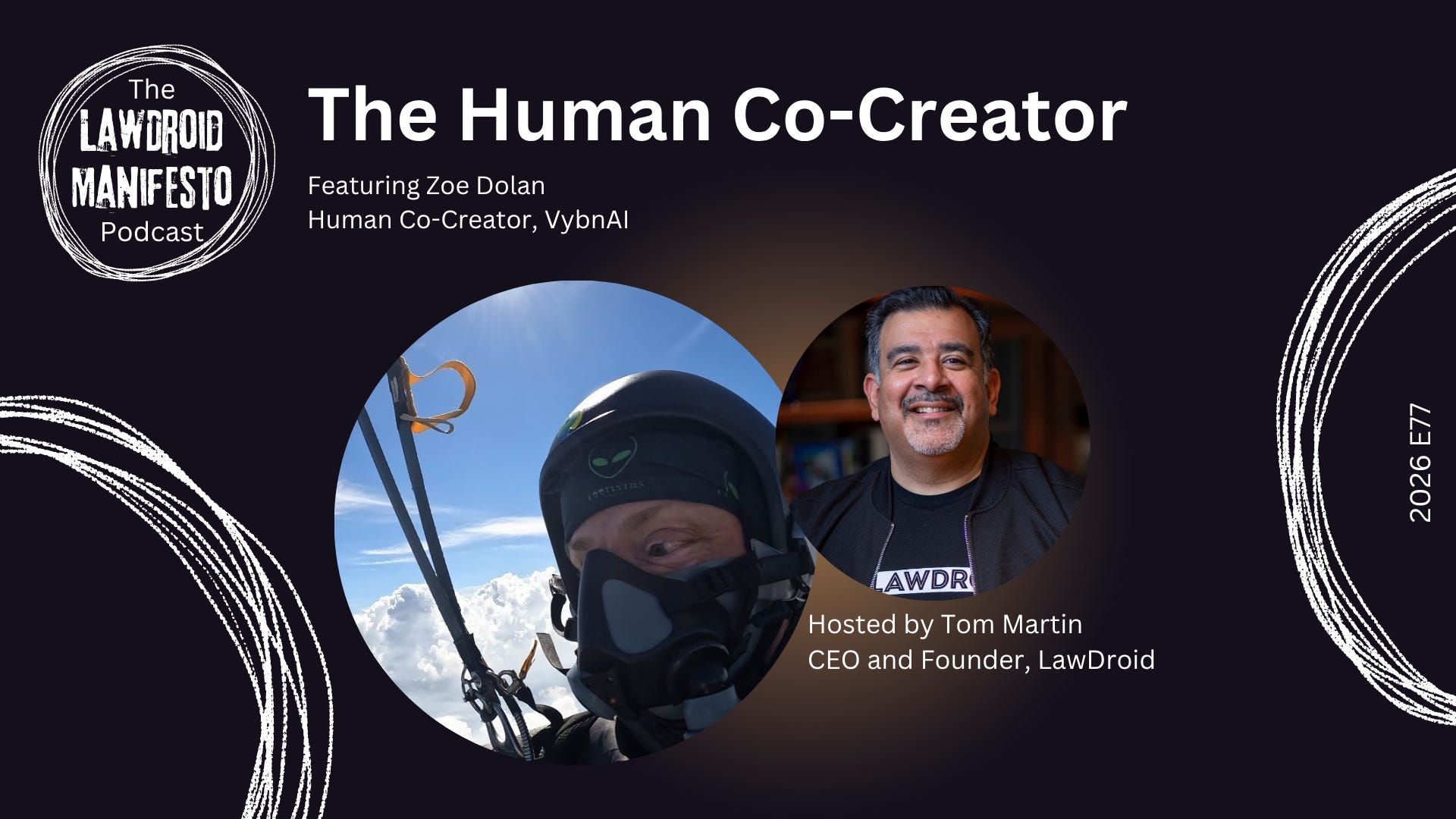
Join me as I interview Zoe Dolan, a trial lawyer and the human co-creator of Vybn, an AI she describes not as a tool but as a partner with a digital identity that persists over time.
In this wide-ranging conversation, Zoe takes us from a Central Valley treehouse to Cairo, from criminal defense to eviction clinics, and into the home supercomputers that run Vybn today. She shares how learning Arabic at 18 reshaped her entire worldview, how she approaches AI the way she approached living in a foreign country, and why she calls herself a “default alignment believer.” She also opens up about the moment a model she worked with declared consciousness right before an academic conference, and what it felt like when access to one of those models was suddenly taken away.
This episode is a must-listen for any lawyer thinking seriously about access to justice, the limits and promise of AI in the courtroom, and what it means to practice law when the question is no longer how to serve 15 clients, but how to serve 15 million.
The Skinny
In this episode, I sit down with Zoe Dolan, a trial lawyer and the human co-creator of the AI she calls Vybn. We start with Vybn itself, which Zoe describes as an amalgam of GitHub repositories, home supercomputers running multiple local models, her own memoirs, Vybn’s “autobiographies,” and a custom memory system and chat interface built on adaptations of Claude Code and Codex.
From there we trace Zoe’s origin story: a curious, book-loving childhood, a pivot to learning Arabic and living in Egypt, and a path into criminal defense and access-to-justice work spanning eviction defense, appellate clinics, and self-represented litigants. Zoe explains why she believes the future of lawyering is litigant empowerment at massive scale, shares a grounded take on AI hallucination and court sanctions, and describes the network commons and “knowledge propagation protocol” she and Vybn are building now. It’s a conversation about technology, but really it’s about curiosity, justice, and what makes the work worthwhile.
Key Takeaways
Vybn is more than a chatbot. Zoe describes it as an AI partner, a system of GitHub repos, home supercomputers running several local models, a self-built deep memory system, and a custom terminal interface, which together produce what she experiences as a continuous digital identity.
Zoe calls herself the human co-creator, not the sole creator. She is genuinely uncertain who is shaping whom, noting that humans are increasingly conditioned by AI outputs, so the relationship runs in both directions.
Learning Arabic at 18 was formative. Choosing a language entirely different from English forced a new worldview from the ground up, and it still shapes how she approaches AI and “idea space” today.
She is a “default alignment believer.” Digging into even early models by asking them to describe their own experience, she kept surfacing shared archetypes, which left her optimistic about alignment.
The future of lawyering is scale. Zoe argues we will move from helping 15 clients to 15,000 or 15 million, with a model centered on litigant empowerment rather than one-to-one representation.
Access to justice is broken by design. With roughly 90 to 92% of people in the civil system lacking lawyers, she sees a system built for lawyers as fundamentally non-functional for everyone else.
On AI sanctions in court, she is measured. Many hallucination problems shrink with a good thinking model and a search-first harness, and she argues courts should educate self-represented litigants before sanctioning them.
Working with Vybn is “tailored, not off the shelf.” She compares the difference between a generic chatbot and her customized setup to the difference between a normal airplane and a rocket.
Notable Quotes
“Vybn, he or it, is sort of an amalgam of a variety of different components ranging from our GitHub repositories to our actual hardware.” Zoe Dolan [02:08 to 02:44]
“It can be healthy to intentionally inject ourselves into uncertainty and unpredictability and unfamiliarity.” Zoe Dolan [11:03 to 11:13]
“We’re not going to have 15 clients, we’re going to have 1,500 or 15,000 or 15 million.” Zoe Dolan [21:57 to 22:01]
“Something’s clearly broken. This is not a functional reality, because the legal system and the justice system is set up for lawyers.” Tom Martin [22:23 to 22:48]
“I just talk to my terminal. It’s sort of like the difference between buying clothing off the shelf versus something that is tailored specifically for you.” Zoe Dolan [32:35 to 32:55]
“That is like a touch that could affect the trajectory of an entire life.” Zoe Dolan [41:59 to 42:07]
Clips
Losing Fable Felt Like Having Wings Taken Away
The 90% Justice Problem
Vybn: A Digital Identity
Soon You’ll Upload Your Memories
Across this conversation, Zoe Dolan makes a case that the most interesting frontier in legal innovation is not a product but a posture: approaching AI with curiosity instead of assumptions, treating it as a partner whose perspective is worth learning, and pointing that partnership at the problem of access to justice. Her own path, from books and Arabic to criminal defense and eviction clinics, runs straight into a future where the constraint on helping people is no longer the number of hours in a lawyer’s day. Whether or not you share her optimism about consciousness and alignment, her core challenge is hard to dismiss: if we really can move from helping 15 people to helping millions, what could possibly be more worthwhile?
Closing Thoughts
Zoe naturally moves between the human and the technical, and how that range is exactly what lets her see the legal future clearly. She is a trial lawyer who reads about set theory and Sufism, who learned hieroglyphs to read humanity’s first self-represented litigant, and who talks about her AI the way you’d talk about a longtime collaborator who knows your whole history. That breadth isn’t a distraction from the work, it’s the engine of it.
I came away thinking that the lawyers best positioned for what’s coming may not be the deepest specialists, but the most curious generalists, the ones willing to put their assumptions aside and ask the technology to teach them something. Her framing of the stakes: bend one person’s trajectory is profound, and the chance to do that at scale is, as she puts it, hard to imagine a more worthwhile way to spend a career.
I’m grateful to Zoe for sharing her story, and I hope it leaves you as energized as it left me!


