


Hey there Legal Rebels! 👋
I’m excited to share with you the 76th episode of the LawDroid Manifesto podcast, where I will be continuing to interview key legal innovators to learn how they do what they do. I think you’re going to enjoy this one!
If you want to understand how open source is reshaping the legal AI landscape and why the gap between what premium tools market and what they actually deliver is narrower than anyone admits, you need to listen to this episode. Will is at the forefront of un-gatekeeping legal AI, and he has a rare combination of big-firm experience and hands-on technical skill.
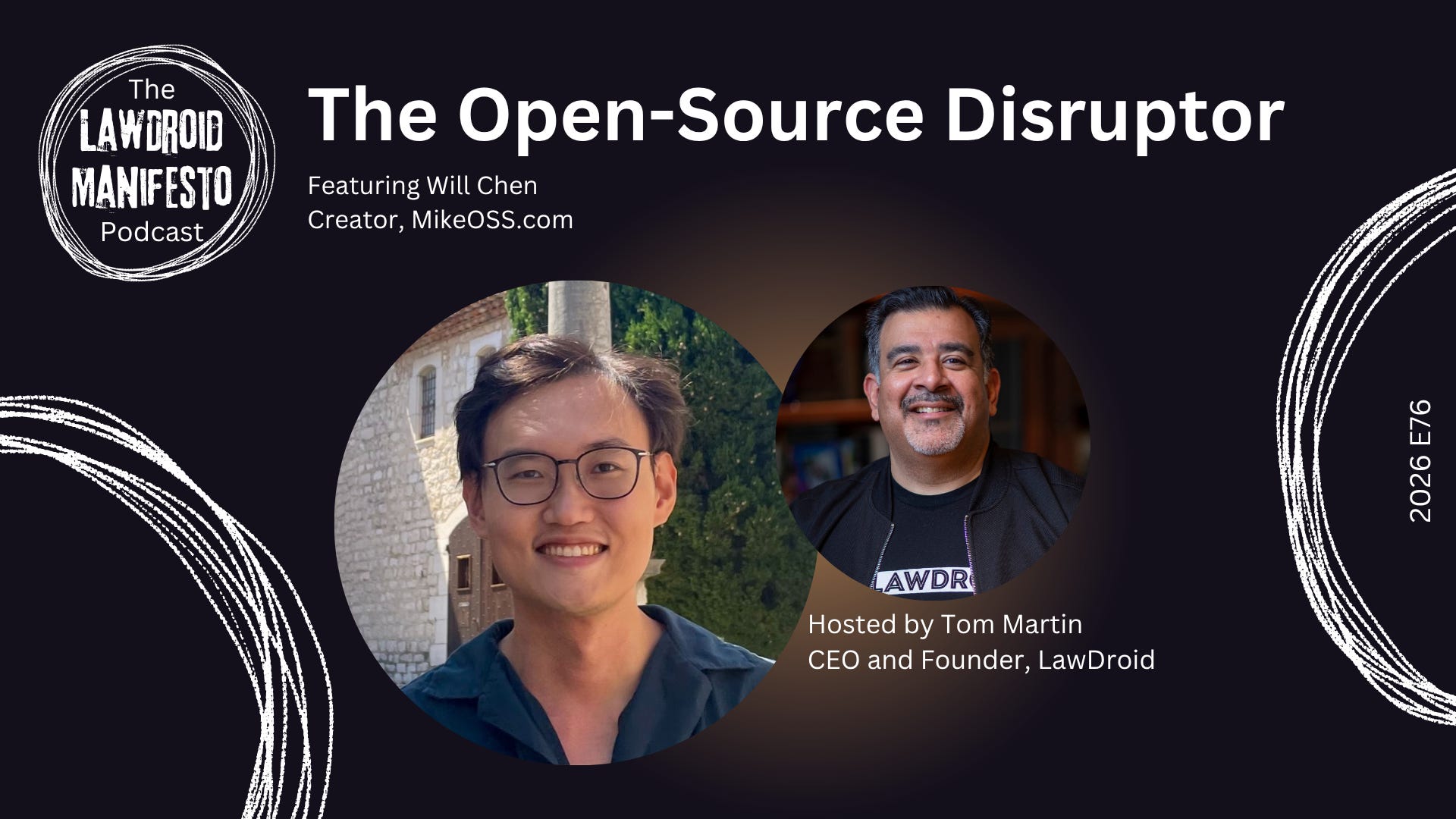
Un-Gatekeeping Legal AI: The Open Source Challenge to Harvey and Legora
Join me as I interview Will Chen, the creator of the open source tool Mike OSS, who left a three-year run as an associate at Latham & Watkins to follow his interest in code and entrepreneurship.
In this eye-opening episode, Will explains how a casual look at his friends’ screens convinced him that the core features of multi-billion-dollar legal AI products could be rebuilt in a couple of months. He walks through what those products actually do, why he decided to open source his version, and the firestorm of attention, thousands of likes, millions of impressions, thousands of GitHub stars, that followed his launch.
Will also shares the personal story behind his disruptive streak, from a law-school notes website that went viral in the UK to the criticism that comes with changing how an industry sees itself. This is a must-listen for any lawyer trying to understand where legal technology is really headed and what becomes possible when the tools stop being locked behind enterprise sales teams.
The Skinny
In this episode, Tom Martin interviews Will Chen, creator of the open source legal AI tool Mike OSS. Will spent about three years as an associate at Latham & Watkins before leaving big law at the end of 2024, drawn by a long-standing interest in coding and entrepreneurship and worn down by the administrative grind he calls “chore law.” As Harvey and Legora rolled out across major firms through 2025, Will heard friends voicing frustration with the tools, with one saying she would rather just have ChatGPT.
When friends finally showed him these products in action, his reaction was twofold: first, “this is it,” and second, that he could likely rebuild the core features himself in two months. He describes those core features, an assistant that reviews documents, “deep research” that is largely web search, workflows that are really just custom prompts, a document vault, and table review, and argues none of it is especially complicated.
He released Mike OSS on GitHub, flew off on a planned vacation, and landed to find his phone exploding with thousands of likes and millions of impressions. The conversation digs into the polarized response across LinkedIn and X, the difference between “static” tools like Harvey and “active” software like Claude for legal, the real role of forward deployed engineers, the Kirkland $500 million figure, and where Will sees the industry heading.
Key Takeaways
The core features of premium legal AI, document-reviewing assistant, research, custom-prompt workflows, a document vault, and table review, are far less complex than enterprise marketing suggests, and much of the apparent sophistication is presentation rather than technology.
“Deep research” inside Harvey and Legora was, at least as of early 2025, largely a web search rather than research grounded in authoritative legal sources.
Open source plus a working live demo was the key to Mike OSS’s credibility: people forked it, tested it, and found it actually worked, which drove the overwhelmingly positive response.
The backlash split by audience. Lawyers on LinkedIn were shocked that something vibe-coded could be safe or real; technically minded people on X could not believe such simple software was being sold to firms for millions.
Vibe coding is now mainstream in tech, where the large majority of code at major companies is AI-assisted, but much of the legal profession still hears “vibe coded” and assumes it means unsafe and unusable.
There is a meaningful distinction between “static” software (Harvey, Legora, fixed out-of-the-box capability) and “active” software (Claude for legal running on top of Claude Code or Cowork) that a capable user can evolve themselves.
Forward deployed engineers are valuable in the Palantir sense of embedding and building custom software from scratch, but writing custom prompts for lawyers is a thin value-add when the lawyers could be taught to write them and the UI could be made intuitive.
Older, less technical lawyers want software that works out of the box, which is why intuitive, accessible tooling, not DIY assembly, is the real opportunity.
Building legal AI in-house does not require a $500 million budget; an open source model with a good wrapper can get most of the way there, run like a startup with a small team of well-paid engineers.
Doing something different reliably attracts pushback, and Will’s earlier viral law-notes site taught him that simple things can have outsized impact and that criticism is part of the price of changing anything.
Notable Quotes
“I can probably just vibe code this in two months.” Will Chen [05:56 to 06:04]
“There’s this massive disparity between what these firms are marketing as a super advanced software” and what is actually there. Will Chen [07:52 to 08:03]
“By the time I got off the flight 10 hours later, my phone just completely blew up.” Will Chen [08:45 to 08:50]
“People don’t expect something vibe-coded by this former associate to actually work, but when you test it, it actually works.” Will Chen [23:49 to 24:13]
“If you need forward deploy engineers, it just means that your software doesn’t work well enough.” Will Chen [29:27 to 29:37]
“It’s almost like you have your IKEA furniture, right? You have to assemble yourself.” Will Chen [34:56 to 35:00]
“It really doesn’t cost 500 million dollars to build a piece of AI in-house.” Will Chen [39:47 to 39:58]
“For me, work-life balance is easy because at the moment I’m doing what I love to do.” Will Chen [43:25 to 43:34]
Clips
I Left Law To Work on Ideas
Junior Lawyers Do “Chore Law”
Platforms Beat Prompts for Most Firms
Why Leaving Law for AI is Harder Than It Seems
This conversation captures a genuine inflection point in legal technology. Will Chen’s story is not really about a single tool; it is about what happens when someone with both big-firm experience and coding ability looks closely at the products the industry treats as untouchable and realizes the gap between the marketing and the machinery. Mike OSS landed the way it did because it was open, testable, and worked, and the polarized reaction it provoked, awe from lawyers, disbelief from engineers, says as much about the legal profession’s relationship with technology as it does about any one piece of software. Whether or not firms adopt open source tools directly, the conversation has already shifted: the question is no longer whether premium legal AI can be challenged, but how quickly accessible, capable alternatives reach the lawyers who need them.
Closing Thoughts
Every so often I talk to someone who reminds me that progress in this field rarely comes from the biggest players. It comes from people willing to look at what everyone else accepts and ask a simple question: is this really as hard as they say it is?
Will Chen asked that question, answered it with working code, and shared the result instead of locking it away. I have been doing this long enough to know the pattern he describes, the naysayers, the “it’s not perfect” chorus, the people insisting you shouldn’t have done it. I have lived it too. What I take from Will’s story is that openness tends to win in the long run, not because it is flawless, but because it invites people in and shows them what is possible. If you have ever assumed the tools you rely on are beyond your understanding or your reach, I hope this episode opens your mind the way Will has opened so many others.


