Hey there Legal Rebels! 👋
I’m excited to share with you the 82nd episode of the LawDroid Manifesto podcast, where I will be continuing to interview key legal innovators to learn how they do what they do. I think you’re going to enjoy this one!
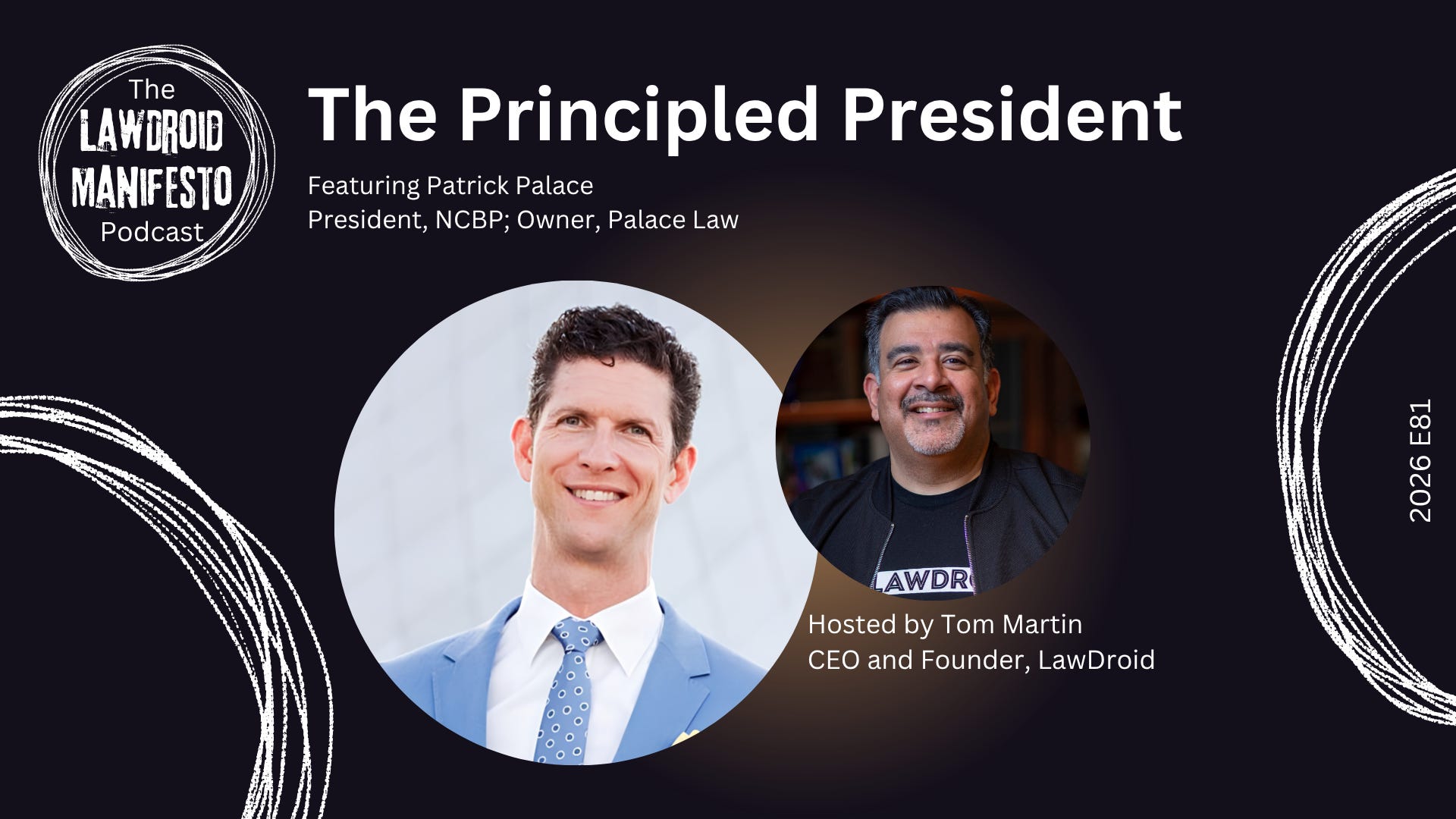
In this episode, I got to talk to my dear friend Patrick Palace. Patrick runs Palace Law in Tacoma, Washington, but he’s also been serving as president of the National Conference of Bar Presidents. In that role, he’s pursued the NCBP Pledge, to preserve the independence of the legal profession and the judicial system, ultimately resulting in the ABA’s unanimous adoption of Resolution 400—known as “The Pledge.” For that reason, I have dubbed him, the Principled President.
If you want to understand how bar leaders across the country came together to defend the rule of law and the independence of the legal profession, you need to listen to this episode. Patrick is at the forefront of that effort and has a unique vantage point on where the legal profession stands and where it’s headed.
Standing for the Rule of Law in an Age of AI and Political Pressure
Join me as I interview Patrick Palace, owner of Palace Law in Tacoma, Washington and outgoing president of the National Conference of Bar Presidents.
Patrick walks through the year-long strategic planning process he led as president, including an unusual twist: using an AI chatbot as a thought partner to help fourteen bar leaders turn a three-day retreat into a full year of prioritized goals and action items. He explains how that planning process led to a podcast, a legacy fund, a diversity scholars program, and, at the center of it all, an initiative called the Pledge.
The Pledge is a set of shared principles including upholding the rule of law, preserving judicial independence, and promoting public trust in the legal system, moved from a grassroots signing effort among bar presidents to a full ABA resolution. Ultimately, Resolution 400 passed unanimously before the ABA House of Delegates, without a single nay or abstention.
We also get into the harder conversation: what AI means for the future of legal practice, the billable hour, young lawyers, and the massive unmet demand for legal services that Patrick believes AI is finally positioned to help close.
The Skinny
Patrick Palace spent his year as president of the National Conference of Bar Presidents building a strategic plan with an unusual collaborator: an AI chatbot custom-built to act as a thought partner during a three-day leadership retreat. That planning work produced a podcast, a legacy fund, a member survey, an expanded diversity scholars program, and national awards, but the centerpiece was the Pledge, a short set of shared professional values around the rule of law, judicial independence, and public trust. Patrick and bar leaders across the country brought that pledge to state bars, regional conferences, and eventually the floor of the ABA House of Delegates, where it passed unanimously as Resolution 400. The conversation then turns to AI’s effect on legal practice: the risk to the billable hour, what happens to young lawyers’ training ground as automatable work disappears, and Patrick’s view that the real opportunity is a massive underserved legal market that AI-augmented lawyers are finally positioned to reach.
Key Takeaways
An AI chatbot, purpose-built for strategic planning, compressed what would normally take three full days of retreat work into about three hours, producing five goals per community across ten communities, each with action items and timelines, but ultimately board reviewed, revised, and approved.
That planning process produced concrete outputs: the Leading the Bar podcast (22 episodes in year one, roughly 9,000 downloads), a legacy fund, a membership survey, an expanded diversity scholars program, and five sets of national awards.
The Pledge is a short set of shared professional values, including upholding the rule of law and the Constitution, preserving the independence of the legal profession and judiciary, promoting public trust, ensuring access to justice, and fostering unity.
Hundreds of bar presidents and dozens of bars, both mandatory and voluntary, signed the Pledge, which was then sponsored by the Washington State Bar Association and brought to the ABA House of Delegates as Resolution 400.
Resolution 400 passed unanimously, with no nay votes and no abstentions, a result Patrick calls one of the happiest days of his career.
Patrick argues that being quiet about attacks on the rule of law is not neutrality, it’s the opposite, and that lawyers have a professional obligation to speak up.
On AI: Patrick frames the lawyer’s enduring role using Jordan Furlong’s three A’s (advocate, advice, atmosphere), arguing that AI will absorb low-level, high-volume legal work while the human components of lawyering remain irreplaceable.
The billable hour model is under real pressure. If AI compresses hours of work into minutes, firms built entirely around billable hours may struggle, while firms that shift toward outcome-based models will have an advantage.
Patrick sees a large latent legal market, potentially in the trillions of dollars, made up of people who currently get no legal help at all, that AI-augmented lawyers could finally begin to serve.
His message to bar leaders and lawyers: prioritize defending the rule of law and professional independence first. Only once that foundation holds can the profession productively address AI adoption, access to justice, and practice growth.
Notable Quotes
“First we kill all the lawyers... there’s a front line of protecting the rule of law and democracy, and it’s lawyers. And if you get rid of them, then you no longer have a democracy, you no longer have a court system, you no longer have protectors of the Constitution.” Patrick Palace [13:22 to 13:55]
“There was not a single abstention, there was not a single nay coming across the floor of the House of Delegates. And when the gavel came down and it was announced that it was passed, it was honestly one of the happiest days of my life.” Patrick Palace [17:43 to 18:20]
“Being quiet is not being neutral. Not speaking to protect your profession is not being neutral. In fact, it’s the opposite.” Patrick Palace [42:19 to 42:57]
“AI ChatGPT doesn’t come to the closing argument. When your client comes into your office and tells their story and needs to connect with somebody, needs to know that someone’s going to be their advocate... AI is not going to do that.” Patrick Palace [28:39 to 28:58]
“If we don’t stand first for the rule of law and the independence of our profession, then we don’t get to talk about AI. We don’t get to talk about access to justice.” Patrick Palace [41:04 to 41:28]
“Democracy does not defend itself. The rule of law does not defend itself. The courts cannot defend themselves. And our independence is not going to last unless we stand up to be independent.” Patrick Palace [44:38 to 44:57]
Clips
First We Kill All the Lawyers
Neutrality Is No Longer Neutral
Blockbuster Versus Netflix Moment
Is The Billable Hour Dead?
Patrick’s year as president of the National Conference of Bar Presidents shows what’s possible when thoughtful, principled leadership and AI work in partnership. The same year that produced an AI-assisted strategic plan also produced a unanimous ABA resolution defending the rule of law, proof that these two threads, technology and principle, aren’t in tension so much as they’re both required. As AI reshapes what lawyers bill for and who they can serve, Patrick’s point is clear: the principled foundation has to come first.
Closing Thoughts
What strikes me most about this conversation with Patrick is how naturally the two halves of it fit together, even though on the surface they seem like different topics. We used AI to help plan a year of work, and that year of work culminated in lawyers standing up, unanimously, to defend the very rule of law that makes the profession worth protecting in the first place. That’s not a coincidence. The tools we build are only as good as the principles guiding the people who use them.
I’ve said it before on this show, AI is not going to replace the human core of what we do as lawyers, the advocacy, the trust, the judgment in the room with a client who needs someone in their corner. But it can absolutely help us think bigger, plan better, and reach the people our profession has left underserved for too long. Patrick’s point about the latent market, the people who need legal help and get none, is one I hope more of us devote our efforts to. That’s where AI’s real promise lies: in helping us reach the people we’ve never had the capacity to reach.
Thank you, Patrick, for a year of real leadership, and for taking the time to show us the way!
By the way, if you would like to meet other superlative legal innovators in person, and enjoy an exceptional awards gala celebration, don’t miss the Oscars of Legal Innovation: the American Legal Technology Awards, this October 25, 2026, in Boston. Reserve your Early Bird tickets today and save $100.