Hey there Legal Rebels! 👋
I’m excited to share with you the 81st episode of the LawDroid Manifesto podcast, where I will be continuing to interview key legal innovators to learn how they do what they do. I think you’re going to enjoy this one!
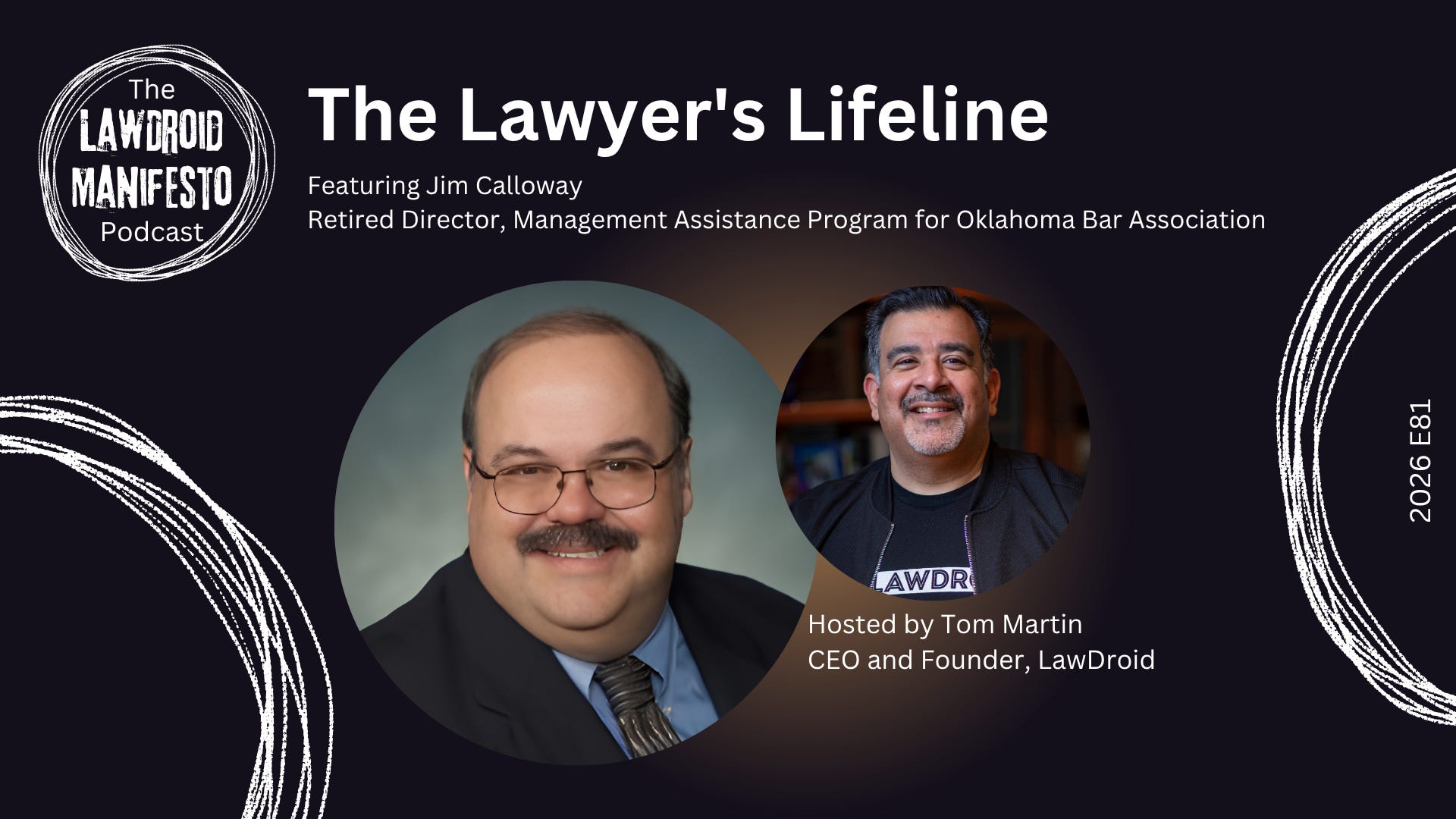
Jim Calloway is a bit of a legend and I’m so honored he spent some time with me to share his story. He has a natural charisma and affinity for helping people — which he used over his career to help lawyers better understand how they can utilize technology to benefit themselves and their law practices. And that’s why I’ve dubbed Jim, “The Lawyer’s Lifeline.”
If you want to understand how solo and small firm lawyers actually adapt to technology, and why the human connection still matters more than the machine, you need to listen to this episode. Jim spent close to three decades helping lawyers across an entire state run better practices, and he brings a rare, grounded point of view on where AI fits into all of it.
From Solo Practice to Shaping a Profession
Join me as I interview Jim Calloway, retired director of the Oklahoma Bar Association’s Management Assistance Program and winner of the 2025 American Legal Technology Lifetime Achievement Award.
In this conversation, Jim walks us through his path from a small Oklahoma town to a large commercial litigation firm, and then to opening his own solo practice when the big-firm lifestyle didn’t fit. That decision, made early and somewhat by instinct, set him on the road to nearly 30 years of helping lawyers across Oklahoma modernize their practices, long before “legal tech” was a category anyone talked about.
Jim also shares his thinking on AI today, where he sees real risk for lawyers who aren’t already good at their work, and real opportunity for lawyers who use it to sharpen skills they already have. He’s candid about the profession’s access to justice gaps, the courts clogged with self-represented litigants, and why he believes the human relationship between lawyer and client is the thing AI won’t replace.
The Skinny
Jim Calloway grew up in a small Oklahoma town, studied journalism and political science before law school, and spent a year at a large commercial litigation firm before deciding the associate lifestyle wasn’t for him. He opened his own solo practice in Norman, Oklahoma, working divorce and bankruptcy matters, while running a computer bulletin board on the side, a hobby that turned out to be the reason he got hired to run the Oklahoma Bar Association’s Management Assistance Program. Over nearly 30 years in that role, Jim taught lawyers across all 77 of Oklahoma’s counties how to adopt new technology, built a successful solo and small firm conference modeled on ABA Techshow, and became one of the field’s most recognized voices, culminating in the Lifetime Achievement Award from the American Legal Technology Awards last year. Now retired, he continues to write and speak about how technology is reshaping practice.
Key Takeaways
Jim’s early electronic bulletin board hobby, run on a second phone line his wife agreed to, gave him the credibility that led directly to his 29-year career in law practice management.
Many young lawyers who don’t know what they want end up opening a solo practice in whatever town they happen to be in; Jim’s own path started that way.
Resistance to legal technology was rarely about the tools themselves; it was often about established lawyers being to busy or close to retirement to change.
Getting busy lawyers to adopt new practices means competing for their attention against an already full desk, not convincing them technology is good in the abstract.
Jim built a successful solo and small firm conference by directly modeling ABA Techshow, including bringing in strong outside speakers and learning that entertaining delivery makes technical information stick.
Information is not legal advice; Jim draws a clear line between helping someone understand a courtroom process and telling them what to do, which is where access to justice work can safely operate.
Unbundled and limited scope legal services let lawyers help self-represented litigants with a specific task, like document drafting, without taking on full representation.
Jim believes AI will make good lawyers better and expose lawyers who were already weak in their work, pointing to hallucinated briefs as an example.
AI may shrink the total work available for solo and small firm lawyers.
Jim argues the strongest protection solo and small firm lawyers have is staying connected to their communities, because people still prefer working with people they know and trust.
Notable Quotes
“If you’re good at something, AI will help you be better. If you’re not great at something, you may be the one who is in court talking about hallucinated briefs.” Jim Calloway [35:07 to 35:28]
“If you spend 50 minutes with AI and you build the client five hours, that’s unethical no matter what set of ethics rules you operate under.” Jim Calloway [35:41 to 36:19]
“People, at least for a while longer, still trust other people more than they trust machine output.” Jim Calloway [37:41 to 38:11]
“Information is not legal advice. When you see somebody in the courthouse that looks lost and you say, are you lost? Can I help you? That’s not practicing law. That’s just sharing information.” Jim Calloway [26:36 to 26:56]
“You’ve got to focus on taking care of yourself. If you don’t plan it, if you don’t schedule it, it’s not going to happen, because something will happen every day at a law firm to take up all your time if you let it.” Jim Calloway [41:09 to 41:37]
Clips
How I Landed the Job I Didn’t Expect
Unbundled Law: Help Without Full Representation
The $1000 Switch Moment
AI Helps, Until It Hallucinates
Jim’s career traces a straight line from small-town Oklahoma to national recognition in legal technology, but the thread running through all of it is the same: technology is only useful to the extent it serves people on the other side of the desk. Whether it was an electronic bulletin board in the 1990s or AI today, Jim’s approach has been to meet lawyers where they are, respect how full their days already are, and show them, often with humor, why a new tool is worth their attention. That same instinct shapes his read on AI now. He’s not dismissive of the risk, particularly for lawyers tempted to skip the diligence that has always separated good lawyering from bad, but he’s equally clear that the relationship between a lawyer and their very human clients is not something a model replaces.
Closing Thoughts
Jim’s story is a reminder that innovation rarely comes from a grand plan. It comes from someone’s human curiosity, noticing a gap, experimentation - a computer bulletin board here, a canceled keynote speaker there, and taking the leap into the unknown. What struck me most about Jim is his disarming good humor and practical approach. He’s not selling hype in either direction. He sees technology’s benefits clearly, and he sees the risk to lawyers who use those gains as a shortcut around due diligence just as clearly. But the point he kept coming back to, and the one that AI cannot replace, is for lawyers to use their humanity to their advantage: stay present in the community, show up, be known, and let people trust you the way they’ve always trusted a person, not a machine. That’s not nostalgia. That’s a strategy that will be effective for many years to come.
By the way, if you would like to meet other superlative legal innovators in person, and enjoy an exceptional awards gala celebration, don’t miss the Oscars of Legal Innovation: the American Legal Technology Awards, this October 25, 2026, in Boston. Reserve your Early Bird tickets today and save $100.