Hey there Legal Rebels! 👋
I’m excited to share with you the 80th episode of the LawDroid Manifesto podcast, where I will be continuing to interview key legal innovators to learn how they do what they do. I think you’re going to enjoy this one!
If you want to understand why so many lawyers who tried AI once and shrugged it off are now diving deep into it, or why so many big tech and AI players seems to be so into legal right now, you need to listen to this episode. Zach Abramowitz has spent years advising law firms, legal departments, and legal tech companies on exactly this shift, and he brings a rare combination of market data, psychology, and showmanship to explaining it.
From Talmud Scholar to Legal AI’s Favorite Showman
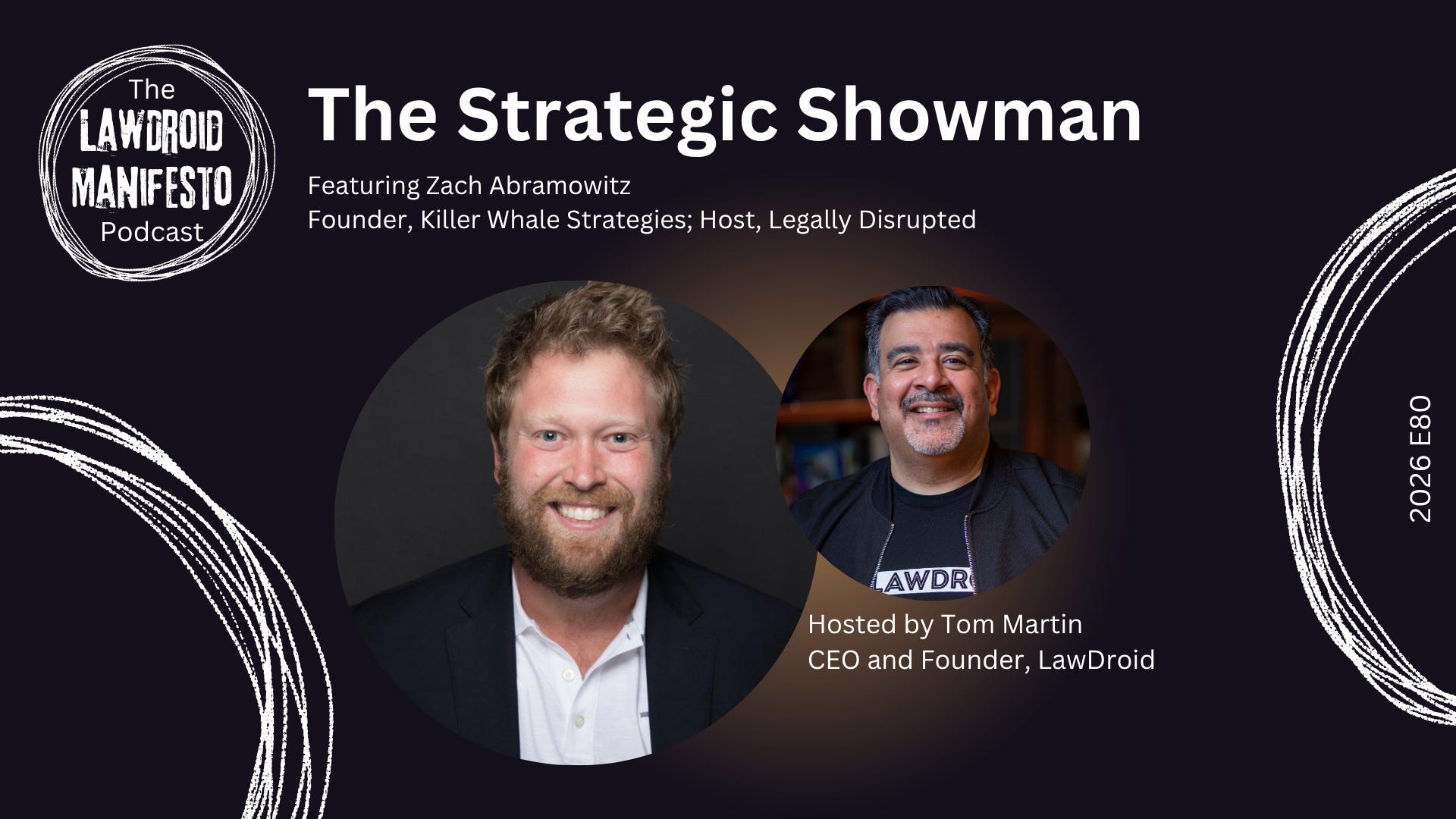
Join me as I interview Zach Abramowitz, founder of Killer Whale Strategies, whose work advising law firms, legal departments, and legal tech companies over the last decade has made him one of the most trusted voices on where legal AI is heading.
I’ve known Zach for years and I always look forward to his conference talks and getting to catch up with him in person. He combines strategic insight, backed up by facts and an insider perspective, and a sense of humor and infectious energy. He’s a rare combination and that’s why I’ve dubbed him the Strategic Showman.
In this conversation, Zach walks through the timeline of legal AI adoption, from the early innovator crowd to the recent, striking shift toward practicing attorneys actually using the tools day to day. He shares the psychology behind why renaming a product from “Counsel AI” to “Harvey” changed how people prompted it, and why he thinks the biggest AI labs will never be the ones to win the legal application layer.
Zach also opens up about his origin story: growing up between Houston and San Francisco, pursuing a religion major at Yeshiva University, and spending nearly two years working the New York stand-up comedy circuit before law school. He connects all of it, unexpectedly and convincingly, to the way he builds and delivers a talk today.
This episode is a great listen for anyone trying to understand not just what legal AI can do, but why adoption has moved the way it has, and what it actually takes to bring a room of skeptical lawyers around.
The Skinny
Zach Abramowitz has been advising the legal industry on technology since 2018, well before ChatGPT made “AI” a term every lawyer has an opinion about. In this episode, he traces the real adoption curve: an early wave of innovators and legal operations professionals, a rocky first encounter for many practicing attorneys (Bain’s research found the largest expectation-versus-experience gap of any industry surveyed), and then a slower, word-of-mouth expansion as colleagues saw peers using AI well. Zach argues the shift isn’t just about whether someone uses AI, but how they learn from each other, and points to psychology, not just capability, as the real unlock. Harvey’s founders saw the volume and quality of usage improve the moment they renamed their product from “Counsel AI” to “Harvey.” He also shares his view that Microsoft, Amazon, Google, Anthropic, and OpenAI piling into legal is a good sign for the market, but that the legal application layer will ultimately belong to companies built specifically for it, since the frontier labs’ real competition is each other. The conversation moves into Zach’s personal story: growing up between Houston and San Francisco, a religious course of study at Yeshiva University, nearly two years performing stand-up comedy in New York clubs, and how all of it shapes the way he researches, iterates on, and communicates his insight today.
Key Takeaways
Legal AI adoption has moved from a small innovator and legal-ops crowd to genuine uptake among practicing attorneys, a shift Zach dates to roughly the last six months based on who is now inviting him to speak
Bain’s research found lawyers had one of the largest gaps between AI expectations and actual early experience of any profession surveyed
Adoption didn’t spread through top-down mandates so much as peer-to-peer, colleagues seeing colleagues getting real value from AI and giving the tools a second chance
Psychology and positioning matter as much as raw AI model capability: renaming / personalizing a legal AI product from “Counsel AI” to “Harvey” visibly changed how people prompted and worked with it
Zach expects the legal application layer to be built and won by legal-specific companies, not by the frontier model labs, since Anthropic, OpenAI, and Google are ultimately competing with each other, not with vertical legal products
Zach’s background studying the Talmud shaped the analytical, conceptual approach he brings to advising and public speaking
Nearly two years performing stand-up comedy in New York clubs taught Zach an iterative process, testing material, reviewing tape, adjusting, retesting, that he still uses to develop his work today
Zach’s advice for anyone considering law school: know why you’re going, and if it’s not for big deals or big fights, let it be to build a paid practice that supports meaningful pro bono work
Notable Quotes
“I actually thought in many ways it would catch on quicker than it did.” Zach Abramowitz [06:52 to 07:44]
“There’s boring use of AI. There’s kind of blah AI. There’s bad AI use. It’s not all the same.” Zach Abramowitz [11:01 to 11:16]
“Winston Weinberg, the founder of Harvey, says that when they first built their product, they called it Council AI. And when they changed the name of the product to Harvey, they immediately saw that people began prompting with better... working with the product better.” Zach Abramowitz [13:58 to 14:17]
“Claude will never be able to spend all of its time focusing on legal. What Anthropic needs to spend its time focusing on is being better than OpenAI, being better than Google.” Zach Abramowitz [43:08 to 43:42]
“If that’s not the case and you’re going to law school, then the reason should be you want to provide access to people in need whose cause you feel genuinely supportive of, and you’re going to support that through paid clients.” Zach Abramowitz [36:13 to 36:35]
“Start soon and fail even sooner.” Zach Abramowitz [22:20 to 22:41]
Clips
Get AI-Pilled
Start Soon and Fail Sooner
This Is Not A Phase
Why I Chose Law School
Zach Abramowitz’s path into legal technology advisory work was anything but conventional, and that’s exactly why his read on AI adoption carries weight. He’s watched the market move from early hype to a real expectation gap, to genuine, peer-driven adoption among practicing lawyers, and he makes a compelling case that the winners of the legal AI application layer won’t be the frontier labs, but the companies built specifically for this profession. Underneath the market analysis is a simple, human thread: psychology and positioning shape adoption as much as raw capability does, and people, not just tools, are what make any of this work.
Closing Thoughts
What strikes me most about this conversation with Zach is how much his unconventional path explains his read on the market. Most people who talk about legal AI adoption curves rely on a spreadsheet, charts and graphs. Zach’s wealth of experiences helps him to see beyond the surface accounting, to the all-too-human motivations and psychology that live beneath the numbers.
The Harvey naming story stands out: we spend so much energy in this industry arguing about the latest capability, about which model is better, which benchmark moved, and here’s a case where the single biggest lever was human — giving people something that felt more like a colleague than a tool. That’s a lesson for anyone building anything in this space.
I also appreciated Zach’s openness about pro bono work and what a legal career could look like if more of us built our practices around it. There is much to the legal profession that is more noble than the pursuit of profit. It’s a good note to end on: legal AI is moving fast, but the reasons we do this work can lift us up.
If you enjoyed getting to know Zach, do yourself a favor and be sure to check out his Substack and podcast 👉 Legally Disrupted! You’ll be glad you did.
By the way, if you would like to meet superlative legal innovators in person, and enjoy an exceptional awards gala celebration, you don’t want to miss the Oscars of Legal Innovation: the American Legal Technology Awards, this October 25, 2026, in Boston. Reserve your Early Bird tickets today and save $100.