Hey there Legal Rebels! 👋
I’m excited to share with you the 83rd episode of the LawDroid Manifesto podcast, where I will be continuing to interview key legal innovators to learn how they do what they do. I think you’re going to enjoy this one!
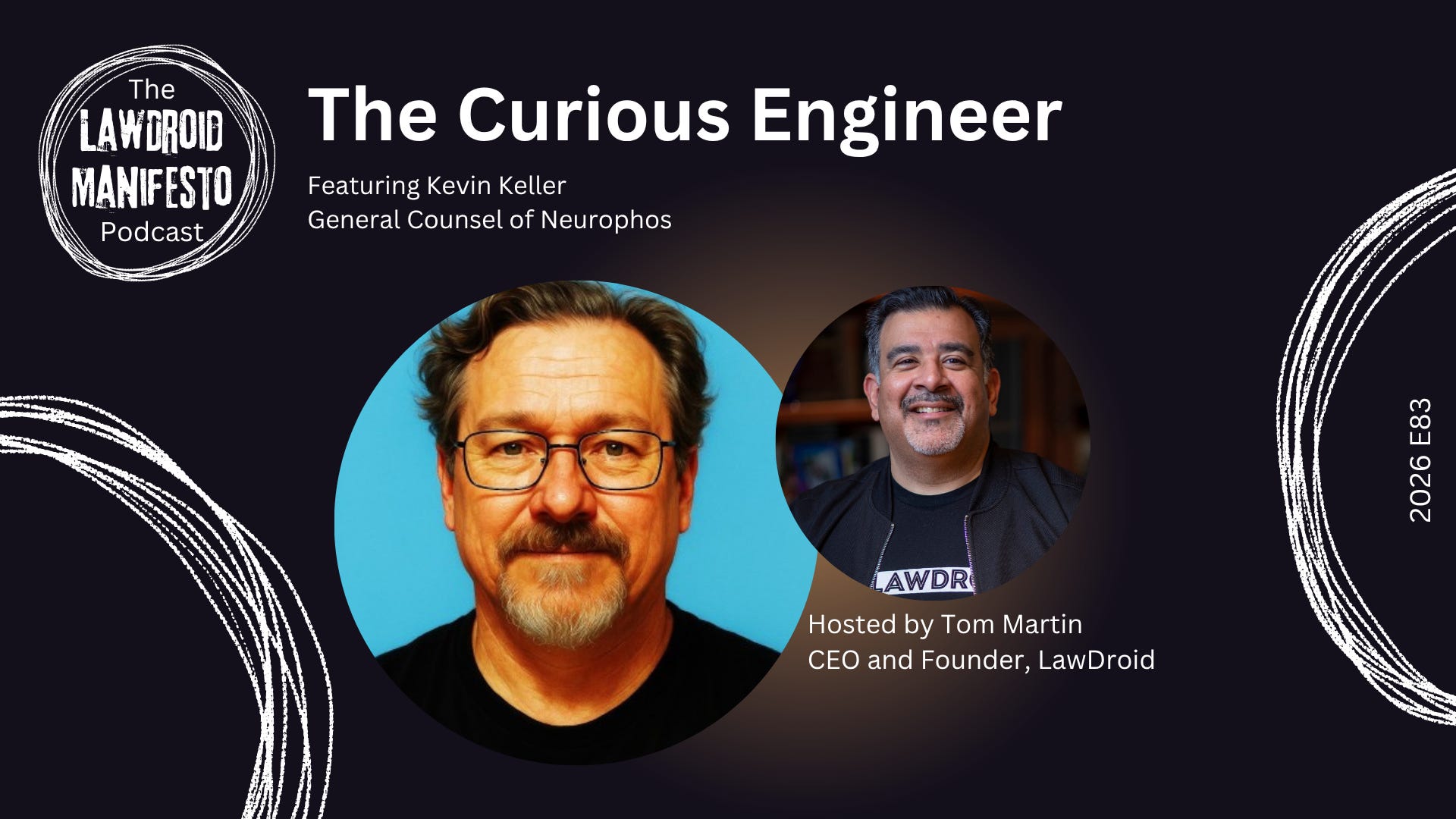
I’ve admired Kevin Keller’s work for a while now. He’s an original and deep thinker. He doesn’t stop at the surface level of AI, but seeks to better understand how it works and how to use that insight to make a better tool. He’s also generous in sharing his learnings with the world and paying it forward. Lastly, he’s a lawyer, but combines the rigorous thinking of an engineer to the application of AI to legal. For those reasons, I have dubbed him “The Curious Engineer.”
If you want to understand how a restless, self-taught curiosity can carry someone from a sawmill town to the frontier of optical computing and open-source legal AI, you need to listen to this episode. Kevin is general counsel of Neurophos and the builder behind LQ AI, and he brings a rare combination of hands-on engineering instinct and legal judgment to how he thinks about AI’s future.
From Sawmill Towns to Silicon Photonics
Join me as I interview Kevin Keller, general counsel of Neurophos, a company building light-based compute systems that could shrink data centers down to a fraction of their current size and power draw.
In this episode, Kevin walks us through an origin story that starts in a small sawmill town outside Boise, Idaho, where he was welding by age seven and driving a farm truck at five. He talks about how that early independence and freedom to explore shaped the curiosity that eventually took him through electrical engineering, law school at NYU, and hardware and legal roles at Micron, Microsoft, Amazon, Facebook, Instacart, Adept AI, and Forward Networks before landing at Neurophos.
Kevin also opens up about LQ AI, his open source legal assistant hosted on the Legal Quants GitHub, built to show exactly what happens to data at every step of an AI workflow rather than asking users to trust a black box. We get into the reasoning systems he’s building now, why diversity of thought matters in multi-agent systems, and his honest, thoughtful take on what’s actually left for humans to do as AI takes over more of the “can I do this” work that used to define expertise.
The Skinny
Kevin Keller’s path from a rural Idaho farming and sawmill community to general counsel of an optical computing startup in Silicon Valley is built entirely on curiosity followed all the way through. He talks candidly about how growing up with real responsibility (welding, driving equipment, tearing things apart to understand them) at a young age, combined with grandparents who trusted him with real jobs, gave him both the confidence and the practical grounding to keep exploring new fields without fear of starting over.
That same instinct took him from a computer science start to electrical engineering (he wanted to understand computers down to the transistor), then to law school (chosen using an engineer’s cost-benefit calculation on the LSAT rather than a lifelong dream), then through a career bouncing between hardware, semiconductors, and SaaS legal roles at some of the biggest names in tech. Now at Neurophos, he’s working on metasurface compute that processes using light instead of electrons, promising far lower power and heat for the same compute density.
On the side, Kevin built and open-sourced LQ AI, a fully transparent legal assistant that shows exactly what data goes where, what gets redacted, and whether an AI’s citation is a verbatim pull or a paraphrase, built partly in response to his wife’s concerns as a therapist about what happens to client data inside AI note-taking tools. He’s now shifting focus toward reasoning systems and knowledge-transfer tools meant to act as a mentor substitute for curious people who don’t have access to one, alongside a side project modeling digital jurors for trial preparation. Throughout, he returns to one core question: as AI absorbs more of the reasoning work that used to define expertise, what’s actually left for us, and how do we make sure the people most capable of using AI well actually get the chance to?
Key Takeaways
Early responsibility and unsupervised exploration as a kid (welding, driving farm equipment, fixing things) can build the confidence to tackle unfamiliar fields later without fear of not knowing the rules.
Kevin chose law school using a literal cost-benefit calculation on his LSAT score rather than a lifelong calling, illustrating how an engineering mindset can approach even personal decisions.
LQ AI, Kevin’s open source legal assistant, is built for radical transparency: users can see exactly what data is sent to the model, what’s redacted, and whether a citation is a direct quote or a paraphrase.
Neurophos is building metasurface-based optical compute that could deliver the equivalent of a large GPU rack’s power in far less space and with far less heat and energy, with real environmental upside.
Diversity of thought, surrounding yourself with people who think differently, matters as much in multi-agent AI systems as it does in human teams and relationships.
Kevin’s current focus has shifted from building legal tech tools to building reasoning and knowledge-transfer systems meant to act as a mentor substitute for people who don’t have access to one.
A recent paper’s point that large language models “can’t jump”, meaning they struggle to make the kind of unexpected cross-domain connections a broadly curious human mind can make, is central to how Kevin thinks about where human value remains.
Kevin is orchestrating multiple AI agents across separate projects the way a manager orchestrates a team, a human skill he sees as increasingly relevant even as the underlying coding work gets automated.
He believes AI will make some people less capable as they offload their own thinking, while making genuinely curious people faster and further-reaching; the real challenge is finding and supporting the latter group.
Notable Quotes
“I spent a lot of time outside just tearing things apart, fixing things, finding... I was welding like, you know, seven or eight, just practice welds and things like that.” Kevin Keller [10:21 to 11:10]
“It’s absolutely possible. If I can do it in a couple months of work on nights and weekends for LQ AI... then commercial companies could offer you this. That they don’t is a choice, I guess, but not a reasoned ethical one.” Kevin Keller [34:01 to 34:27]
“There’s a great paper that came out last week or the week before, LLMs can’t jump... At what point will I have any value at all?” Kevin Keller [42:38 to 43:18]
“While AI generally I think has dumbed and will dumb the world down to some degree as people lean too heavily on it and off source their own thinking, I think there’s a lot of people out there who that will never be the case for. They will use it as a tool to accelerate their learning, to explore their curiosity.” Kevin Keller [46:13 to 47:00]
“We’re building it for the younger me. If there’s one kid out there, one person that just can really be impacted in a positive way, can learn some taste of what I was lucky enough to have with grandparents who helped me explore my curiosity.” Kevin Keller [50:39 to 51:13]
Clips
I Let AI Agents Coordinate Work
We’ve Found the Amino Acids of AI
Use AI to Mentor Curious Kids
Replace 100 Data Centers with One
Kevin Keller’s story is proof that curiosity, followed consistently over decades, can carry someone across fields that look completely unrelated from the outside: farming, welding, electrical engineering, law, semiconductors, and now optical computing. But the throughline in this conversation isn’t really about jumping between industries, it’s about what he’s building at every stop: systems that make their own workings visible, whether that’s a legal assistant that shows its data flows or a metasurface that processes light instead of hiding computation in a black box. As AI absorbs more of the reasoning work that used to signal expertise, Kevin’s answer isn’t to retreat from the technology, it’s to ask who gets left out of its benefits and to build tools that close that gap.
Closing Thoughts
Kevin isn’t chasing the frontier because it’s exciting, though it clearly is to him. He’s chasing it because he remembers exactly what it felt like to be curious and under-resourced, and he’s spent his career trying to build the thing that would have helped his younger self. That’s a different motivation than most builders talk about, and I think it shows in the choices he’s made, open-sourcing LQ AI instead of commercializing it, building transparency into systems instead of asking people to trust a black box, stepping back from legal tech to focus on reasoning and mentorship tools that could help anyone, not just lawyers.
The question he keeps circling: what’s actually left for us as AI gets better at reasoning, doesn’t have a clean answer yet, and I appreciated that he didn’t pretend it did. But his instinct that our edge might live in lived experience, in the ability to really see another person, in making connections across fields that no one system was trained to make, feels like the right place to be asking the question from. If you’re building anything right now, in legal tech or otherwise, this episode is worth your full attention.
By the way, if you would like to meet other superlative legal innovators in person, and enjoy an exceptional awards gala celebration, don’t miss the Oscars of Legal Innovation: the American Legal Technology Awards, this October 25, 2026, in Boston. Reserve your Early Bird tickets today and save $100.